


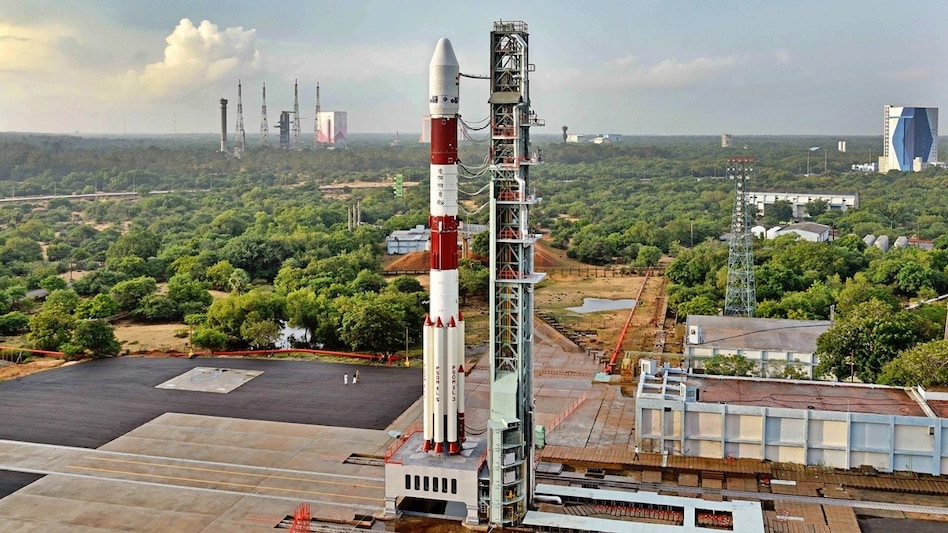
 The PSLV-C62 rocket stands ready at Sriharikota for a historic mission that will launch a fleet of 16 satellites into the void of space. (Photo: Isro)
Activity is at a peak at the Satish Dhawan Space Centre in Sriharikota as the Indian Space Research Organisation prepares to kick off 2026 with a complex and closely watched launch. Scheduled for lift-off this morning, the PSLV-C62 mission marks Isro’s first orbital outing of the year and underscores the growing ambition behind India’s small-satellite programme.
The Polar Satellite Launch Vehicle, Isro’s proven workhorse, will carry 16 satellites into a Sun-Synchronous Polar Orbit, reinforcing India’s position as a preferred launch partner for domestic and international payloads.
The launch is set to take place from the First Launch Pad at 10:17 am IST.
Primary payload: EOS-N1 ‘Anvesha’
Leading the mission is EOS-N1, an advanced Earth Observation Satellite developed by the Defence Research and Development Organisation. Named Anvesha, the satellite is equipped with hyperspectral imaging capability that allows it to capture data across hundreds of narrow light bands for every pixel.
This technology enables detailed analysis of surface materials and conditions, with applications ranging from monitoring crops and soil moisture to identifying mineral resources and mapping urban expansion with high precision.
Testing India’s first on-orbit refuelling concept
A key experimental payload on PSLV-C62 is AayulSAT, developed by Bengaluru-based startup OrbitAID Aerospace. The satellite will serve as a technology demonstrator for India’s first on-orbit refuelling model.
AayulSAT is designed to test a proprietary docking interface along with propellant, power and data transfer in microgravity. If successful, the concept could extend the operational life of satellites by allowing them to be serviced in orbit, reducing the creation of space debris once onboard fuel is exhausted.
AI in orbit and a space ‘cybercafe’
Another standout payload is MOI-1, a satellite developed by Hyderabad-based startups TakeMe2Space and Eon Space Labs. The mission will debut India’s first orbital AI image laboratory, capable of processing data directly in space using edge computing.
By analysing imagery onboard rather than relaying raw data to Earth, MOI-1 aims to cut latency dramatically. The project has been pitched as the world’s first “cybercafe in space”, allowing users to rent processing time on the satellite for $2 (Rs 180) per minute.
Embedded within MOI-1 is MIRA, billed as the world’s lightest space telescope. Weighing just 502 grams, the monolithic optical system has been carved from a single block of fused silica glass. Its one-piece construction is designed to keep the telescope perfectly aligned despite the intense vibrations experienced during launch.
An international satellite rideshare
Through its commercial arm, NewSpace India Limited, Isro has turned PSLV-C62 into a global rideshare mission. The manifest includes Munal, a 1U CubeSat from Nepal supported by India’s Ministry of External Affairs, which will help map the country’s terrain.
Spain’s 25-kg Kestrel Initial Demonstrator capsule will test atmospheric re-entry technology by splashing down in the South Pacific roughly two hours after launch. The flight also carries the Indo-Mauritius Joint Satellite and a Brazilian cluster featuring Aldebaran-1 for maritime rescue operations, along with the “Orbital Temple”, which will store 14,000 names in space.
From India, Dhruva Space is flying multiple satellites, including LACHIT and Thybolt-3, to validate indigenous communication subsystems.

 Exam reforms: Tech titan Nandan Nilekani picked by PM Modi to fix national public examination system
  'Tax officers struggled for own land': Nirmala Sitharaman slams laidback attitude of govt depts
 CBDT issues new crypto reporting guidance: No new tax, but exchanges must track and report all transactions
 Did Cockroach Janta Party's 'Chalo Sansad' 2.0 threat trigger Dharmendra Pradhan's resignation? What we know so far
 'Will discharge my responsibilities with complete humility': Pralhad Joshi after being appointed Education Minister
 AI Data Centers, Aerospace & Gas Turbines: What's Powering Indo-MIM's Future Growth?
 Best Healthcare Stocks: Gaurang Shah's Outlook On Apollo Hospitals, Fortis & The Manipal Health IPO
 Is Indo-MIM's IPO Valuation Justified? Here's Why The Company Sees Strong Growth Ahead
 Treasury Bills Explained: Why T-Bills Are One Of The Safest Short-Term Investment Options
 FDs vs Markets: Where Should You Keep Your Short-Term Money?
 Gland Pharma stock: Price target of Rs 3,250 likely in medium term, says analyst
  Metal recycling stocks to buy: Gravita, Pondy Oxides, Jain Resource among top picks
 TRIL shares: Should you average the falling stock? Here's 'fixed and final' stop loss
 Adani Power: 45 GW target, Rs 2 lakh crore capex plan among conference call highlights
  ITC Hotels, Chalet, Ventive, IHCL, SAMHI: Hotel stocks to buy despite travel disruptions
 Beyond mutual funds: Why analysts see SBI Funds' alternative asset business as a long-term growth engine
 'Ashamed of it...': Manoj Muntashir calls Adipurush his biggest mistake, seeks country's forgiveness Exam reforms: Tech titan Nandan Nilekani picked by PM Modi to fix national public examination system 'Tax officers struggled for own land': Nirmala Sitharaman slams laidback attitude of govt depts
 Delhi targets traffic bottlenecks on Aruna Asaf Ali Marg with ₹1.97 crore elevated road study









