








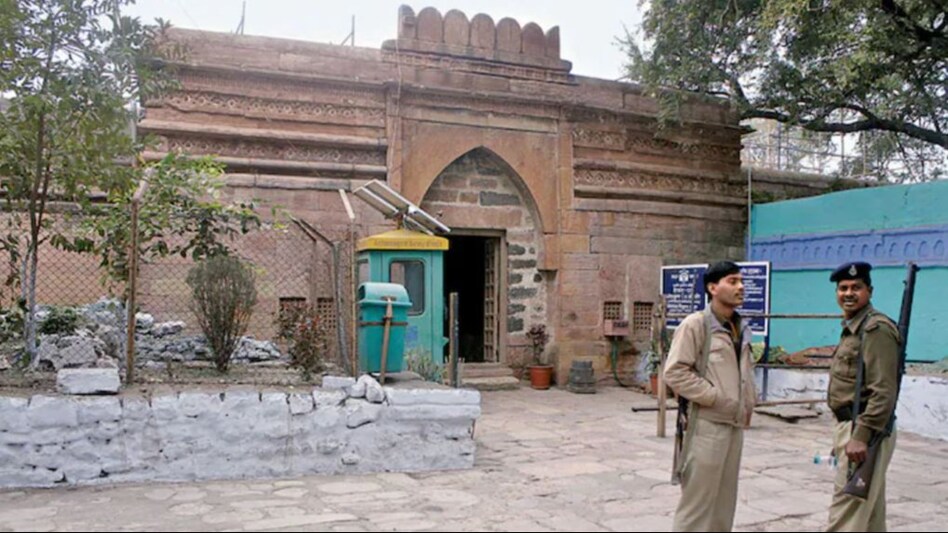
 The Madhya Pradesh High Court permitted an Archaeological Survey of India (ASI) at Bhojshala Temple
 The Madhya Pradesh High Court permitted an Archaeological Survey of India (ASI) at Bhojshala Temple
The Madhya Pradesh High Court on Monday allowed a survey by the Archaeological Survey (ASI) at the Bhojshala Temple, also known as the Kamal Maula Mosque. The Hindu side had moved the court, seeking a survey to determine the true character of the place which Muslims treat as a mosque.
The dispute is over the Bhojshala-Kamal Maula mosque, a religious site claimed by both Hindus and Muslims. Hindus claim that is the temple of Goddess Wagdevi, i.e. Saraswati. Muslims, on the other hand, believe it to be Kamal Maula mosque.
The Bhojshala-Kamal Maula mosque is protected by the ASI, which allows Hindus to pray on the site on Tuesdays and the day of Basant Panchami, and Muslims are allowed to offer namaz on Fridays.
A bench of Justices Sushrut Arvind Dharmadhikari and Devnarayan Mishra ordered a complete scientific investigation, survey, and excavation of the Bhojshala complex.
The court said that a proper documented report on the survey prepared by an Expert Committee of five or more senior officers of the ASI, led by the Director General or Additional Director General of the ASI, should be submitted to the court within six weeks.
"Complete scientific investigation, survey, and excavation, through the adoption of latest methods, techniques, and modes of GPR-GPS survey of the site in question constituting the disputed Bhojshala Temple cum Kamal Maula Mosque complex, as also the entire 50m of peripheral ring area surrounding/constituting the circular periphery from the boundary of the complex be conducted," the court said in its order shared by advocate Vishnu Shankar.
The court said that a detailed scientific investigation should be conducted by carbon dating method to ascertain the "age" of the structures in the complex, both above the ground and underground. The court further ruled that the survey proceedings should be photographed and videographed in the presence of two representatives nominated by each side.
The term 'Bhojshala' first appeared in a 1903 paper by superintendent of education KK Lele, who was also in charge of an archaeology office set up by Captain Earnest Barnes, the British political agent in the Dhar princely state, according to an India Today report published in June 2022.
Lele's term, linking the site to the 11th-century figure of Raja Bhoj, was later dismissed as a 'misnomer' in the colonial gazetteer of 1908. The Dhar state declared it a protected monument in 1909 and proscribed prayers in it. In 1934, the state placed a board outside it that mentioned Bhojshala. Namaaz was resumed in 1935 and the first Urs observed in 1944.
In 1952, the ASI took over the complex and reinstated the ban on prayers. In 1998, it gave Muslims permission to pray on Fridays and Hindus on Basant Panchami. A modified order of 2003 allowing Hindus to pray there every Tuesday was challenged in the Delhi High Court, but the petition was rejected.
The latest round of litigation began in May 2022 with the Hindu Front for Justice filing a petition at the Indore High Court demanding that only Hindus be allowed to pray in the complex.
"The dewan of Dhar state allowed namaaz and dua for one day for the ruler’s health in the late 1930s. Since then, the Muslim side has been present at the Bhojshala,” claims Dipendra Sharma, secretary of the Bhoj Shodh Sansthaan. The Muslims, who have a family serving the dargah for close to 700 years, counter the claim.
(With inputs from Rahul Noronha)
 Claims of sovereignty loss in India-US trade deal ‘absolute nonsense’: Piyush Goyal
 SEBI draws line between listing norms and RBI rules in guidance to PNB
 Domestic airfares set to rise as IndiGo capacity cuts hit summer schedule: Report
 Cyber attacks, AI misuse and data privacy rules emerge as top boardroom risks for India Inc
 'India has played it pretty safe, deal is very balanced': Top agri economist on India–US trade agreement
 BT Golf 2025-26 Kochi, Kerala Awards Ceremony Marks A High-Energy, Successful Conclusion
 Golf Is An Addiction. We Eat And Sleep Golf!
 The Fairway Fixes Everything. Mindset, Life, Relationships
 BT Golf LIVE: Join AU Small Finance Bank Presents BT Golf 2025-26 For Its 4th Leg In Kochi, Kerala
 AI Will Change MBAs, Not Leadership: IMD President On India’s Global Education Rise
 RIL, SBI, Kotak Bank, Kalyan, HAL, BEML, BDL among stocks in focus next week; here’s why
 NSE IPO may unlock mega gains for billionaire investors RK Damani, Premji
 SBI Q3 Results: Profit jumps 24% to Rs 21,028 crore; asset quality improves
 IDBI Bank stake sale: Kotak Mahindra Bank says ‘has not submitted a financial bid’
 BDL, Mazagon Dock, MRF, Hindustan Copper, RVNL, others to turn ex-dividend next week