









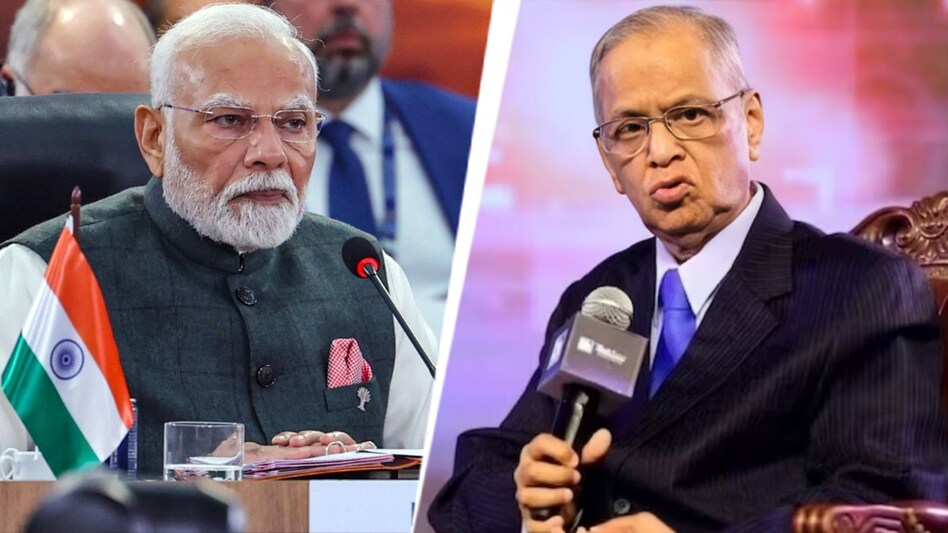
 Tejasvi Surya recounts 2-hour flight with Narayana Murthy
 Tejasvi Surya recounts 2-hour flight with Narayana Murthy
BJP's Bengaluru South MP Tejasvi Surya on Tuesday shared insights from a long in-flight conversation with Infosys co-founder NR Narayana Murthy. He called the interaction "a 2-hour masterclass" on everything from artificial intelligence and manufacturing to leadership and ethics.
Posting on X, Surya wrote: "Had an inspiring conversation with the legendary NRN today on the way back to Bengaluru from Mumbai. NRN pioneered the Indian IT services sector, turning it into a global powerhouse. He created wealth for literally lakhs of middle-class families through Infosys."
Surya added, "From AI to manufacturing, state of our cities to upskilling our youth to ethics and leadership—it was a 2-hour masterclass learning from him."
In a lighter moment, Surya said he joked about striving to meet Murthy's famously high work-hour benchmark. "I humorously quipped at the end of our conversation that I'll strive to meet his 70-hour-a-week target—to which he laughed and said, 'The only person I know who probably works 100 hours a week is Prime Minister Modi!’"
Murthy's reference was a nod to his now widely-debated statement from last year, when he urged young Indians to work "at least 70 hours" a week to raise national productivity. At the time, he drew sharp reactions across the country, with supporters hailing his work ethic and critics warning of burnout, stress, and unrealistic expectations.
However, Infosys — the company Murthy co-founded — has since taken a different approach. According to a report by The Economic Times, the IT firm has implemented a policy that caps work hours at 9.15 hours per day. Employees working beyond this limit across a month now receive alerts from the HR team, including personalised reports and tips to take breaks, delegate tasks, and "disconnect after hours to recharge."
At various public events last year, Murthy maintained that India must "sacrifice" for progress and that there is "no such thing as work-life balance" if the country hopes to match global standards. He had also opposed India's transition to a five-day work week in 1986 and told a leadership summit that long hours were a necessity for young professionals—not an optional discipline.
 Rajesh Exports ownership snapshot: LIC holds 10.8%; check FII stake and more
 Mukesh Ambani drops to 3rd richest spot in Asia, gets toppled by THIS Chinese billionnaire
 India’s semiconductor moment is bigger than outsourcing: UST COO Gilroy Mathew
 Uber layoffs 23% of its HR workforce; CEO says ‘Changes are necessary’
 PhysicsWallah shares jump 18% as ed-tech co revamps lending strategy, ties up with NBFCs
 Section 301 Tariffs Could Hit Indian Exports Just As Trade Deal Nears Completion
 Market Masters With Aniruddha Sarkar | Top Stock Ideas, Market Outlook & Investment Strategy
 The Retirement Strategy: NPS, SWP, Mutual Funds, Insurance & Passive Income Explained
 What’s Hot: Stocks, Gold & Big Money Moves | Daily Market Show | Business Today TV
 Maruti's Flex-Fuel Car Launch: Ethanol Industry On Fuel Pricing, Mileage & Demand
 PhysicsWallah shares jump 18% as ed-tech co revamps lending strategy, ties up with NBFCs
 Ola Electric, Tata Motors PV, Bosch, Varroc Engg shares: Check target price, outlook
 Ideaforge Technology shares extend winning streak to 3rd day, hit 52-week high – Here’s the trigger
 Small-cap funds lead mutual fund performance; inflows hit one-year high
 M&M, Bajaj Auto, Maruti, TVS Motor, Hero MotoCorp: Buy, sell or hold? - Target prices