












 The high court emphasized that any resolution to the ongoing situation should prioritize amicable solutions, with the use of force being considered only as a last resort.
  The high court emphasized that any resolution to the ongoing situation should prioritize amicable solutions, with the use of force being considered only as a last resort.
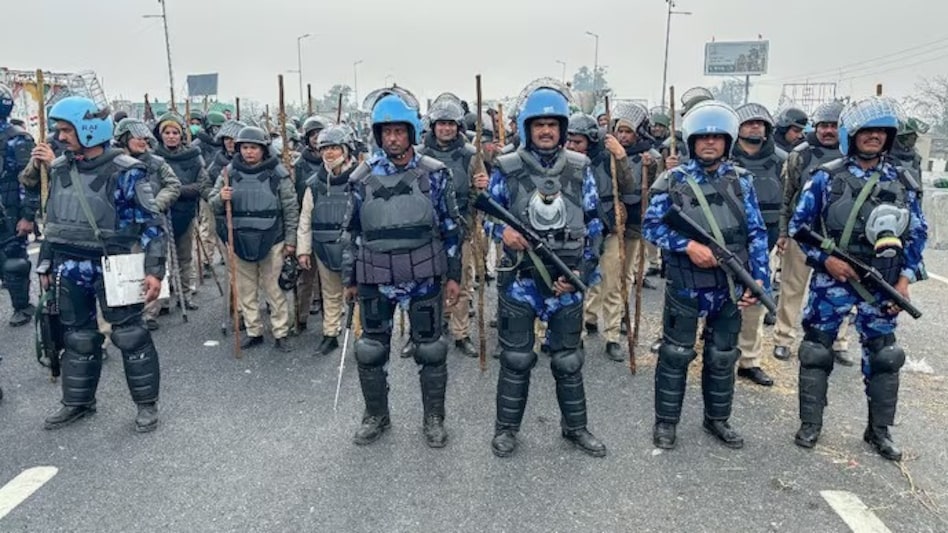
 The Punjab and Haryana High Court on Tuesday addressed the escalating farmers' protests at the borders of Delhi, Punjab, and Haryana. The court emphasized that any resolution to the ongoing situation should prioritize amicable solutions, with the use of force being considered only as a last resort.
This statement came during a hearing of two petitions related to the protests—one challenging the Haryana government's decision to seal borders, thereby preventing protesters from entering Delhi, and another highlighting the impact of the protests on the public due to blocked national highways.
The bench, comprising Chief Justice GS Sandhawalia and Justice Lapita Banerji, acknowledged the fundamental right to expression held by the protesters. However, they also recognized the state government's responsibility to protect its citizens and prevent disruptions to daily life.
The court urged all parties involved in the dispute to engage in dialogue and identify designated areas for peaceful protest.
"There has to be balance in the fundamental right to speech and expression. None of the rights are in isolation. The cautionary should be kept in mind and the issue should be resolved amicably. All parties in the present dispute should make efforts to sit down and solve the problem and the area should be identified by states to protest," the bench observed.
Farmers, primarily from Uttar Pradesh, Haryana, and Punjab, had called for a protest on February 13 to demand legislation guaranteeing Minimum Support Price (MSP) for their crops. On the morning of the protest, farmers began their journey towards the national capital from various villages, equipped with supplies for a prolonged demonstration.
In related news, a petition was filed before the same court on February 12, challenging the "obstructive actions" of the Central and State governments, including the sealing of the Haryana-Punjab border and the suspension of mobile internet services in several districts of Haryana.
The petitioner argued that these measures violated the constitutional right to assembly and peaceful protest, as well as the right to information and communication.
The farmers' demands center around the legal guarantee of MSP, which they see as essential for ensuring their financial viability. They also call for the implementation of the Swaminathan Commission's recommendations and farm debt waivers.
The protests, referred to as Farmers Protest 2.0, represent a continuation of earlier demonstrations that had similarly focused on securing MSP for all crops.
Also Read: Massive traffic jams at Delhi borders due to farmers' protest; over 1-km-long vehicle queue reported
 BT Explainer: The Centre has notified the rules under the four Labour Codes. Here’s what it means
 'India better positioned than many during energy shock, but...': Economists on oil risks
 BT Exclusive: What are the views of the next Chief Naval Staff of the Indian Navy on the West Asia crisis? Here’s more
 Rs 229 per share dividend! Bumper amount by most expensive Indian stock; check payout history
 'Ami Suvendu Adhikari...': Senior BJP leader takes oath as West Bengal CM in mega ceremony
 "India Rose To The Occasion": EAM Recalls How Vaccine Maitri Saved The Global South
 Killer On Board: Rare Hantavirus Leaves 3 Dead On Atlantic Luxury Cruise
 Muridke To Bahawalpur: How India Systematically Dismantled Pakistan's Terror Hubs
 Mother’s Day: How To Secure Your Mother’s Financial Future | SIPs, Insurance & Retirement
 Resort Politics Returns: 25+ AIADMK MLAs Move To Puducherry To Push For TVK Alliance
 Sensex, Nifty outlook for Monday, May 11: What to expect from stock market? Key levels, strategy & moreRs 229 per share dividend! Bumper amount by most expensive Indian stock; check payout history
 Digital platforms are democratising investing; BSE CEO explains how markets changed
 ‘Interesting data; how out of favour India currently is with global investors’ - Sandip Sabharwal
 Know why Nifty is down 8% from Sept 2024 high but global markets rallied up to 150%