












 The Finance Ministry has clarified that income generated from domestic economic activities will remain taxable in India under the existing provisions.
Budget 2026: The Finance Ministry on Tuesday clarified the scope and conditions of the data centre tax holiday announced in the Union Budget 2026, emphasizing that the measure is designed to provide tax certainty to foreign cloud service providers and strengthen India’s position as a global data centre hub.
According to ministry sources, the exemption ensures that the global income of overseas cloud companies will not be taxed in India merely because they procure data centre services from within the country. The clarification addresses long-standing concerns among multinational cloud players, including hyperscalers such as Google, Microsoft and Amazon Web Services (AWS), over the risk of creating a taxable presence in India by using domestic data infrastructure.
The exemption will come into effect from April 1, 2026, and will apply from the 2026–27 tax year through the 2046-47 tax year, offering a long-term policy horizon of over two decades. It will be available to foreign companies that provide cloud services globally, including in India, and source data centre services from notified facilities located in the country.
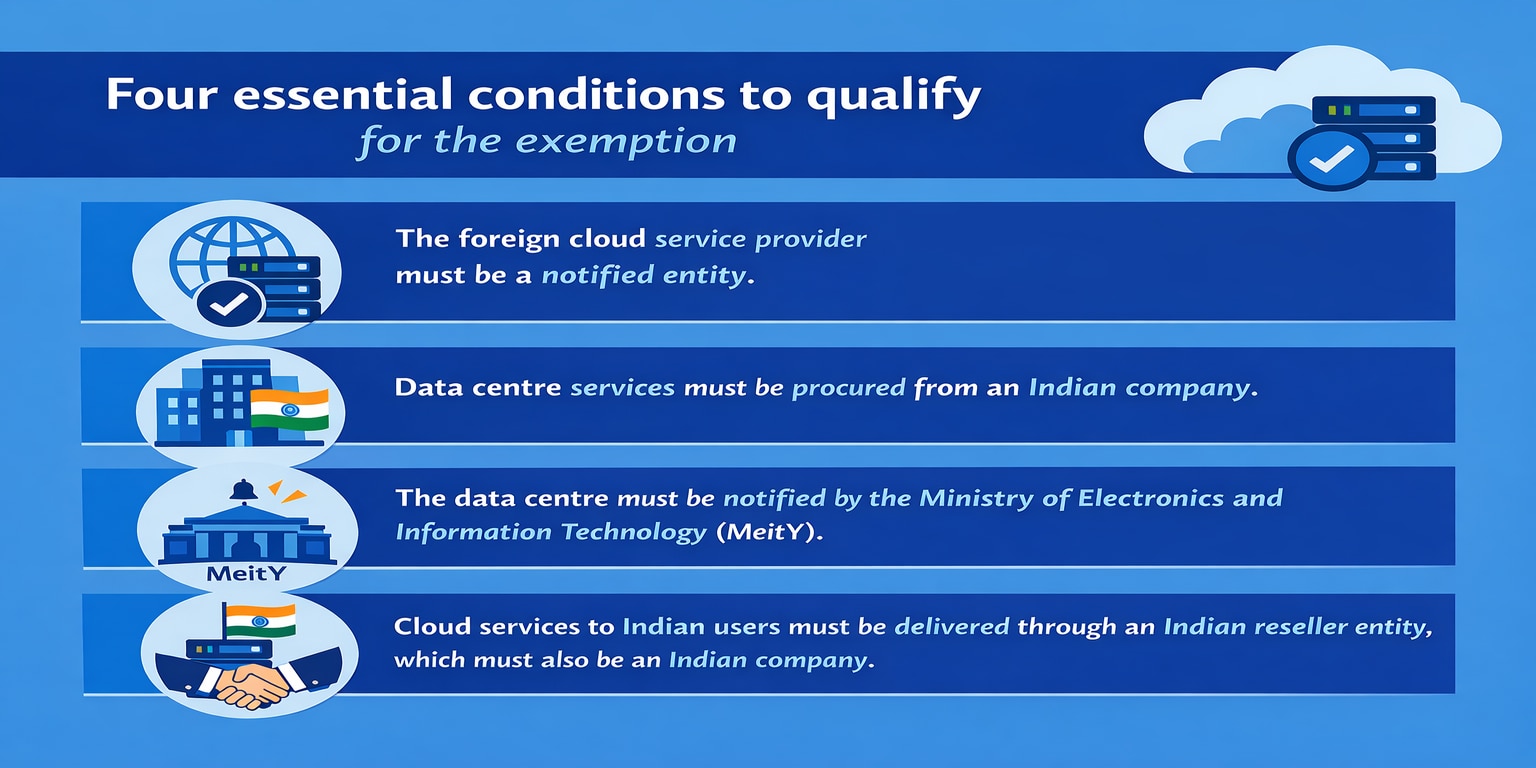
Finance Ministry officials said there are four essential conditions that foreign cloud companies must meet to qualify for the exemption. First, the foreign cloud service provider must be notified under the relevant provisions. Second, the data centre company from which services are procured must be an Indian company. Third, the data centre itself must be notified by the Ministry of Electronics and Information Technology (MeitY). Fourth, cloud services provided by the foreign company to Indian users must be routed through an Indian reseller entity, which must also be an Indian company.
The ministry emphasised that the exemption is designed to provide certainty to foreign companies engaged in cloud services that procure data centre services in India, ensuring there is no risk of their global income being taxed in the country solely on this account.
At the same time, the government has clarified that income arising from domestic economic activities will continue to be taxed in India. This includes profits earned by resident data centre companies from providing services to global cloud entities, as well as income earned by Indian reseller entities from reselling cloud services to Indian customers. Such income will be taxed in the same manner as that of any other domestic company.
In cases where the Indian data centre is a related entity of the foreign cloud company, such as a cost-plus captive centre, the Budget provides a safe harbour margin of 15%, offering clarity on acceptable profit levels and reducing transfer pricing disputes.
Importantly, the tax treatment of foreign cloud service providers will remain the same regardless of whether the Indian data centre is independently owned or a subsidiary of the global entity. Officials said this ensures a level playing field across the sector and removes any perception of differential treatment.
With this clarification, the government believes Indian data centre operators can confidently offer services to global cloud companies without those entities fearing unintended tax exposure in India, potentially accelerating investments in digital infrastructure and cloud ecosystems across the country.
Tax holiday and investments
According to Minister of Electronics and Information Technology Ashwini Vaishnaw, in comments made after the February 1 Budget, the tax holiday could attract investments worth $200 billion. However, the Bharath Digital Infrastructure Association (BDIA), which represents local data centre operators, has expressed reservations, citing the Budget’s use of the term “reseller” to describe Indian businesses.
The Budget proposes “a tax holiday up to 2047 to any foreign company who provides services to any part of the world outside India by procuring data centre services in India. Sale of such services to Indian users shall be made through an Indian reseller entity and taxed appropriately.”
Meanwhile, tax practitioners from the Big Four consulting firms said the Budget proposal was intended to remove certain tax anomalies. “The tax exemption is proposed with a view to avoiding any potential tax dispute in the future on whether storage of a software platform or data on a data centre in India by foreign cloud service providers can lead to its permanent establishment in India, thereby leading to potential tax implications in India. To allay taxpayer concerns and avoid uncertainty on this issue, the government has proposed this amendment,” said Himanshu Parekh, tax partner at KPMG India.

 Who is Pralhad Joshi? Modi names veteran Karnataka BJP leader to lead Education Ministry after Pradhan's exit
 Third round of talks: CJP ends 49-day-long protest, says govt accepted 'key demands'
 Dharmendra Pradhan resigns, says decision taken to protect students' future amid NEET row
 All about Dharmendra Pradhan's educational qualification, wealth, assets and more
 India's first REIT mutual fund is here. Can it change how Indians invest in real estate?
  FDs vs Markets: Where Should You Keep Your Short-Term Money?
 Why Term Insurance Is Essential for Every Earning Member | Sum Assured & Coverage Explained
 Pakistan's Alleged Terror-Politics Nexus: Lashkar Links Spark Questions Over Fazlur Rehman
 Think Life Insurance Is Optional? Here's Why Every Indian Family Needs It Today
 FD Vs Arbitrage Fund: Which Is Better For High Taxpayers?
 Adani Power: 45 GW target, Rs 2 lakh crore capex plan among conference call highlights
  ITC Hotels, Chalet, Ventive, IHCL, SAMHI: Hotel stocks to buy despite travel disruptions
 ITC shares: Rs 307 a key short-term level to watch; here's target price
 Mphasis shares: FY27 guidance maintained; brokerages keep 'Buy' after Q1; check target price
 Should you buy every IPO? Research suggests patience may be the smarter strategy
 New York's $400 million climate bet: How a million trees are cooling a city the city from extreme heat Who is Pralhad Joshi? Modi names veteran Karnataka BJP leader to lead Education Ministry after Pradhan's exit
 Houthis target Saudi Aramco sites in Jizan and Yanbu as Red Sea tensions take a new turn
  Lifestyle inflation, delayed investing, high-interest debt: 3 biggest money mistakes young professionals makeThird round of talks: CJP ends 49-day-long protest, says govt accepted 'key demands'