Path to profitability
Aggarwal outlined a three-pronged strategy for driving growth as well as profitability in the future. With a vertically-integrated manufacturing setup, the company has a current installed capacity of nearly a million electric scooters and motorcycles in its gigafactory situated in Tamil Nadu. According to Harish Abhichandani, CFO, Ola Electric, once operational next year, the gigafactory will have a production capacity of four million units.
The second core area will be focusing on research and development. According to Aggarwal, the EV transition is the most important automotive transition in 100 years. “It is not enough to just buy from other suppliers and assemble. You have to create your own technology IP and hence build a better product and improve your margins,” says Aggarwal. The company plans to improve its margins by increasing volumes and capacity.
The third area for Ola Electric, per Aggarwal, is locally manufacturing 4,680 lithium-ion cells. The lithium-ion battery accounts for 30-40% of electric vehicle costs. Currently, most EV manufacturers import lithium-ion batteries either from China or Korea.
“Once you create your own cell technology, you are able to deploy it in any form factor of a product, be it a scooter via a motorbike or in the future, any other products, whether ours or any other people,” says Aggarwal. The company will be locally producing 4680 lithium ion cells with both NMC and LFP technology.
“Both are relevant, there is no either or in these two choices because both have different propositions. LFP is heavier and more voluminous, but cheaper and NMC is higher energy density, but slightly costlier. So the cell that we are building, the 4680 cell, is actually a format which is compatible with both NMC and LFP. We are first coming out with an NMC variant of the cell because our vehicles right now use NMC. But in the future, we can also do LFP in the same format,” says Aggarwal.
The company has invested Rs 500 for the lithium-ion cell project and has taken a term loan from the State Bank of India of Rs 1,900 crore. According to Aggarwal, a decline in the lithium-ion battery prices as well as removal of customs duty for critical minerals such as lithium, nickel and cobalt, will be beneficial for the company. According to the international energy agency (IEA), the prices of lithium ion batteries have come down from $750 kilowatt/hour to $140 kilowatt/hour.
“So lithium prices in the last 10 years have come down by nine tenths because lithium is a technology oriented business. So as technology is improving, every year or two, the cost keeps coming down. And that's the dynamic I foresee in the future also../I do expect lithium prices to keep going towards a certain direction as technology enhances. Not only for us that's a good benefit for the whole ecosystem because one of the main input costs comes down. And as we scale up our giga factory and commercialise it, we actually have the benefit of low prices because the input costs for our own cell making also comes down from,” says Aggarwal.
Notably, with its gigafactory, the company plans to reduce imports. According to Aggarwal, the company’s imports have come down from 37% in FY23 to 29% in FY24. “Our focus remains to continue to localise more and more as we build more and more components in India. And also most of our imports, that larger number is not from China, but come from a Korean company. Electronics come from an East Asian supply chain, the chips etc. Don't come from China. But thematically skip the speaking, I actually support your point that we in India need to localise more. It's not just Ola, but it's the whole industry, which needs to do more than everybody is doing more, and the government schemes like PLI, etc, to help in that direction,” says Aggarwal.
The company is the largest recipient of the production-linked incentive scheme of automobile components as well as advanced chemistry cells (ACC). While Ola Electric has already received auto PLI for S1X and S1 Pro, the PLI for advanced chemistry cells (ACC) will kick in next fiscal year once the company starts commercialising lithium-ion cells.
Focus on electric two-wheeler industry
Meanwhile, the company will be launching three variants of its electric motorbike soon. While there have been speculations of the motorbike launching this year, Aggarwal didn’t specify the timeline.
“If you look at the Indian two-wheeler market, 2/3rd is bikes and 1/3rd is scooter. So there's a lot of market opportunity in motorbikes. And the basic fundamental selling proposition of EV remains the same in scooter and bike, it is that the total cost of ownership is much lower. So as we enter the bike segment we feel that we have a good product lineup and we are addressing the right segments of the bike market with our spectrum of products,” says Aggarwal.
On the electric car front, Aggarwal says that the company’s focus will be on the electric-two-wheeler segment.


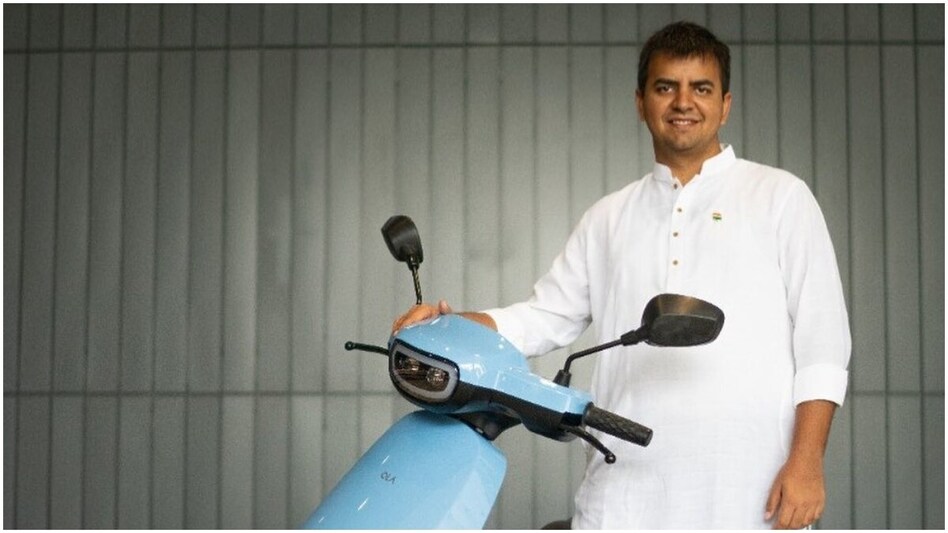 Bhavish Aggarwal outlined a three-pronged strategy for driving growth as well as profitability
 'RBI letter does not mention listing': Noel Tata seeks full briefing on Tata Sons-RBI talks
 Tata Trusts asks Tata Sons to explore options other than listing, says ‘Tata Model has to be saved’
 Tata Trusts proposes ₹25,000 crore plan for SP Group, says Tata Sons listing is not an option
 Chandrasekaran had assured all necessary steps were being taken to remain private: Noel Tata
 'We cannot put the cart before...': Noel Tata's argument against N Chandrasekaran's reappointment
 Corporate Health Insurance Vs Retail Policy: Why You Need Personal Health Cover Too
 How India Changed In 12 Years: PM Modi’s Journey From Economic Reforms To Viksit Bharat
 Modi @76: From Twitter To Instagram, How His Digital Outreach Has Evolved
 Stock Picks To Watch: Shibani Kurian Reveals Kotak AMC’s Market Bets
 Gold ETF vs Physical Gold: Know the Tax Rules, Charges and Key Differences
 Hero Motors IPO subscribed 3.37 times on Day 2; retail portion subscribed over 5 times
 NSE IPO: India's largest exchange gets 43% subscription on Day 1; NIIs, retail see strong demand
 Rentomojo shares settle maiden trade nearly 32% above IPO price; what should investors do now?
 Sensex slips, Nifty settles higher; Tata stocks gain after N Chandrasekaran reappointment
 Cochin Shipyard, KRBL, RITES, Ramky Infrastructure among stocks to turn ex-dividend on September 18
 Venezuela introduces new PRO-V-90 visa for foreign professionals; key details for Indians
 iPhone Duo won’t go on sale on Sept 18: Here’s when you can buy Apple’s first foldable
 Moon took a massive hit: Why nobody noticed this giant crater at first
 Not clay, but pani puri: Pune's 13-foot Ganpati is made from 21,000 shells
 Fireballs after dark: 5 autumn sky events you won't want to sleep through












