









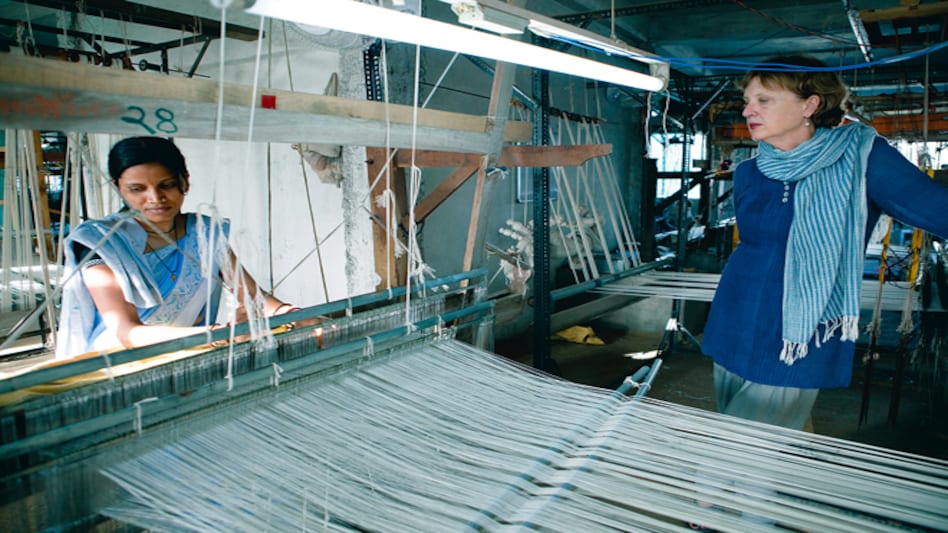
 Sally Holkar, who works with women handloom weavers, at her centre in Maheshwar, Madhya Pradesh (Photo:Womenweave.org)Sally Holkar, who works with women handloom weavers, at her centre in Maheshwar, Madhya Pradesh (Photo:Womenweave.org)
For decades, during the fight against colonial rule, it was a symbol of self reliance. Inspired by Mahatma Gandhi's call, many wore khadi - hand-woven cloth - on principle. Post Independence, however, it became mostly the uniform of political power, worn only by established and aspiring politicians.
People in general preferred factory-produced apparel, which was cheaper and more easily available. Yet lately, thanks to efforts of the government and other agencies, there has been a gradual change. "Handloom products went through a slump in the 1990s," says Laila Tyabji, Chairperson, Dastkar, an organisation which encourages crafts and craftspeople. "But in the last five or six years, they have picked up again."
Leading the effort to revive khadi is the Khadi and Village Industries Commission (KVIC) with a number of projects such as the Scheme of Fund for Regeneration of Traditional Industries (SFURTI) or the Marketing Development Assistance Scheme.
Under the latter, the KVIC provides a financial package of up to Rs 25 lakh. "In the khadi clusters, production has increased by an average of 31 per cent, and sales by 35 per cent, during the XI th Five-Year Plan period," says S.K. Sinha, Director, Marketing, KVIC.
This has been achieved by replacing outdated equipment, as well as innovation in both products and marketing. At the khadi cluster in Gorakhpur, Uttar Pradesh, for instance, 10 handlooms and 500 charkhas have been replaced. The cluster at Thalappalli, Kerala, has developed trendy khadi shirts under different labels such as 'Sheetal' and 'Tanushree', targeting the youth.
The cluster at Surendranagar, Gujarat , has created a khadi denim range with the support of Arvind Mills. A cluster in Arunachal Pradesh has been blending traditional designs of the tribes in that region with modern ones to produce apparel that is even being exported.
There is also the Khadi Reform and Development Programme (KRDP) being implemented with the assistance of $150 million from the Asian Development Bank, which has helped to increase capacity at 300 khadi institutions and renovate 1,200 khadi stores across the country. "After the renovation in 2011/12, sales have gone up 75 per cent," says S.A. Aramvalarthan, Assistant Development Officer (khadi) at the Gandhipuram Sarvodaya Sangh, a KVIC outlet in Coimbatore.
Says Sally Holkar, Founder-CEO of WomenWeave Charitable Trust, an organisation for empowering and improving the lives of women who weave in rural India: "The remarkable point is that we are running WowenWeave for the last one year without any external funding and making a clear profit." "Handloom is the second-largest employment generator in the country after agriculture," says Sunil Sethi, President, Fashion Design Council of India.
The number of handloom weavers is estimated at nine million. Those associated with KVIC now get a much better deal than before, being paid Rs 150 a day against Rs 60 in 2009. With the renovation, their productivity, too, has risen. "Cotton khadi weavers used to make 10 to 11 metres of cloth a day, now they make 20 metres," says Aramvalarthan.
"Khadi did fade into the background, but now with new designs it is finding more buyers," says Purnima Rai, President, Delhi Crafts Council, a voluntary non-profit organisation. "It is not only KVIC stores, even private ones such as Fabindia and Anokhi have built a reputation for their khadi products."
With e-commerce growing, fashion retailers such as Myntra, Snapdeal and Jabong are also selling khadi apparel in a big way. "People are happy to buy khadi," says Vikas Ahuja, Chief Marketing Officer, Myntra. "The determining factor is the design quotient and how fashionable it is. We have several brands offering khadi on our website." More are likely to follow.
Particularly, encouraging is the growing interest of leading fashion designers in khadi. "People are willing to buy handloom saris now," says designer David Abraham of the famed duo, Abraham and Thakore.
"It is a niche market, but consumer awareness is growing rapidly. Our handloom saris cost between Rs 10,000 and Rs 40,000." Other noted designers who have turned to khadi include Bibhu Mohapatra and Rta Kapur Chishti.
 'Iran taking too long to negotiate a deal, will have to pay the price': Trump's fresh warning to Tehran
 Centre likely to take measures to stem net FDI outflows
 Why is India’s obesity drug market thinning despite the GLP-1 rush?
 Planning to fly from Jewar? Air India Express pulls out. What changes for you
 Shocker for Mamata: Saayoni Ghosh, Yusuf Pathan, Shatrughan Sinha among 19 TMC MPs on rebel list
 Why SpaceX, OpenAI, Anthropic IPOs Are A Pipe Dream For Indian Investors
 Why Are Oil Prices Cooling Despite Renewed U.S.-Iran War ? | Narendra Taneja
 Foreign Capital Could Return As Oil Prices Stabilise, Market Outlook Improves
 PoK Uprising: 27 Dead As Pakistan Army Cracks Down On Banned JAAC Protests; India Demands Justice!
 Market Commentary: Ashish Kila's Wealth-Creation Strategy For Investors
 Ather Energy, Ola Electric, Bajaj Auto or TVS Motor: Which EV two-wheeler stock is best placed for the next leg of growth?
 Trapped at the Terminal - Where Even Your Stop-Loss Won't Work
 Stock market today: Why Nifty failed to hold gains and closed lower
 SpaceX IPO demand surges as investors chase Elon Musk's biggest market bet
 Bharti Airtel vs Vodafone Idea: Poring over key financials of telcos