








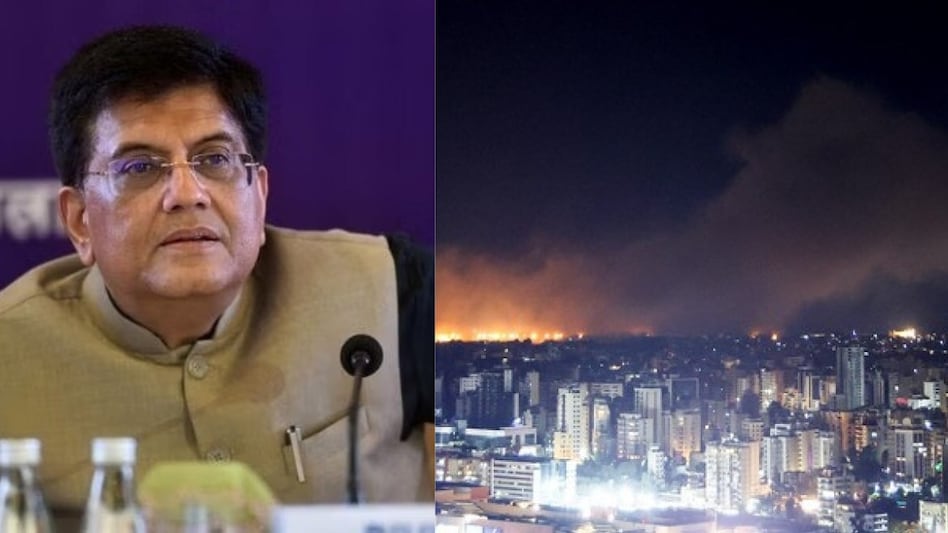
 Iran war: While airspace closures have already disrupted passenger aviation, attention is now turning to maritime corridors that underpin a significant share of India’s exports.
 Iran war: While airspace closures have already disrupted passenger aviation, attention is now turning to maritime corridors that underpin a significant share of India’s exports.
India's Commerce Ministry will convene a meeting with exporters, shipping lines, freight forwarders, and senior officials to assess the impact of the escalating Iran–Israel conflict on the country's trade flows.
Also read: From Iranian revolution and Gulf war to Libyan civil war: A look at 25-300% oil price rallies
The review comes as military action across West Asia intensifies, with retaliatory strikes reported near major Gulf commercial hubs. While airspace closures have already disrupted passenger aviation, attention is now turning to maritime corridors that underpin a significant share of India’s exports.
Also read: West Asia tensions raise risks for trade, oil prices, Indian markets
Industry representatives have flagged vulnerabilities around the Strait of Hormuz and the Bab el-Mandeb, two critical chokepoints linking India’s trade to the Gulf, Europe, and North America. Any prolonged instability in these routes could alter global shipping patterns.
Export bodies said early signs of strain are emerging across logistics networks. Air cargo routes are being adjusted due to restricted airspace, while shipping companies are closely monitoring security conditions in the Red Sea and adjoining Gulf waters. If tensions escalate further, vessels may again be rerouted via the Cape of Good Hope, a diversion that can add 15–20 days to transit times for shipments bound for Europe and the United States.
Such detours typically push up freight rates and insurance premiums, while also stretching exporters’ working capital cycles. Industry executives said it may take several days for clarity to emerge on vessel availability, revised sailing schedules, and new freight benchmarks.
The exposure is significant. The United States, Europe, and West Asia together account for over half of India’s merchandise exports. Annual outbound shipments to the US exceed $85 billion, while exports to Europe are close to $100 billion. West Asia remains both a key destination market and a critical transit gateway.
The situation revives memories of the 2023–2025 Red Sea disruptions, when shipping lines avoided shorter routes and diverted around Africa, sharply increasing transit times and costs. However, trade observers caution that the current tensions appear wider in scope, raising the risk of broader supply chain volatility.
Adding to uncertainty, major shipping lines are scheduled to announce revised freight rates at the start of the month. Earlier this year, rates had been moderating amid softer global demand. Whether that trend reverses will largely depend on the duration and scale of instability in West Asia.
 From Iranian revolution and Gulf war to Libyan civil war: A look at 25-300% oil price rallies
 West Asia tensions raise risks for trade, oil prices, Indian markets
 Fino Payments Bank MD & CEO arrest: Officials state lender operationally stable, GST evasion by certain programme managers
 OpenAI said ‘Yes’ where Anthropic said ‘No’: Sam Altman's AMA reasons the Pentagon deal
 US halts visa services in Pakistan on March 2 amid deadly protests over Iran conflict
 “Fuel Of The Future”: Gadkari Bets On Hydrogen To Power India
 Why Banking Cannot Go Fully Digital In India Yet
 Shaktikanta Das: India-EU, India-U.S. FTAs Position India At Global Core
 Viksit Bharat 2047: The Big Banking Challenge India Faces
 Shaktikanta Das: Fiscal Prudence Drives Massive Infra Push
 Gold rate today jumps Rs 5,500, silver price Rs 10,000 as Iran war triggers risk off trade
 Why is market down today? Top reasons behind share bazaar crash amid Iran, Israel, US news From Iranian revolution and Gulf war to Libyan civil war: A look at 25-300% oil price rallies
 'Buy' HAL; don't panic on L&T amid Middle East tensions: G Chokkalingam
 Stock impact: Winners & losers from Iran war; primary, secondary effects across 10 sectors