








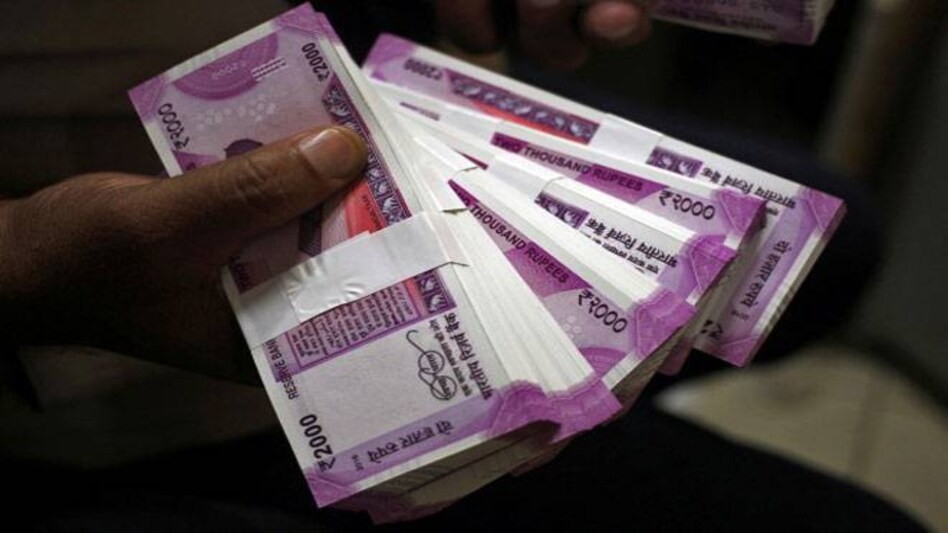

India's rupee against the US dollar is among the three worst performing currencies in the emerging market pack this year. The Russian rouble tops the list followed by Brazilian real and the rupee. Rouble has crashed by 10.76 per cent since January this year. Real has depreciated by 6.94 per cent while the Indian rupee has lost 4.57 per cent of its value against the US dollar.
Thai Baht, Malaysian Ringgit and Chinese Yuan have appreciated in this period.
While strengthening of the US dollar on expectations of higher interest rates back home is one of the reasons, domestic factors are also playing out in each of the emerging market economies. India's financials have also deteriorated substantially over the last few years. For instance, current account deficit (CAD) has been deteriorating since the last fiscal. The CAD was as high as 4.8 per cent of GDP in 2012/13 but it started falling subsequently and touched a low of 0.7 per cent in 2016/17. The CAD ended at 2 per cent of GDP in the quarter ended December 2017. It is most likely to have ended 2017/18 at 2 per cent of GDP.
There are other signs like growing trade deficit. In fact, the trade deficit almost doubled in the last two years. It rose from $47.7 billion in 2015/16 to $87.2 billion in 2017/18. While there are issues of competitiveness, product quality, etc. taking a toll on exports, imports are also rising. Rising crude oil prices over the last two years will further aggravate the trade deficit as the currency is also depreciating, which will add to the import bill.
Secondly, foreign investors also poured money into the Indian financial markets in the past few years. But this trend is also expected to change as the markets look fully valued and the US is also recovering with interest rates expected to go up. Foreign inflows touched a high of Rs 2,77,461 crore in 2014/15 but moderated subsequently -- inflows were negative the next year at Rs 18,176 crore and recovered to Rs 48,411 crore in 2016/17. They, however, jumped to Rs 1,44,682 crore in 2017/18. In 2018/19, the latest available figures show negative Rs 18,315 crore. With elections round the corner, inflows will certainly moderate in the current fiscal year.
 NSE IPO may unlock mega gains for billionaire investors RK Damani, Premji
 'The real sting is the monitoring': Brahma Chellaney flags risk for India in Trump's Russian oil order
 Moltbook hype unravels: Viral posts were human-written, not AI, finds MIT Technology Review
 After mass layoffs, Washington Post publisher Will Lewis resigns; Jeff D’Onofrio named acting CEO
 India-US BTA: Harley Davidson bikes to get 0% duty, gradual tariff reduction on luxury cars
 BT Golf 2025-26 Kochi, Kerala Awards Ceremony Marks A High-Energy, Successful Conclusion
 Golf Is An Addiction. We Eat And Sleep Golf!
 The Fairway Fixes Everything. Mindset, Life, Relationships
 BT Golf LIVE: Join AU Small Finance Bank Presents BT Golf 2025-26 For Its 4th Leg In Kochi, Kerala
 AI Will Change MBAs, Not Leadership: IMD President On India’s Global Education Rise
 RIL, SBI, Kotak Bank, Kalyan, HAL, BEML, BDL among stocks in focus next week; here’s whyNSE IPO may unlock mega gains for billionaire investors RK Damani, Premji
 SBI Q3 Results: Profit jumps 24% to Rs 21,028 crore; asset quality improves
 IDBI Bank stake sale: Kotak Mahindra Bank says ‘has not submitted a financial bid’
 BDL, Mazagon Dock, MRF, Hindustan Copper, RVNL, others to turn ex-dividend next week