


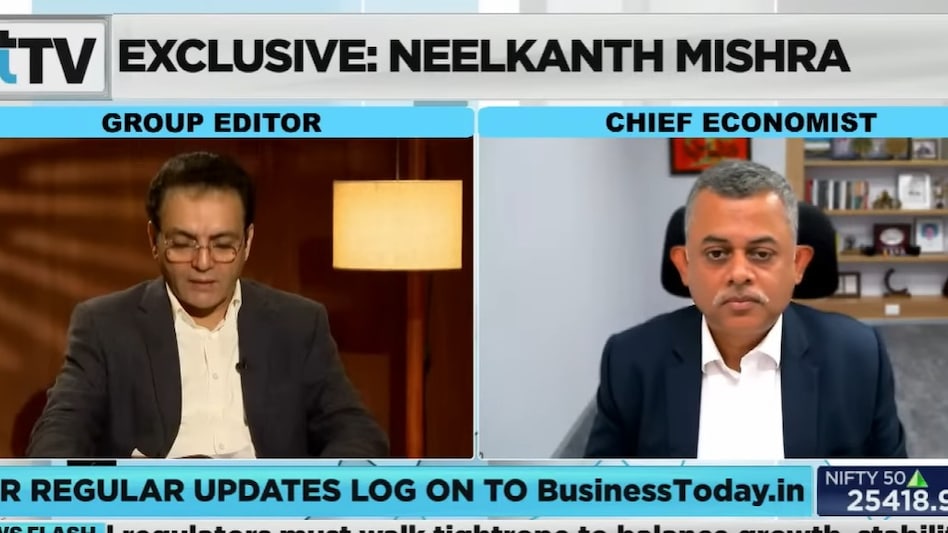
 Furthermore, the Axis Bank chief economist said that geopolitics is not the chink in the armour for India. (Image: YouTube screengrab)
Neelkanth Mishra, Chief Economist, Axis Bank, said on Thursday that India should shift from importing goods from China to encouraging Chinese firms to set up factories within India. He argues that this would help India localise production and integrate into global value chains instead of remaining a destination for dumped finished goods.
"In the past, some of the comments made in the [Economic] Survey ... Instead of importing things from China, why not get the Chinese to set up factories in India, and we've seen that the government has started moving in that direction," Mishra told Business Today TV in an exclusive interview.
He underscored that this strategy is crucial for developing India's electronics and energy ecosystems, especially for batteries and electric vehicles (EVs). At present, China controls a lion's share of the global value chain in these sectors.
Furthermore, the Axis Bank chief economist said that geopolitics is not the chink in the armour for India as of now. "Our biggest challenges are domestic deregulation, removing supply bottlenecks, and fixing urbanisation."
Sounding a note of caution, he said that rising real estate demand will shore up prices and stall growth if India does not unlock real estate supply quickly. He mentioned that major improvements in urban infrastructure are required to sustain construction-led growth for 15–20 years.
These improvements include faster approvals and better governance across hundreds of cities. He, however, added that as geopolitical situations evolve, they play a key role in shaping technology partnerships.
"At the same time, when you're changing, when you're seeing these changes, I think the alliances, the need for technology as we grow our electronics ecosystem, it needs to have a blend of technology partnership with Europe and with the US and given that such a large part of the value chain now lies in China. We need to have trade linkages, maybe joint ventures with Chinese companies," Mishra said.
He added, "In the energy ecosystem, we need to have uh to get competitive battery prices to get competitive electric vehicles. There's so much that needs to happen in terms of technology partnership and attraction of capital that we do need to take geopolitics seriously and make sure that our broader strategic interests are not compromised, and in that I think the government."
He also weighed in on the recently signed India-EU FTA, also called the 'mother of all deals'. "I think India has signalled that it stands for trade openness, that there is an advantage it sees in free trade and that it stands for it, and so I think these kinds of measures can counterbalance some of the disruptions that are happening."
Another red flag for India is China's overcapacity, especially after the US restrictions and tariffs. With US restrictions in place, Chinese exports are now being redirected to countries such as Africa, Southeast Asia, and other regions.
Mexico has also raised import tariffs on Chinese goods. So, what should India do? Mishra suggests, "We have to selectively remember that on intermediate goods. So we have to be very careful in thinking through where to put the barriers up and where not to."
He warned that in the case of intermediate goods, excessive protection can hike domestic costs and impact downstream industries adversely.
Watch the full video here

 Rs 4 Lakh crore investor wealth boost! Why stock market is back in green after four days
  Coforge shares gain ahead of Q1 results: Profit may rise 80-90%; Encore integration eyed
 RAF’s conduct during students’ Parliament march under review, say sources
  US-Iran pause attacks for second day; Trump 'giving talks some space' as Hormuz deal discussed
 New paper leak bill in Lok Sabha today, proposes harsher punishment; MPs given draft
 AI Data Centers, Aerospace & Gas Turbines: What's Powering Indo-MIM's Future Growth?
 Best Healthcare Stocks: Gaurang Shah's Outlook On Apollo Hospitals, Fortis & The Manipal Health IPO
 Is Indo-MIM's IPO Valuation Justified? Here's Why The Company Sees Strong Growth Ahead
 Treasury Bills Explained: Why T-Bills Are One Of The Safest Short-Term Investment Options
 FDs vs Markets: Where Should You Keep Your Short-Term Money?
 AU SFB shares at Rs 800 or Rs 1,275? Targets by JPMorgan, Morgan Stanley, MOFSL and others
 Tanfac, Emcure, Privi, HFCL among 8 stocks with fresh brokerage interest for upto 84% rise
 Juniper Green Energy IPO to open on July 30; check price band, issue size & more
 Adani Power vs NTPC post Q1 results: Power capacity, capex, price targets and more
 MV Electrosystems IPO opens on July 30; check price band, issue size, key dates & moreAU SFB shares at Rs 800 or Rs 1,275? Targets by JPMorgan, Morgan Stanley, MOFSL and others
 'Jana Nayagan' box office collection day 4: Thalapathy Vijay's farewell film crosses ₹217 crore globally
 'Pather Panchali blew my mind': Christopher Nolan hails Satyajit Ray's legacy, praises 'The Apu Trilogy'
 Transforming Tourism in MaharashtraTanfac, Emcure, Privi, HFCL among 8 stocks with fresh brokerage interest for upto 84% rise









