


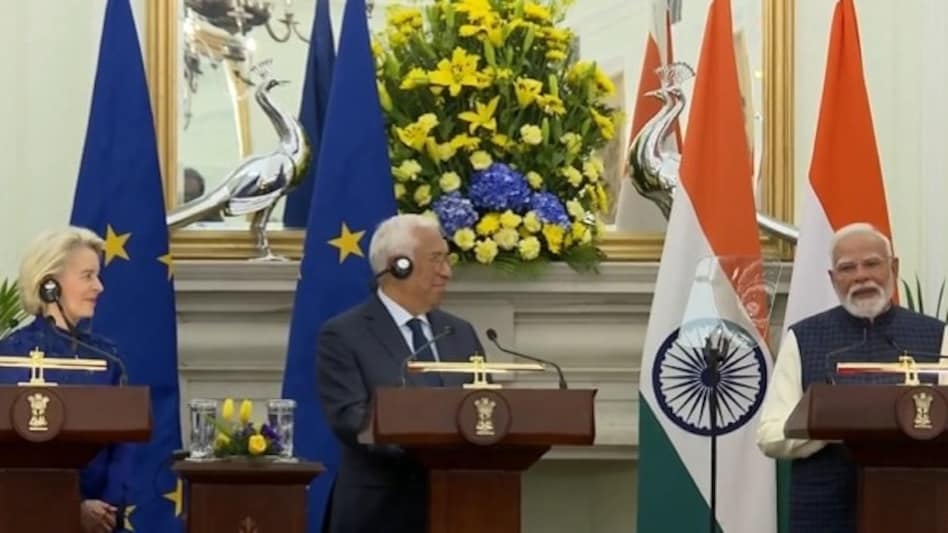
 The EU leaders also lauded India’s warmth and cultural diversity, recalling their experience as chief guests at the Republic Day celebrations.
India and the European Union on Tuesday confirmed that they have wrapped up negotiations on the long-pending free trade agreement, widely described as the “mother of all deals.” The announcement was made in New Delhi at a joint press conference attended by Prime Minister Narendra Modi, European Commission President Ursula von der Leyen, and European Council President António Luís Santos da Costa.
Addressing the media, PM Modi said closer India–EU collaboration would add stability at a time of global uncertainty. The EU leaders also lauded India’s warmth and cultural diversity, recalling their experience as chief guests at the Republic Day celebrations.

 Trump made 1,000-plus trades in June: Here's what he bought and sold
 ‘F&O trading is bad for almost 99% of retail traders’: Nikhil Kamath draws ITC parallel, says brokers need to diversify
 NDA explores holding joint polls in 22 states, UTs in 2029: Report
 'IAF is not against theaterisation': Air Force chief AP Singh cautions against copying foreign models
 ABH Healthcare IPO: Check key dates, price band, issue size, latest GMP, listing details & more
 Motor Insurance Add-Ons You Actually Need Explained: Zero Depreciation, RSA & Return-To-Invoice
 No Claim Bonus Explained: When Should You Claim Or Pay For Repairs Yourself?
 Motor Insurance Premium: What Factors Determine How Much You Pay?
 How Is Retirement Income Taxed For Senior Citizens? Key Rules Explained
 Rental Income Tax: 3 Key Deductions Every Senior Citizen and Property Owner Should Know
 Trump made 1,000-plus trades in June: Here's what he bought and soldABH Healthcare IPO: Check key dates, price band, issue size, latest GMP, listing details & more
 India stocks lag global markets in 2026: BofA data shows 9.1% decline in USD terms
 'FOMO, fixed return': SEBI proposes revamped ad code for bond portals from misleading investors
 Crompton Greaves says no plan to sell stake, expects revenue to double by FY31
 12,000 students, 80 seats: IIM Bangalore’s first UG programmes see huge demand; check courses, campus & what students getTrump made 1,000-plus trades in June: Here's what he bought and sold
 From Buddhist monk at 16 to Meta engineer : How 30-year-old Lilly Chen built a $25 million startup to challenge AccentureMotor Insurance Add-Ons You Actually Need Explained: Zero Depreciation, RSA & Return-To-Invoice‘F&O trading is bad for almost 99% of retail traders’: Nikhil Kamath draws ITC parallel, says brokers need to diversify












