After chewing on the rubrics of the
National Food Security Bill for a few days, the Union cabinet has toed
UPA chairperson Sonia Gandhi's line. On Sunday, it approved the proposed statutory entitlement of
cheap foodgrain for the country's poor in the second attempt.
The nod became inevitable after agriculture minister
Sharad Pawar softened his stand on the draft Bill, while Mamata Banerjee's Trinamool Congress also fell in line - crucial developments that the brief meeting at the Prime Minister's residence culminated in.
It was a pleasant coincidence for the ruling party that the approval came hours after it cemented its ties with the RLD and inducted the latter's chief, Ajit Singh, into the Cabinet. The Congress hopes the move will pay it dividends not only in poll-bound Uttar Pradesh, but in the other states where assembly elections will be due in 2012 as well.
Sonia had taken umbrage at the cabinet
failing to clear the Food Bill on December 13 when Pawar had spiritedly opposed it and the Trinamool Congress sought more time to study it, while a "somewhat reluctant" PM let it be.
Pawar's reservations, which first emerged during his stint as food minister, had continued to be a sore point with the Bill's protagonists. The NCP chief had apparently objected because of the humongous monetary load it would exert on the exchequer, that too when the state of the economy leaves little to cheer.

The Food Security Bill is considered to be close to UPA chairperson Sonia Gandhi's heart.
Earlier, the economist in Prime Minister Manmohan Singh had conceded ground to the politician in him when, during his return trip from Moscow, he predicted that the economy could still clock an 8-9 per cent growth rate. The subtext was that
the load which the Bill entails could be overcome with some deft handling of the economy.
The PM briefed top ministers such as Pranab Mukherjee, Sharad Pawar, A. K. Antony and P. Chidambaram just before the cabinet meeting where he said it was "political commitment" that the government must fulfil.
"The cabinet has cleared the Bill and it will be introduced during this session," food minister K. V. Thomas said in a crisp statement after the meeting, refusing to divulge more since Parliament is in session.
The Bill, likely to be tabled on Tuesday after mandatory law ministry and presidential clearances, is certain to be referred to a standing committee of Parliament.
The government expects to ink it into law during the February-March budget session next year by when the economy's outlook may be a little better.
More significantly, the approval gives the Congress a large political harp to play during the upcoming Uttar Pradesh assembly elections if the government's plans of enacting it by then turn real.
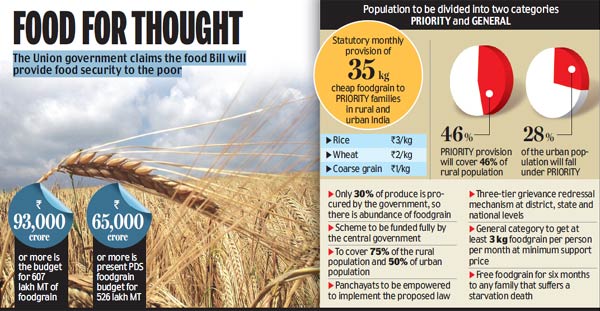
Food for thought: The Union government claims the Food Bill will provide food security to the poor
The Bill provides rice at Rs 3 a kg, wheat at Rs 2 kg and coarse grain at Rs 1 a kg every month to almost 75 per cent of the rural and 50 per cent of the urban population. The entitlement for a family of five would come to 35 kg of foodgrain every month.
The population would be divided into two categories - 'priority' and 'general' households. Almost 46 per cent of rural and 28 per cent of urban households would fall in the 'priority' segment.
The total estimated cost for 607 lakh million tonnes (MT) of foodgrain would be more than Rs 93,000 crore. The present PDS foodgrain load for 526 lakh MT is more than Rs 65,000 crore.
The 'general' category individuals are slated to get at least 3 kg foodgrain per person per month at the minimum support price if the Bill is enacted. It also provides for a three-tier grievance redress mechanism at the district, state and national levels.
Food rights activists have opposed the Bill because it seeks to divide the population of the beneficiaries into two categories.
In fact, a handful of them, hailing from the Right to Food Campaign, protested outside 7, Race Course Road. But they were soon detained by the police.
The government, sources said, was confident about the availability of foodgrain because only 30 per cent of the farm produce was procured by it at present.
The scheme would be funded fully by the central government and the states will act as distributors through panchayats.
There are, however, no clear views about the government's ability to actually provision the budgetary outlay to foot the cost of implementing the proposed law and the ways and means of sourcing the money.
Thomas had earlier said that the total financial liability to implement the law would be Rs 3.5 lakh crore as funds would be required to raise agriculture production, create storage space and generate publicity among other things.
The food Bill is Sonia's second pet project after the Mahatma Gandhi National Rural Employment Guarantee Act (MGNREGA).
The Congress had promised a food law in its manifesto for the 2009 general elections and President Pratibha Patil had mentioned it in her address to the joint session of Parliament in June 2009.
The Bill has been under consideration of an empowered group of ministers, headed by finance minister Pranab Mukherjee since September 2009. The National Advisory Council (NAC), chaired by Sonia, and an expert committee under Prime Minister's Economic Advisory Council (PMEAC) chairman C. Rangarajan also submitted their recommendations on the Bill.
Rice and wheat are currently supplied to 6.52 crore BPL families through the PDS at Rs 5.65 per kg and Rs 4.15 per kg, respectively.
About 11.5 crore APL families get at least 15 kg of wheat and rice per month at Rs 6.10 per kg and Rs 8.30 per kg.
Courtesy: Mail Today 


 GLP-1 drugs are under fresh scrutiny over rare condition; here's what's happening
 IRDAI’s insurance distribution reforms: What changes for insurers, brokers, customers
 SBI announces ATM charge waiver during bank strike; UPI, NEFT, RTGS services to continue
 This is not a tax, cess, surcharge...: FM Sitharaman explains what the new UPI MDR really means
 BT Big Story: The price tag of UPI: Will small shops go back to cash?
 How Is Alexa+ Different? Will It have Ads Even If You Pay? Exclusive Chat
 Demand Robust Across Segments | Production To Ramp Up, Exports To Expand: Vivek Srivatsa
 GST Council To Meet On October 7: Invoice Matching, ITC & UPI MDR Tax In Focus
 Tata Chip Plans Stay On Track Despite Boardroom Rift; Dholera Fab Investment Unaffected
 GLP-1 Drugs Face Eye Safety Concerns: Will Fresh Scrutiny Impact India's Growing Market?
 IPO rush: Four IPOs conclude today; check subscription status, other details of issues still open
 Meesho shares slip 7% as Nomura assigns 'reduce' call; here's what the brokerage says
  Sensex, Nifty extend losing streak to seventh week, longest since 2020: What's next?
 Suzlon in bear grip: Oversold signals emerge near 52-week low for the stock
  EIL shares jump 7% to hit record high; stock up nearly 62% in six months: What's driving the rise?
 RBI changes bulk FD rules from October 1: What depositors and banks need to know
 Financial Horoscope Today, September 26, 2026: Aries Should Follow a Budget, Know the Status of All Signs
 RBI’s FCNR window: Why banks need seamless digital onboarding to win NRI customers
 BlackRock sees AI agents creating a new economy for stablecoins, blockchain and compute












