Flight delays and cancellations are common in Indian airports, often leaving helpless passengers stranded for hours together. To put an end to the problem, the Directorate General of Civil Aviation (DGCA) recently announced a new set of rules that mandate airlines to pay up to Rs 10,000 to passengers for cancellations and delays of two hours, or more. If the traveller is denied boarding, the compensation can go up to Rs 20,000.
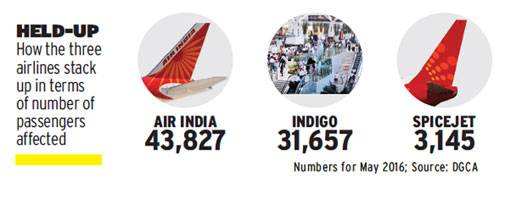
The decision will affect both large and small carriers. Flight delays of two hours or more by Air India, for instance, affected 43,827 passengers - about three in every 100 it flew in May 2016 - while IndiGo inconvenienced 31,657. Air India paid around Rs 72.58 lakh compensation for delays, but IndiGo did not pay anything. The increase in penalty would further dent revenues of airlines in a big way. Small regional airlines, such as Air Pegasus, Air Costa and Trujet, topped the cancellations list, with Air Pegasus cancelling a whopping 21.34 per cent of its scheduled flights. Some of the most common reasons for delays include cleaning time of the aircraft, congestion at airports and bad weather. The DGCA has said that airlines need not pay compensation in case of delayed permission from the air traffic control. But, here's the catch. If a flight is delayed because of ATC action, the respective airlines will most likely miss other scheduled departures as well on that day. The remaining flights, however, will not be exempt from the compensation clause.
But the most telling problem is inadequate infrastructure. For instance, Delhi has just three runways, and airlines have been demanding one more for smooth functioning during peak hours. The fourth runway will be ready by 2020. DGCA data shows Mumbai is the worst in terms of on-time performance (OTP) for all airlines. Air India's OTP, for instance, stood at 66.5 per cent in May. The proposal to build an airport in Navi Mumbai is pending since 1997.
According to International Air Transport Association, Delhi, Mumbai and Chennai fall under level three airports, where infrastructure is scarce. The situation is expected to worsen as traffic increases. IndiGo, for example, has placed order for 430 planes - over four times its existing fleet of 108.
On the one hand the government is talking about reviving regional airports, but the pace of expanding existing airports has been extremely slow. Currently, 75 out of 450 airstrips and airports have scheduled operations. The Centre aims to revive the remaining by investing Rs 50-100 crore for each. It's easy to tighten the noose around airlines, but fixing the root cause of the problem will be more important. DGCA's consumer-centric decision seems to lack the vision.















