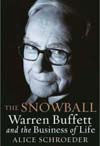
Quite undeniably, the Snowball is the last word on (and the most authentic bio of) Warren Buffett. Finally, here is the human being hidden behind the ruthlessly methodical, consistent and successful investor we all love to admire in public, but understand very little about once we are through praising his investing genius. We’ve worshipped (but never fully adopted) his legendary investment style but wondered just who the real Buffett is. So, here’s your chance, dear reader; just dash off to your favourite bookstore and grab analyst-turnedwriter Alice Schroeder’s painstakingly detailed insight for a leisurely ramble through your financial hero’s life over your next weekend.
The snowball
Alice Schroeder
Random House
Pages: 838 Price: $35 (Rs 1,715) |
Like most great biographies, Schroeder’s 838-pager starts abruptly—in the autumn of Buffett’s life. This is no ordinary autumn, as the allegedly clued-out and obstinate (but articulate) Buffett systematically trashes the grandiose dreams of dotcom bubble-mongers in an exclusive investors’ hideout in Sun Valley, Idaho, in July 1999. Not afraid to hold his own in front of an initially disbelieving audience, he proceeds to illustrate how Internet companies are being (over) valued in much the same way as initial upstarts in the automobile or air travel businesses, both of which also changed the world— but earned little for investors. The Internet bubble burst less than a year after Buffett’s prescient criticism of its excesses.
The book is littered with anecdotal gems that Buffett-lovers will relish. And this, more than any revelation of investment rules or wisdom, is what makes it a real treasure. Right from his childhood days, and even those that preceded his birth, the narration of the Buffett family’s history gives startling insights into some of his desires, anxieties and rebellious instincts at various stages in his eventful life. Schroeder weaves a rich tapestry of his life and times, looking (and splendidly narrating) from a window of proximity that Buffett has never opened for anyone outside his family, except her.
Who can imagine that beneath the often cocky (but always brilliant) decipherer of financial and strategic insights into many a business lies an insecure, impish boy longing to be loved and cared for? That the financial genius (who was recognised pretty early in life as one) was terribly gawky and tongue-tied with girls who should ordinarily have been easy for him to snare? That Buffett’s millions (now billions) of dollars of personal wealth held no meaning for him once they accrued to his net worth? Or that, in his otherwise unflinching commitment to his wife Susie and his children, he was always “miserly” in matters of spending on even small luxuries that he could easily afford? Or even that he almost got caught for volunteer service for the National Guard the day he married Susie Thompson? Much to the reader’s delight, Schroeder digs deep... and especially deeper in trenches that are least explored by other Buffettologists.
For her part, Warren’s wife Susie comes across as a true and strong pillar in his life, loved in many intangible ways and relied upon implicitly, as it were, to put all his affairs outside of business in order. Even when the relationship drifts, she is rock solid, bringing into his life her own motherly and protective tendencies, often unspoken but always present. In an incredible incident, she actually flips pages of Playboy magazine to humour a seriously ill and weakened Warren as he lies in hospital, after a near-fatal allergic reaction to penicillin. Typically, he complained that she was flipping the pages too quickly!
Buffett’s numerous business buyouts, deals and landmark transactions have been endlessly chronicled and reconstructed in our times. Schroeder has no choice but to include these stories as the defining events in Buffett’s colourful financial history, but otherwise it is the story of Buffett the man, not Buffett the businessman. On full (and shimmering) display is Buffett’s stinginess in getting the lowest possible price from a seller in deal after deal, patiently wearing him down and squeezing out the last penny left on the table.
A shift is clearly visible over time, as Buffett changes from a “stub hunter” and gatherer in the classic mould of his mentor Ben Graham’s value investing style to an owner of entire businesses, which he could then steer (via capable and carefully chosen or inherited stewards, never by himself) for years till they became valuable geese that laid golden eggs, year after year. This was a natural outcome of his own evolution from being a pure money manager and portfolio allocator for his early “investment partnerships” to becoming a long-term majority owner of the investee businesses.
Buffett’s thrift, his uncompromising intellectual honesty (the “inner scorecard” always taking precedence over the “external scorecard”) inherited mostly from his father, his meticulously developed political opinions and his strong philanthropic trait give an enduring respectability to the story of his life. And this is the reason why The Snowball hits home: that a life lived with attitude and conviction is worth living—as well as reading through, any number of times.
The reviewer is the Head of Research, Wealth Management Advisory ServicesRevisiting the classics
Who has the time for a one-week management retreat to review problems? Definitely not bankers! Don’t miss this one-minute pitch.
Was big because: Well, 13 million copies of the book have been sold worldwide since it was first published 20 years ago—and apparently 10,000 copies are sold every month even today. The book, which is said to be the first management best-seller, pioneered an easy-to-read format, and unfolds a three-pronged strategy via a parable of a young manager learning from a wise old guru. The three prongs: have clear goals that can be set out in one minute, be prompt and open with praise, and equally prompt and clear with reprimands.
Why read It now:
The world has changed a lot— BlackBerrys rule, employees are sacked via SMS and a Fortune 500 company can collapse in less than a minute, triggering a slide that can take out a country thousands of miles away. Minutes (and good leadership) count more than ever. The book’s three ideas—setting a clear, agreed goal, laying out the praise when the goal is achieved, and reprimanding when people slip up—are basic to any human management situation. Setting out clear goals is the first important part. Once done, it is a matter of good steering. And oh, careful about the reprimand bit: don’t ride roughshod over learners, as it can paralyse them. Lastly, keep it short.