

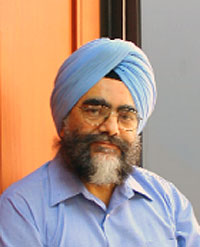
 In any moment of decision, the best thing you can do is the right thing, the next best thing is the wrong thing, and the worst thing you can do is nothing.” Pradeep Singh often acts on Theodore Roosevelt’s, statement of wisdom. When in 1995 he decided to quit the cosy comfort of a government job to move into the non-governmental sector, people called his action foolhardy. Rarely do you find someone making a career switch at the age of 43 years.
But Singh, an Indian Administrative Service (IAS) officer from the Assam-Meghalaya cadre, was quite sure of what he wanted: “For 17 years I had access to the power and perks that go with being an IAS babu. But I was not getting a chance to work on projects that would directly impact the people.”
And it wasn’t as if he woke up one morning and decided that he had enough of being a director in the Ministry of Defence. In 1993, CARE, one of the world’s largest private humanitarian organisations, had approached him with a prospective job offer. “I was sure I wanted to move but took time to think things through. I didn’t want to end up with regrets later in my life,” says Singh.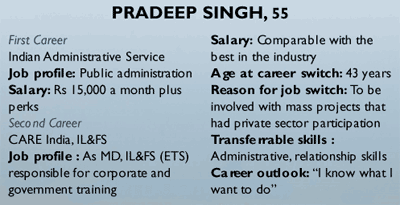
The analytical streak, honed by the study of physics in college, is evident in the clarity he has about what he wants to do in his professional life.
Just as clarity of goals and objectives are essential to the success of any business, the same holds true of building one’s career. “I never felt insecure while taking up new responsibilities as I was always confident of my abilities,” says Singh.
His master’s degree in Engineering Economic Systems from Stanford University was finally put to use when he took up the challenge of developing strategic plans as assistant country director, CARE India. Two years later, CARE wanted Singh in its Atlanta office. The family was packed and ready to migrate to the US when a call from Infrastructure Leasing & Financial Services (IL&FS) altered Singh’s career course once again. “When the board explained the work profile, I could see my dream being realised. It had the right mix of public and private sector participation,” says Singh.
The next 10 years provided him with a smorgasbord of opportunities in the field of infrastructure development. He was engaged in developing new paradigms, financial instruments, legal frameworks for development of infrastructure. “Making these projects bankable and viable was my biggest value addition,” says Singh, whose major projects include the Bangalore International Airport, a games village in Ranchi for the 34th National Games and over 1,000 km of roads in Punjab.
Working in partnership with the government—private enterprises provided the financial and management support—Singh saw his role as an entrepreneur. “I oversaw development of projects across power, housing, ports, water supply,” he says.
However, he is quick to give due credit to the time he spent in the civil service and regards it as a great learning experience. For it was during his stint in the IAS, he learnt the ropes of being a manager. And more importantly he got to work across various sectors in various capacities. But the hurdles, especially red tapism, could put off many. One thing Singh never stopped short of was picking up new skills.
In 1991, he completed a degree in public administration from Harvard University, and remained a visiting faculty member till 1994. Singh continues with the same approach even today. He has embarked on a new venture at IL&FS as managing director, education and technology service. In this new job he would be working in close coordination with the department of information and technology, provide motivation programmes at grass-root levels on better governance, upgrade 300 Delhi government schools, among others. Singh’s plate is full.











