Every Sunday, Das and his wife, Sushmita, would drive long distances and take note of the most obscure landmarks to help them reach an accident site on time. As they failed to get much help from the local bodies, they approached individuals for donations to purchase ambulances. "One day, the health secretary of Gujarat saw our poster at a roadside eatery. On a whim, he called the number and an ambulance reached him in 12 minutes. Impressed by the prompt service, he promised to help us," says Das.
The need for organised emergency medical aid has been so pervasive that within eight years the foundation has extended its service to seven states and plans to offer it to two more this year. This isn't a random success story. The foundation's growth mirrors the void in the healthcare system and the immense potential that remains to be tapped.
According to a survey report, 'Indian Healthcare—New Avenues for Growth', published in January this year by industry researcher RNCOS, the healthcare sector in India was reported to be worth $45.8 billion in 2009 and is expected to grow at a compounded annual growth rate (CAGR) of 21 per cent during 2010-13. According to the report, sectors such as medical tourism and pharma outsourcing will grow at a CAGR of 31 per cent and 34 per cent, respectively.
Make the right diagnosis Stuti Chandok
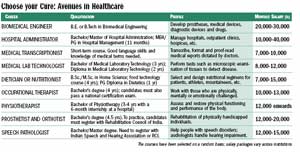
For years, if you wanted to indulge your humanitarian instincts, you needed to be armed with an MBBS degree. This closed the doors for those who couldn't get through entrance exams or cope with the rigorous study schedule. But now there are more options than the traditional medicinal roles. If chemicals interest you, choose pharmacy. If the musculature system fascinates you, train as a physiotherapist. And if you're science-phobic, yet want to serve society, become a hospital administrator (see Choose your Cure). However, be prepared to update yourself constantly as it's one of the most dynamic sectors and you'll need to keep your finger on the pulse of new technology.
"There is a strong reformation under way in the healthcare sector with the need to optimise resources. This has opened the doors for innovative fields, niche research areas and the need for professional expertise in running medical institutions," says Sunil Goel, director, GlobalHunt India.
Take Stuti Chandok, a clinical music therapist. She exemplifies how one doesn't need a medical degree to provide panacea. Trained in classical music, the single parent set up Little Mastiz in 2001 to teach music to children. She soon became intrigued with the concept of music therapy. "The idea that music could help autistic children and those with learning difficulties was exciting. Unfortunately, no institute provided this training in India," she says. In 2004, Margaret Lobo, founder of the UK-based Otakar Kraus Music Trust, conducted a one-year post graduate course in Mumbai. Chandok, who had already been in touch with Lobo, signed up immediately. "Other than aptitude, you need to have patience and an instinctive understanding of what will work best for the child," she says. Chandok soon found that her talent was in high demand and now regularly conducts motivational training workshops for corporates.
Entrepreneurs: Healthy outlook  Mehul Parekh
Though careers in this field are cropping up, it's tough for entrepreneurs to find a foothold. "When I started my business, I took whatever work came my way. Beggars can't be choosers and neither can start-ups," says Mehul Parekh, MD and founder, Unimark Remedies. Parekh always knew he wanted to be an entrepreneur but couldn't make up his mind about the field. He studied to become a chartered accountant and worked for six months to learn the ropes of running a business.
In 1982, Parekh set up Rainbow Fine Chemicals, a pharmaceutical marketing company with Rs 3 lakh as seed money. However, Parekh knew that the opportunity and money were in making medicines. So, after his brother got a master's degree in organic chemistry, Parekh decided to venture into the field confident in the knowledge that he could bank on his brother's expertise. In 1995, he set up a manufacturing unit and renamed his company Unimark Remedies. "The biggest challenge is always funding. I bought the premises simply because the owner was the only one willing to sell it on credit," says Parekh. In 1997, he purchased another plant, this time promising the owner that if he put in the capital, he would get to share the profits. "I avoid putting in huge amounts because it blocks the money that can be invested in more important areas," he adds.
Besides funding, another roadblock faced by entrepreneurs is government regulations. Concurs Das: "Some subjects, such as highway emergency, are nobody's baby. The police dumps it on the Transport Department, which says it's a Health Ministry issue, which, in turn, states accidents to be a police matter." If such issues were to deter people like Das, the healthcare sector would be in a comatose state. The fact that it has begun to emerge from it speaks volumes about the healthy outlook of such entrepreneurs.