
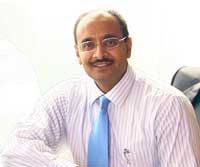
He breaks the conversation midway to pick up the ringing phone. “It could be a customer,” says Krishnamurthy Vijayan, chief executive of JP Morgan Asset Management India, a strong believer in a hands-on approach. Something he may have never done if he had chosen the career of his first choice—the civil services.
Winner of the President’s Gold Medal for his MA scores, Vijayan appeared for various competitive exams, including the IAS. “I decided to join UTI instead of waiting for the result of the civil services,” he says. From Bilaspur in Chhattisgarh, he moved to Mumbai in 1986 to join UTI as a staff officer on a monthly salary of Rs 2,300.
UTI was in the process of setting up its human resource (HR) department and Vijayan volunteered to join it. While most of the new employees were requesting for a transfer back to the comfort of their home towns, Vijayan decided to stay and learn the business of managing people.
| KRISHNAMURTHY VIJAYAN, 45 B Com, MA (English) |
|---|
| Previous careers: HR and IT |
| Job profile: To set up the systems as head IT, JF Asset Management India |
| Salary in previous job: Rs 14,000 a month |
| Age at career switch: 36 years |
| Reason for job switch: Career growth |
| Current career: Business management |
| Job profile: Responsible for India operations as CEO of JP Morgan Asset Management India |
| Earning: Best in the industry |
| Transferable skills: People management, marketing |
| Career outlook: "Have a plan in place" |
He also took on the task of creating a flowchart of all the functions of UTI. “This helped a lot in understanding the system,” he says. Having handled the assignment well, he was given the responsibility of other projects too. “Most of my learning in HR was on the job,” he says.
When the first personal computer was installed in the office, Vijayan would stay back late, learning to operate the system. Leading the computer-training programme for employees of the company was the next natural step for this self-taught programmer.
The ambition to pursue a career in the civil services dissipated as exciting opportunities kept him gainfully occupied. By 1991, he was formally transferred to the information technology (IT) department for its Rs 106-crore upgrade programme.
“The transition from HR to IT happened over a period of time as I was picking up various IT skills,” says Vijayan. In 1993-94, he became totally immersed in setting up UTI Investor Services, a cell to process consumer complaints.
However, Vijayan couldn’t see his career making further headway in UTI. As deputy manager with a monthly pay of Rs 3,400, his salary had registered a CAGR of just 5% in eight years. Opportunity knocked in 1994. An ex-colleague asked him to handle the IT functions of Jardine Fleming (JF) Asset Management India at a salary of Rs 14,000 a month. The start-up atmosphere at JF suited Vijayan’s enthusiasm.
He had greater authority and autonomy. “It was a small team and I participated in almost all the functions,” he says. The mid-1990s were turbulent for the Indian stock market and the fund house couldn’t meet its targets. The 25-member team was scaled down to five. But Vijayan didn’t lose his job. “I was sort of a jack-of-all-trades because of my exposure to all fields of business,” he says. Vijayan concentrated on the operations division and by May 1999 he was heading the marketing and operations of the company — his second career transition.
| VIJAYAN'S TIPS FOR CAREER SHIFTS |
|---|
| 1. Moving from one branch of business to another should not be sudden. As a first step, volunteer for tasks others are not willing to undertake |
| 2. Only after you are adept with the basics, scale up for bigger assignments. This approach adds value to your skills and establishes you in the new role |
| 3. Avoid horizontal moves. It could lead to career stagnation. Make linear changes if you are sure of making a big difference to the work |
| 4. Take on extra responsibility |
His mandate was to increase the stagnating sales of JF India Bond Fund. “Together with UR Bhat, CIO, we achieved unbelievable targets in eight months,” says Vijayan. Moving to JM Mutual Fund as its CEO in 2000 was an offer he couldn’t resist. “Money was never the main driver of my moves. I shifted for my career’s growth,” he adds.
Along with the move, came the responsibility he had been preparing himself for. “From organising the business, creating a team, developing a vision, each day was a new challenge,” he says. For the next five years, Vijayan went on to manage an AUM of over Rs 4,500 crore and nine key mutual funds.
His next move in 2006 to JP Morgan as its CEO and director happened after JF Asset Management merged with it. “It was the same team that I had worked with earlier. I knew I could achieve much more in such an environment,” says Vijayan, whose personal investments are mostly in mutual funds and property.
For Vijayan, the challenge also lay in building the Indian chapter of a multinational company from scratch. “When you build a company, you also grow personally and professionally. Considering we started managing funds from February 2007, we have performed quite well,” says Vijayan. The AUM of the JP Morgan Fund is currently at Rs 2,000 crore. “This is just the beginning,” he says.













