
You worked hard for it. And finally it is in your hands. The offer letter from the company you have been wanting to work with. But before you sign the joining letter give one final thought to the prospects at the new workplace. Be sure that you understand all the conditions of the job before you accept it. Doing so takes some experience and practice. So understand the reasons you want to quit and ensure that your expectations are met at the new place. In your hurry to get out you may just be jumping from the frying pan into the fire. Don’t be dazzled by the salary or the designation, understand the work semantics first. Undertake a simple exercise of cross-checking the benefits at both the workplaces. Be sure there is growth, excitement, learning and—most importantly— enhanced responsibility at the new job. Consider if there is scope for enhancement of role and salary at the current workplace and how it matches with the new offer.
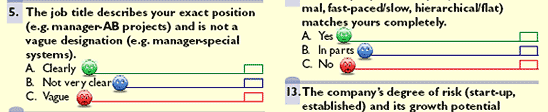
MONEY TODAY has compiled a checklist that will assist you in deciding whether the new job is a step forward in realising your career goal.









 Bhavna C. Srikrishna helped MONEY TODAY in constructing and analysing the quiz. She is a senior consultant,TMI India Bhavna C. Srikrishna helped MONEY TODAY in constructing and analysing the quiz. She is a senior consultant,TMI India |
| Mostly As | Mostly Bs | Mostly Cs |
| Congratulations. Take the great leap forward. The new job is a financial gainer, and you are taking a meaningful and significant step in your career ladder. There is growth, excitement, learning and enhanced responsibility here. Of course, the icing on the cake is that they and you know what exactly are you expected to do (lack of role clarity can be one of the biggest reasons of job dissatisfaction). Assuming you have enjoyed your current job (and even if you haven’t), make sure you leave on the best professional terms. Give enough notice as per the company rules. Help in identifying/recruiting your replacement, who understands the work equally well. Remember to be a loyal and committed employee till the last. Leave detailed progress reports for your supervisor and co-workers. To convince your new employers that they have made the right choice, discuss your duties and responsibilities; and establish your priorities. Set challenging, but achievable, short-term and longterm goals. Establish a reputation as a good team player by developing good working relationships and cultivating friendships with as wide a range of people in the company as possible. Just ensure that you are enhancing productivity, improving quality and maintaining good relations. Follow this mantra wherever you work for a successful career. | Here is the tough one. Consider the following before saying a yes or no—find out if the company offers meaningful training programmes, those that are conducted by experts and recognised across the industry. What is the market saying about this company? How are the stocks doing? Are people happy and committed? Are they known for a good work culture? Will there be good growth, two years down the line? How is the team of people you will be working with—do they share the same background, work style as yours? Will you be able to display your expertise here? If the answer is yes to most of the above, you may want to go ahead and confirm. It may not be a quantum change but still there is a definite step up the ladder. Are appraisals round the corner at your current job? Could you push for a role enhancement? Are you expecting a huge pay rise? Maybe your current boss is really happy with you. Maybe the company is part of a high-growth industry—a better role for you perhaps. Do reconsider staying here. Else, continue looking out. This option will be full of questions and a certain amount of risk, but if you are a good performer, you are going to do well—no matter what. The bottom line is, don’t change the job just for the heck of it. | Assuming that you are not between the devil and the deep sea, keep steadily plodding at your current job and continue your search. As they say—there are no wrong people, only wrong jobs. Meanwhile, you are richer with this experience. Take this opportunity to evaluate and analyse. Look at yourself and your own capabilities. Do you have the right experience (number of years served and skills) to be looking for a change? Perhaps some more time spent on the current job with some added responsibilities may be a wiser approach to aspire for. Get enrolled in some of the better training courses that the company offers, augment your own education by enrolling for a course from a recognised institute. Consider the possibility of some role modification or increase. Sit back, take a deep breath and critically evaluate—can you change your own attitude to enjoy this job more? If the above is settled, then continue to be on a lookout for better options for yourself within or out of the company. Get in touch with different recruitment consultants, try to find a firm that knows how to be creative when placing career changers—not one that solely focuses on moving people up the ladder in the same field. A little patience coupled with change in attitude will help. |













