
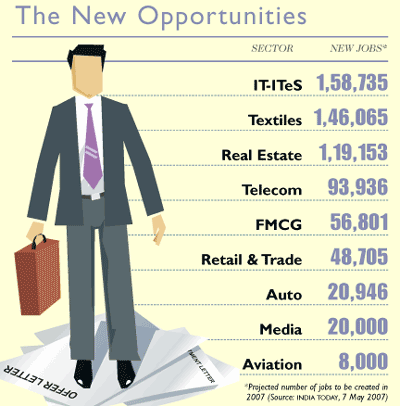
The rapid rise in the number of jobs across various industries and functions has inundated employees with more employment options than they can imagine. As the number of jobs across industries continue to grow unabated, it will become imperative for employees to take a long-term view of the market.
Because all new jobs created in a booming economy do not survive for long. Or even if they do, the job may not align with the job seeker’s career goals. Worse still, the economic boom itself won’t last forever. But your job will surely have to outlast one or more economy booms. So how can employees ensure that they stand to gain regardless of the boom and bust, the bullish or bearish turn that the economy takes?
 Change for the right reasons: Given today’s buoyant market conditions, employees have no trouble getting multiple job offers with enough leverage to trump over employers on issues regarding salary, designations and perks.
However, it becomes extremely important for employees to understand the fundamental reasons for change and its impact (both short term and long term) on the learning experience and expertise that they stand to potentially lose or gain.
Simply changing jobs because of an increase in salary can be rewarding in the short term, but extremely detrimental in the long term if other factors, such as belief in the job, quality of work, etc, are not understood and given importance to.
Says Harveen Singh Bedi, business head, Quadrangle: “Remember that each change in your job will have to be explained in detail to your next employer.” Your future employers will be impressed less with your salary level and more with the quality of experience and your sincerity to the job and previous organisations that your CV will reflect.
You can make a mistake once or even twice in choosing your employer but repeated mistakes (reflected in frequent job hops) are likely to brand you as a loser or someone who is not sure of what he wants.
“Frequent job-hopping could label you as a ‘floater’ and prospective employers would hire you only because they need someone urgently and may be apprehensive about handing out important responsibilities,” says Rahul Mulay, general manager-operations, Harbinger Group. So while considering a job change, don’t only consider the opportunities that exist, but also evaluate your exact need for seeking a change.
Hedge job loss in the event of an economic downturn: What goes up will come down. So when you go jobhopping make sure that you are adding to your skills that may come in handy when employment opportunities are not as plentiful as they are today.
Even if you are not changing jobs, enhance your skills so that you can bargain for new roles within the organisation. This kind of movement will add value to your career. Regardless of today’s profusion in job options, a slowdown is inevitable at some point. Therefore, while expertise in a particular industry and in a particular role can be extremely rewarding both financially and in terms of experience, it becomes important to cultivate skills that develop you as an all round employee with relevant skills, expertise and experience. You are lucky if you happen to work for a corporation that takes initiatives in running training programmes for its employees, not only to improve skills, but also attitude,
behaviour, leadership and emotional intelligence.
Take notice of your overall ‘fit’ in the organisation: The work can be good, the pay even better, but what happens when the people you work with are totally out of sync with your way of thinking and functioning? What happens if you don’t fit with the organisation’s culture? As part of a comprehensive approach towards seeking the perfect job, an organisation’s cultural and intangible assessment becomes imperative— all the more in a service dominated economy.
As companies grow their capabilities by increasing headcount and adding smarter and more creative individuals, it becomes important to create a culture that effectively harnesses the skills of each individual and amalgamates them into the brand or solution that the organisation sells.
An important first step towards this goal is in the selection process—for both the employee and employer. For this symbiotic relationship to truly unlock its intangible potential, the employer and employee should spend time considering the other’s goal, vision, requirement and experience.
Changing jobs is a function of both opportunity and need. Employees should think in terms of becoming long-term agents, responsible for creating wealth and sustainable value for themselves and the organisation. It is only a proactive employee who will rake in the maximum benefits—either in bagging better opportunities with his current employers or getting better offers from other organisations.
(The author is consultant, TMI India)













