Previous career: System analyst, Microvision Salary in previous job: $38,000 a year Age at career switch: 24 years Reason for quitting: Relocating to India Current career: Counselling students seeking admission abroad Present salary: Comfortable Transferable skills: Client management Career outlook: “Strive for work-life balance” |
Mrinalini Batra’s life in New Jersey was what most middle-class Indians strive for: a well-paying job as a computer engineer, doing her riyaaz and taking care of her newborn. But in 1994, her husband’s decision to pack their bags and return home to Delhi had her wondering about career options. “I was sure of one thing: I didn’t want to spend all my time at work even if it meant eschewing a fancy salary. My priority was bringing up my child,” she says. Seeing the evergrowing popularity of US as an education destination, her husband suggested she could market US university courses in India.
Studied approach
Batra always wanted to be an engineer. After graduating in electrical engineering from Delhi School of Engineering, she moved to Central Michigan University in 1988 to do a post-graduation in computer science. Her first job with Bellcore in 1990 involved research, while she wanted to work on project-based assignments. She moved to Microvision as software analyst in 1992. “Job satisfaction always took precedence over pay cheques,” she says.
At Microvision she honed her computer hardware skills as well as learnt a few software languages. She also began interacting with clients and solving their problems. Little did she know that these skills would help her make a success of her subsequent career. “Client management and trouble shooting were something I had no knowledge of. It was my first brush with marketing,” she says.
Planned move
Once the decision to move to Delhi had been taken, Batra sat down to chalk out her new career. Taking her husband’s suggestion, she created presentations to help sell the idea to various educational institutions. She spoke to at least 15 universities in the US. It was with Fairleigh Dickinson University in New Jersey that she finally hit pay dirt. The job involved organising seminars to showcase the university’s courses, processing applications and admissions. In 1994, the couple returned to India. Batra started work from family-owned premises.
Second career
Batra’s Tips For A Career Shift• Research the new career properly before making the shift• Think long term and beyond your career. What exactly are you seeking in life? • A new career means you start afresh. You’ll have to work hard • A career will materialise if you don’t lose focus |
She learnt the nitty-gritty of organising seminars and managing admission procedures. In 1997, she tied up with Study Group, a USbased company that helps students with admissions. Batra understood the basic difficulties most students encounter and would prepare them for it. Her training for handling visa interviews was also quite effective. “I used my experience to handle different situations,” she says.
Despite the success and the excitement of a new challenge, Batra realised her current profession was different from what she had imagined. “I felt I was not using my skills,” she says. With the business doing well, the question of shutting it did not arise. Moreover, being her own master meant that she was free to work flexi-hours and spend time with her family.
New chapter
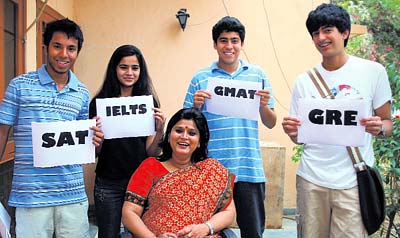
In 1998, a student asked Batra to help him with the essays he had written along with the applications. Batra spent time brainstorming with him on the right format. “Somehow I found this task quite interesting,” says Batra. Since students had been approaching her to help with visa queries and filling up application forms, she decided to start a service that would only focus on these aspect of admissions. By 1999, the tie-up with Fairleigh had ended, but requests from students seeking help in preparing for the Scholastic Aptitude Test (SAT), the Graduate Record Examination (GRE) and the Graduate Management Aptitude Test (GMAT) were coming in. She prepared course material for teaching maths and increasing one’s English vocabulary. “I loved doing all this and soon built a question bank,” she says.
Batra realised she quite enjoyed teaching and roped in her student counsellors to become faculty. Since Batra herself had gone through the whole process of exams, applying to different universities and visa procedures, she was equipped to handle student queries. Until 2003, she concentrated on helping students prepare for SAT. “By then I was confident of handling GRE and GMAT preparation programmes,” she says. Within a year, Batra could see a transformation in her work profile. “I was glad, I had made the right transition,” she says.
During the admission season, Batra manages around 40 students. She still takes classes and considers it gratifying when her students secure admission into good colleges. “I no longer market courses, I train students to get the best courses,” she says. Regrets? “Programming is out, but I have achieved so much. Giving direction to students is more satisfying,” she says.