
"Our schools and colleges churn out students with degrees, but don't give them enough capability to crack the entrance exams at home or abroad," says Akrita Kalra, founder, Jamboree, which helps students with admissions in overseas colleges.

Tapping the potential
If you consider the customer base, that is students, that can be tapped, the number is staggering. According to an HDFC Securities' institutional research report on opportunities in higher education, there were 20 million students in 17,000 colleges, in 2008. The gross enrolment rate for higher education is 6 per cent and is expected to double to 12 per cent in the next 10 years.
As the economy grows, the demand for skilled workers is going to be higher, which will translate to need for specialised education. The education system is still bogged down by red tape and it takes a lot of time to introduce new courses. This is where private institutions have muscled in. Currently, there are 700 private colleges and 10 private universities in the country. Some of these colleges and courses are not recognised by the government, but this has not deterred the students from enrolling. All they require for the institutes is to provide marketable skills and fulfill their promise of placements. Now, even a tier III city has call centre training classes, English tutoring institutes, air hostess training centres, animation studios and short-term radio jockey courses, among others.
Moulding young minds
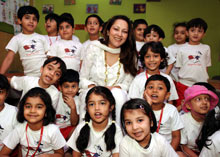
The most dramatic change can be seen in the mushrooming of preschools. Lina Ashar, chairperson, Kangaroo Kids, was among the first to spot the opportunity. In 1993, armed with a bachelor's degree in education and teaching experience from Australia, Ashar started a preschool at Bandra, Mumbai, with 25 kids. "The only reason people sent their children to pre-schools was to ensure they could get admissions in renowned schools," she says.
Ashar decided to change the mindset—do away with rote learning and concentrate on confidencebuilding exercises. She borrowed Rs 30 lakh from her father to buy a 600-sq-ft space. "The initial days were tough, especially while trying to understand Indian laws and dealing with the red tape," she says. "It also took about a year for the word to spread as I had no money to advertise."
Her strategy paid off as she opened a second branch at Juhu and then went on to set up shop in Hyderabad, Chennai and Bengaluru. Ashar then branched out to regular schools by opening the Billabong High International Schools, which cater to students from classes I to XII. Her latest venture is a chain of day-care centres called Brainworks, which also have hobby classes for older children. In 17 years, her initiative has grown to include more than 80 schools. "To be a true entrepreneur, you need to find your calling. Your destiny is guided by your will power. If you think you can, you will be able to," says Ashar.
Virtual tutors 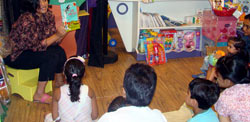 Rabani Garg
Supplemental education is another area where edupreneurs are making their mark. We are slowly moving away from the local masterji to long-distance online tutors. Learning Hour, the brainchild of Riju Gupta, Mohit Bansal and Chandan Agarwal is one such venture. After passing out from IIM, Ahmedabad, in 2003, the batchmates got lucrative jobs, but were more interested in starting their own business. After refining the idea of online tutoring for nearly a year, they launched Learning Hour in March 2006. They then began looking for a suitable market. The US already had a lot of players and India wasn't a viable option as the Internet penetration was low. So they focused on the UAE. To promote the venture they held road shows and advertised aggressively.
The initial response was slow. "Most parents weren't sure that their children would study without the physical presence of the tutor, so it took time to convince them," says Agarwal. To ensure that their start-up was a success, the trio concentrated on the most important aspect of a business—customer satisfaction.
"We periodically called up the students to get feedback, recorded sessions and conducted sample checks," says Agarwal. After a year, the venture was acquired by Educomp Solutions. "It was a good move for us as it gave us access to Educomp's customer base and helped us pump in money to take the venture further," says Agarwal. Learning Hour now has 400-500 part-time tutors, who teach about 8,000 students a month. The next step is to launch a test preparation centre by April 2010.
Kalra began her entrepreneurial journey when she was in class VIII. She began giving tuitions to the neighbourhood kids so that she could earn pocket money. In 1989, Kalra cracked the SAT exam and got admission in Brown University, USA, but did not join due to financial constraints. Three years later, after getting her bachelor's degree in commerce, she cleared the entrance exam for XLRI, Jamshedpur. "I realised then that I wasn't interested in a 9-to-5 job, but couldn't figure out exactly what I wanted to do," says Kalra. So she decided to continue tutoring, this time with two students who wanted her to help them get through GMAT, the entrance exam for management colleges abroad. "I taught them in the garage of my house and used the family's dining table. My only investment was Rs 800, which I spent on buying a blackboard," she says.
"The biggest obstacle was my age. I was just 20 years old, so people were sceptical of whether I could help others achieve their goals," she adds. So she offered two free lectures as a demo. Jamboree is now a Rs 10 crore plus company, has 12 centres and provides coaching to 15,000 students a year.
Off-beat choices
Teaching is not the only option in this field. You could take the lesstrodden path, as was done by Delhibased Rabani Garg. She wanted to transfer her love for books to her daughters and came across other parents who had similar aspirations. This prompted her to start Reading Caterpillar, a children's library, in April 2008. Operating from her home, she began a story hour for children aged between two and eight years to get them interested. This led her to expand her venture to a book reading club.
"I want children to appreciate books and expand their creative horizons," says Garg. The fee for library ranges from Rs 1,500 to Rs 3,000, depending on the period of membership. Now, Garg also organises music sessions, weaving classes, art classes and origami workshops. As the library grew to 700 books, Garg shifted the premises to Nizamuddin and is set to start another branch in April this year.
Like any other venture, education start-ups also require a lot of hard work. "I have taken classes for nine hours, researched till 4 in the morning, and then woken up at 8 a.m. to take classes at 10 a.m. It has been hectic," says Kalra. It is this perseverance that ensures excellence in education, be it as a student or as an entrepreneur.













