
Most people leave their jobs due to poor pay or dissatisfaction with their work profile. But 46-year-old Arun Grover had no such complaints.
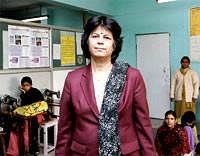 |
| MA in Political Science |
| Previous career: Deputy general manager, Small Industries Development Bank of India (Sidbi) |
| Job profile: In-charge of a branch |
| Salary in previous job: Rs 50,000 a month |
| Age at career switch: 46 years |
| Reason for quitting: Routine transfers |
| Current career: Social work |
| Job profile: Responsible for Jan Shiksha Seva Sansthan project |
| Present salary: Rs 20,000 a month |
| Transferable skills: Administrative and management skills |
| Career outlook: "Be diligent in whichever field you work" |
As deputy general manager with Small Industries Development Bank of India (Sidbi), she was enjoying both — a handsome pay cheque of Rs 50,000 a month and very challenging work as officer - incharge of the Faridabad bank branch. Throw in job security typical to public sector organisations and it was a position worth clinging on to.
But Grover quit. At the peak of her career that charted a stupendous rise from a clerk to the managerial level, she gave it all up. No, there wasn't any plan B or a world tour that motivated her. It was a decision triggered by the difficulty in balancing her professional and personal life due to routine transfers integral to her job profile.
Three years later, Grover has no regrets. As director of Jan Shiksha Seva Sansthan, a mass-education programme funded by the Ministry of Human Resources and Development, she is extremely content with her second job. What she does regret is not making the move earlier.
Giving up such an established career had to be difficult. Especially when Grover had painstakingly climbed her way up the hierarchical ladder. Starting as a clerk with the Industrial Development Bank of India (IDBI) in 1981, her monthly salary was only Rs 960. Marriage followed soon after and Grover was convinced that her life would be moving along conventional lines.
"I had absolutely no career plan in the six years that it took me to reach the grade A officer level," she admits. What changed her outlook? "I was transferred to Kanpur," she answers. The jolt of leaving a comfortable set up in Delhi forced her to think about a career strategy. "My promotions till then were routine. From then on, I realised that only merit would count," she says.
When Sidbi was formed in 1990, IDBI employees were given an option to move to the start-up bank. They were allowed to return after a nine-month stint. Determined to prove her worth, Grover saw opportunity where most saw risk. And she took the plunge. While her colleagues preferred to return to the comforts of their secure job at IDBI, she decided to stay on with Sidbi.
So taking tough decisions isn't new to Grover. "I was charged up with the prospect of proving myself," she recalls. It was the same intensity of motivation — though for a different reason — that pushed her to the risky decision of quitting in 2004. But it was a calculated risk — taken after as much deliberation as at the time of choosing Sidbi over IDBI.
In 1995, Grover had been transferred to the bank's new Faridabad branch. The administrative work profile suited her and she excelled at it. In 1999, she was promoted to the post of deputy general manger. Her experience with handling the branch's business kept her in Faridabad till 2004 with a one-year interlude in 2000.
| GROVER'S TIPS FOR CAREER GROWTH |
| Scout for career growth opportunities within the organisation |
| Take initiative in work. It will help you expand your skill set |
| Career change is risky. Do a comprehensive recce of the job profile before taking it up full time |
But Grover knew that the stability was short-lived. A transfer couldn't be postponed forever. At that time, Sidbi introduced the voluntary retirement scheme for it's employees.
The retirement package was good. Plus, her husband had a secure job with the railways and earned enough to sustain the family's expenses for sometime. Grover decided that there couldn't be a better time to quit.
While leaving her job was a planned move, the second career was anything but. And no job offers miraculously came her way. Instead, for one year she pursued yoga and taught poor children. She also enrolled for an MBA in IMT Ghaziabad. A clear indication that doing something new was always on her mind. In preparation, she invested time in improving her credentials.
It was after one laid-back year that Grover came across an advertisement by Prayas for the position of director of Jan Shiksha Seva Sansthan in 2005. She applied and was selected.
The second beginning was as conventional as the first one. But Grover wants to do things differently. She now organises vocational training for 200 boys at a shelter in Delhi. "The challenge is to add value to existing courses and introduce new, more marketable ones," she says.
Grover is putting the administrative skills learnt in her first job to good use. She has worked out tie-ups with various institutions that have promised jobs for these children. There is a lot of scope, both of earning and learning more.
Obviously, Grover is excited. She has demonstrated that career streams have widened tremendously. A good career needn't only be medicine or engineering. And it certainly needn't start when you are 25.













