














India’s financial inclusion story is rightly celebrated as one of the country’s greatest policy successes. Over the past decade, hundreds of millions of Indians have entered the formal financial system through Jan Dhan accounts, Aadhaar-enabled services, UPI payments, direct benefit transfers, and expanding access to insurance and pension products. By most conventional measures, financial inclusion has moved from aspiration to reality.
Yet an important question remains: has financial inclusion translated into preparedness?
The recently launched Financial Maturity Index (FMI), developed by the JM Financial Centre for Financial Research at IIM Udaipur in collaboration with PRICE, suggests the answer is partly affirmative. Based on a primary survey of nearly 10,000 households across Gujarat and Rajasthan, the study finds that while access to finance has expanded dramatically, long-term financial planning, retirement preparedness, and household financial resilience remain surprisingly weak.
This distinction matters because India is entering a new phase of economic development. The challenge is no longer bringing households into the system; it is ensuring they can use that system to build long-term financial security. Nowhere is this gap more visible than in retirement planning.
Not thinking about Old age
The FMI survey finds that only 14% of respondents think “a lot” about retirement. Particularly worrying is the limited retirement orientation among younger Indians. Among respondents aged 18–25 years, only 15.4% reported thinking seriously about retirement, rising to 30.4% among those aged 26–35 years.
This is not trivial. Retirement preparedness is fundamentally cumulative; delayed planning significantly reduces households ’ ability to accumulate adequate retirement savings. In a country that will age rapidly over the coming decades, weak retirement planning among younger cohorts should concern policymakers.
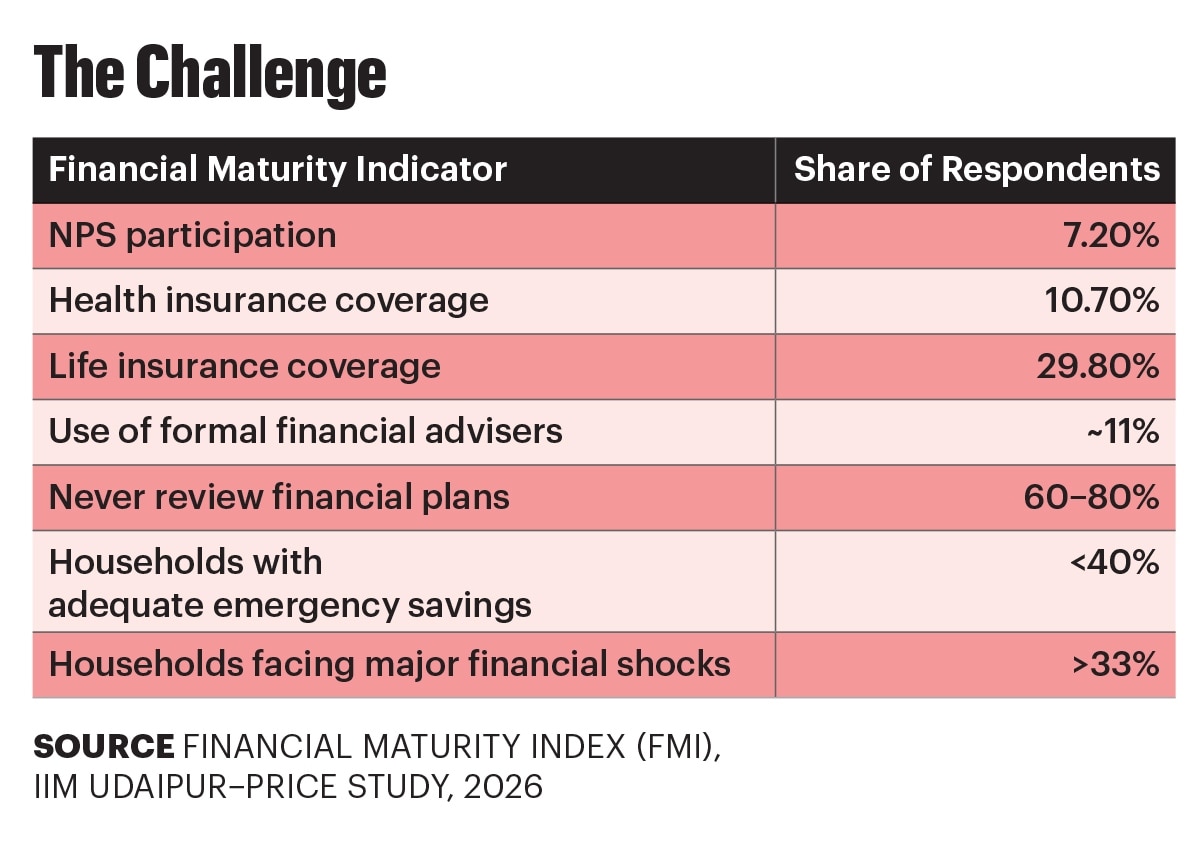
The challenge becomes even clearer when pension participation is examined. Despite years of efforts to expand retirement savings through the National Pension System (NPS) and Atal Pension Yojana (APY), participation remains remarkably limited. According to the FMI survey, only 7.2% of respondents reported investing in NPS. More strikingly, nearly three-fourths had never heard of NPS, while another 18% had heard about it but had not invested. The evidence suggests that India’s pension challenge extends beyond awareness and into financial behaviour itself.
One of the most important findings of the FMI is that pension participation is closely linked to broader measures of financial maturity.
Households that think seriously about retirement save more, invest more, maintain higher insurance coverage and participate more actively in NPS. Conversely, households with weak planning orientation perform poorly across multiple dimensions of financial preparedness.
The broader evidence points in the same direction. Health insurance coverage remains low, professional financial advice is rarely used, many households do not review their financial plans, fewer than 40% have adequate emergency savings, and more than one-third have experienced a major financial shock. Taken together, these findings suggest a broader conclusion: India’s pension challenge is actually a financial maturity challenge.
The behaviour of A saving nation
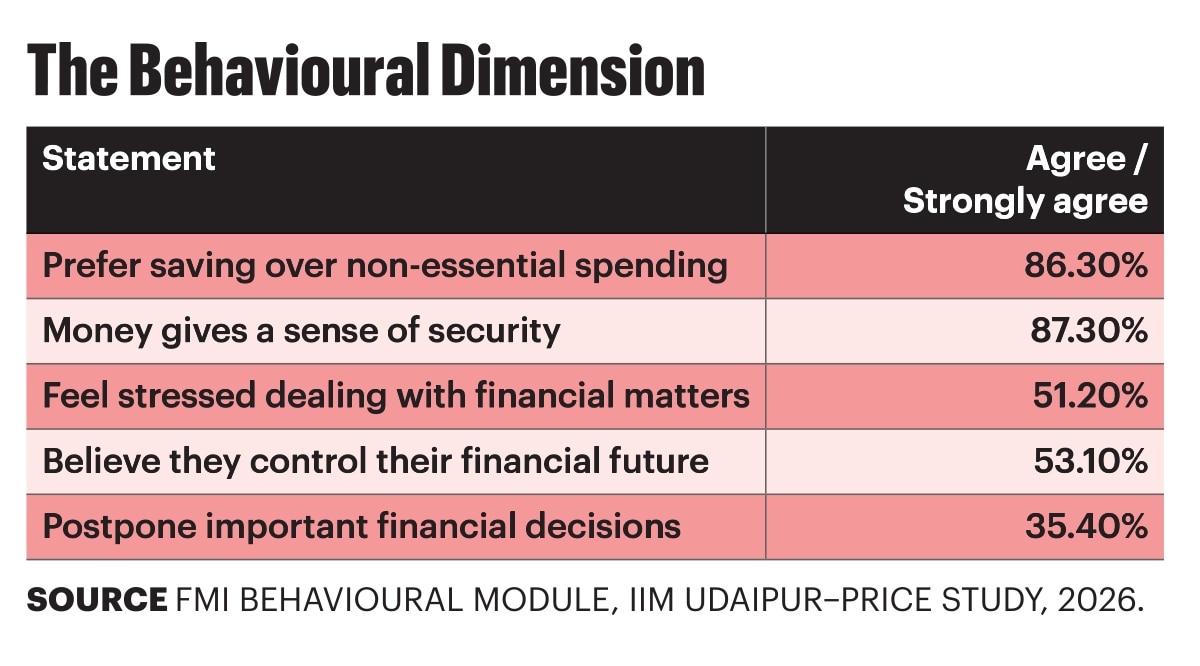
To understand why preparedness lags inclusion, the FMI examined household financial behaviour. The findings reveal an important paradox. Indians overwhelmingly see themselves as savers—86.3% prefer saving over non-essential spending and 87.3% say money gives them a sense of security. Yet many remain financially fragile. 35% reported a major financial emergency during the past five years, while only 38.6% have emergency savings sufficient to cover at least three months of expenses. When shocks occur, households continue to rely heavily on family and friends rather than formal financial buffers or insurance.
The FMI assessed five behavioural dimensions—saving preference, financial stress, procrastination, perceived financial control, and money as psychological security. Together they portray a population that values saving but struggles to convert that instinct into long-term financial preparedness.
The security paradox
Perhaps the most striking finding is what may be called the security paradox. Indians overwhelmingly associate money with safety, yet this preference often encourages households to remain in familiar, liquid savings instruments while delaying long-term retirement planning. The result is precisely the pattern observed throughout the FMI: low pension participation, limited insurance coverage and insufficient long-term financial preparedness.
Stress, procrastination, limits of intention
If conservatism explains what households want, stress and procrastination explain why they often fall short. More than half (51.2%) of respondents report feeling stressed while dealing with financial matters, while 35.4% admit postponing important financial decisions. Financial stress narrows decision-making, encourages short-term coping and delays insurance purchases, retirement planning and emergency savings. Good intentions therefore do not automatically translate into sound financial behaviour.
A modest sense Of control
Underlying these behavioural patterns is a fragile sense of financial agency. Only 53.1% of respondents believe they have control over their financial future. Confidence is considerably lower among rural and lower-income households, suggesting that financial capability depends not only on economic resources but also on the confidence to navigate an increasingly complex financial system. Those with the greatest need for long-term financial security often feel least capable of achieving it.
Access to capability
These behavioural findings reinforce the central message of the FMI. India’s next phase of financial development cannot rely on access alone. The challenge is to build financial capability.
Three priorities follow. First, policymakers should distinguish between households that save because they are financially disciplined and those that save because they feel economically vulnerable. Second, behavioural barriers such as stress, procrastination and complexity should be addressed through simpler financial products, automated savings, default pension enrolment and clearer disclosures. Third, strengthening consumer protection and financial capability can improve households’ confidence in formal financial institutions and encourage greater adoption of long-term savings products.
Financial literacy remains necessary, but it is unlikely to be sufficient on its own. The challenge is not simply helping people understand financial products; it is enabling them to convert knowledge into sustained financial action.
The next frontier
The broader lesson is that India now needs a framework for measuring financial maturity with the same seriousness that it measures financial inclusion. Rather than remaining a one-time study, the Financial Maturity Index (FMI) could evolve into a recurring national framework.
India already measures inflation, employment, health and financial inclusion with considerable
Sophistication. What it lacks is a systematic way of assessing whether households are becoming financially capable and retirement-ready. Such a framework would help policymakers move beyond counting bank accounts and pension registrations towards understanding whether households are actually building long-term financial security.
The next frontier of India’s financial development is therefore not inclusion—the country has largely built that infrastructure. The next frontier is financial maturity.
The Financial Maturity Index provides a practical way forward. Built on a multidimensional framework spanning ten dimensions of financial well-being, it generates a single Financial Maturity Score that measures not just financial access but financial capability. Scaling the FMI into a nationally representative framework would provide India’s first benchmark of financial maturity, enabling better policy, sharper targeting and stronger household financial security.
Views are personal


