













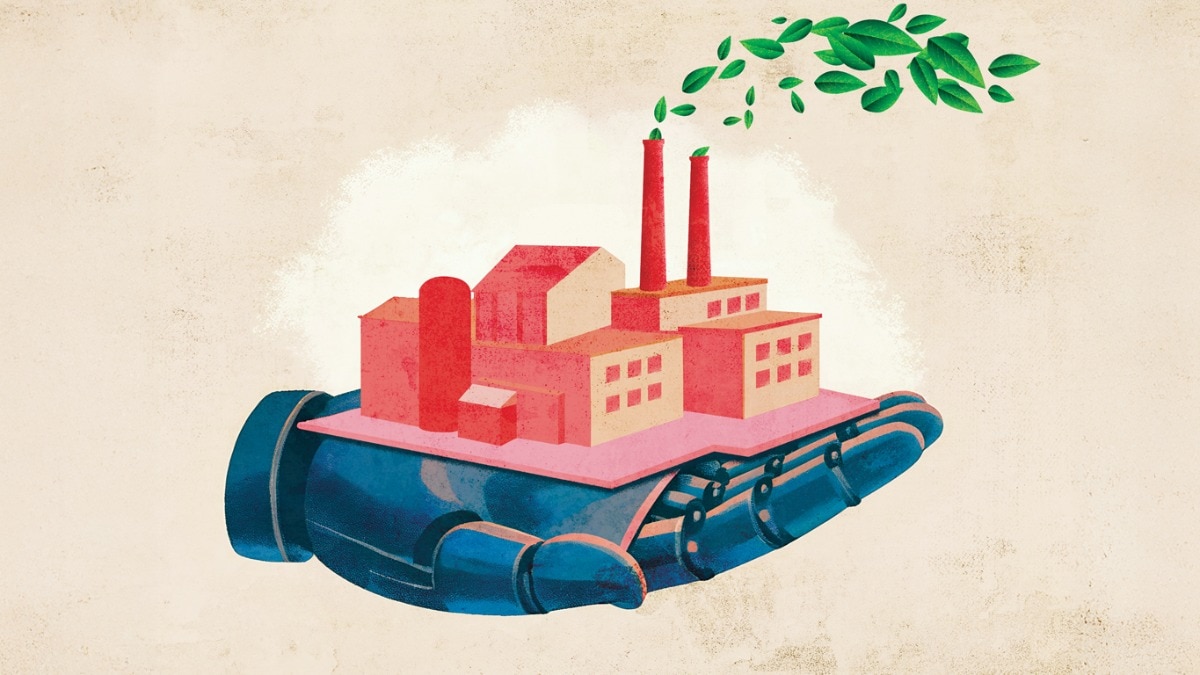
Sustainability in india can no longer be treated as a cyclical discussion tied to annual reports and regulatory deadlines. Sustainability must become a continuous, intelligence-driven discipline.
For India, where economic advancement intersects with urgent decarbonisation imperatives, this evolution is increasingly enabled by one transformative force: technology.
India is emerging as a crucible of tech-enabled sustainability. From real-time emissions monitoring to AI-driven resource analytics, technology is shifting the sustainability agenda.
Technology is enabling a shift. Remote sensing, IoT sensors, and AI analytics now power real-time Monitoring, Reporting, and Verification (MRV) systems, flagging emissions, water, and air quality anomalies for timely response. Yet fewer than 10% of industrial units operate continuous monitoring. The imperative is clear—scaling these systems isn’t just a technical upgrade, it’s a national resilience strategy.
From Observation to Prediction
One of the most valuable contributions of technology to sustainability is its capacity to unify granular operational data with planetary-scale environmental intelligence.
At the micro level, digital infrastructure enables organisations and farmers to optimise electricity, water, and materials in real time. The results are evident.
At the macro level, satellite imagery, earth observation systems, and advanced climate models offer a panoramic view of ecological change, whether deforestation, glacial retreat, or urban heat stress.
India’s transition from reactive climate responses to proactive mitigation hinges on how intelligently we integrate technology across sectors.
Rise of Climate Tech
India’s climate technology growth is supported by structural enablers and a receptive policy environment. Additionally, India is implementing a digital-first carbon market framework designed to include SMEs, which promotes accountability through technology-enabled MRV. With projections of over two million green jobs by 2030 across the circular economy, India’s climate tech surge is not just ecological but economic.
Digital platforms are also unlocking cross-sector collaboration, benchmarking, and decentralised innovation—reducing silos. Despite its transformative potential, integrating technology into sustainability efforts is not frictionless. On-the-ground deployment reveals interlocking challenges that must be addressed.
First, there exists a structural arbitrage between non-compliance and proactive investment. For many businesses, particularly in emissions-intensive sectors, the cost of inaction is often perceived as lower than the capital expenditure required for advanced sustainability technologies. This creates a lag in adoption.
Second, implementing technology often necessitates a foundational shift in organisational systems and culture. Realising the benefits of data-driven sustainability requires behavioural change, new decision-making protocols, and cross-functional buy-in.
Third, the sector faces a persistent viability gap in financing. Finally, the efficiency of digital tools in field conditions can be inconsistent.
These challenges highlight the need for robust climate governance frameworks.
The Road Ahead
India’s momentum is encouraging, but to scale climate tech from pilot to platform, three enablers must align:
A. Policy-Tech Convergence
Sustainability regulation must evolve from periodic compliance to continuous intelligence. Integrating real-time MRV systems, AI-based scenario modelling, and digital disclosures into corporate governance frameworks is essential.
B. Shared Climate Infra
India needs a unified, interoperable climate data stack. This infrastructure must consolidate public and private environmental dataset.
C. Last-Mile Enablement
Technological capacity must extend to the grassroots. Local governments, urban municipalities, and village panchayats must be empowered with the tools, training, and resources to act on environmental data.
India’s climate challenge is immense. But so too is its capacity for innovation. We are witnessing not just a surge in cleantech entrepreneurship, but the emergence of a new national operating system—one where sustainability is embedded in infrastructure, powered by data, and driven by inclusion.
India doesn’t just need climate solutions—it needs climate systems. By harnessing technology to institutionalise sustainability, the country can move from ambition to execution, from episodic action to systemic transformation.
If India can lead this transition with speed, scale, and intelligence, it will not only adapt to the global climate transition—it will define its contours.
Views are personal


