













As we turn into the year 2025, we will be approaching the mid-point of the decade, and it is time to take a broader view of the world. The events of the first half of the decade were dominated by the Covid-19 pandemic and the economic and political aftermath. It also witnessed several important shifts in the technological and geopolitical spaces, many of which were in the making in the previous decades but came to fruition in recent years: The rise of China as a full-fledged global power and the spread of higher-order digital technologies such as artificial intelligence (AI).
Some changes since the beginning of this decade have been so all-encompassing that many of us forget how recently they took place. The use of Zoom and similar video-conferencing platforms is now ubiquitous, but it was only during the Covid lockdown in 2020 that most people became fully comfortable with the daily use of videoconferencing. Similarly, in India at least, we witnessed a dramatic shift to digital payments. Many younger readers of this column will probably have little use for cash other than the token “emergency money” in their wallet.
So, what could we see in the second half of the decade? As they say, forecasting is difficult, especially when it comes to the future. At the risk of being mocked five years hence, here are some likely scenarios for 2030:
First, China will have bypassed the US by 2030 to become the world’s largest economy in nominal dollar terms (it is already the largest in purchasing power parity terms). India will be a distant third but still the fastest-growing major economy. However, despite the loss of economic preeminence, the US dollar will remain the world’s anchor currency. Anchor currencies often outlive the dominance of their home country-Roman, Spanish, and British money continued to enjoy widespread usage decades after their empire had been superseded by others. The British pound, for instance, remained the world’s most important reserve currency into the 1950s even though the British economy had lost its dominance by the time of the First World War.
Second, having reached the number one spot, China will be struggling to maintain domestic growth by 2030. The demographic decline of China will be taking a larger bite by this point. Any attempt to reverse it, even if successful, would only pull out childbearing-age women from an already shrinking workforce.
Meanwhile, Chinese policymakers will discover the limits of mercantilism. A dominant, export-driven economy cannot keep growing faster than the overall world economy even if there were no barriers put up by trading partners. My guess, and it is only a guess, is that the Chinese will end up dumping capital on the global financial system in an attempt to shore up demand for its overproduction and to give itself financial leverage abroad. A current account surplus having to be balanced by sustained capital outflow. The problem is that a currency cannot become a global anchor currency unless it derives from a systematic current account deficit—the large US dollar-denominated reserves of various countries (including China and India) were made possible by the US running twin deficits on fiscal and current accounts. After all, a currency is the liability of the issuing central bank, and a world currency comes into widespread use precisely because the issuing country is willing to run a deficit.
In theory, the Chinese Yuan (CNY) can be supplied to the world through capital flows, but supplying large quantities of CNY to the world purely through capital flows would require a willingness of the Chinese authorities to overlook frequent defaults by recipients (they have already faced this). In the end, the Chinese would have to consider a very different policy strategy if they wish to sustain growth past 2030.
Third, a messy network of alternative supply chains will have emerged by 2030 to take on Chinese dominance in many sectors. This is unlikely to be a neat Cold War-type parallel system but one where a combination of national strategies, trade pacts, geopolitical alliances, and specialised clusters will compete with a more Chinese-dominated one.
Nevertheless, both systems will be interacting with each other in an arena of shifting dynamics. Indeed, Chinese capital may well end up financing the alternative systems. This financing of rivals is not as unusual as it may seem at first sight—it was nineteenth-century British capital that financed German and American industrialisation, while Japanese and American capital financed the industrialisation of China from the late 20th century. India will have to figure out how to insert itself into this messy world and take advantage of the opportunities. This would include devising a framework for absorbing Chinese capital without compromising national security concerns.
Fourth, a combination of domestic policy reforms, late-stage mercantilism, and geopolitical alliances may allow the US to recapture its industrial dynamism in at least a few areas by 2030. For all its many flaws, American society still retains a level of flexibility that is rare in developed countries (contrast with Japan or Europe). However, this partial revival will only be made possible through economic trade-offs that are inherent to all forms of industrial policy. Let us say the Trump administration is successful in reigniting certain manufacturing sectors and making the US globally competitive in those products. This would suck in resources and workers from other areas at the same time that immigration is also being squeezed. In other words, a return of US industrial dynamism in some areas would only be possible if other things are sacrificed or outsourced. India is a potential beneficiary of such outsourcing or friend-shoring.
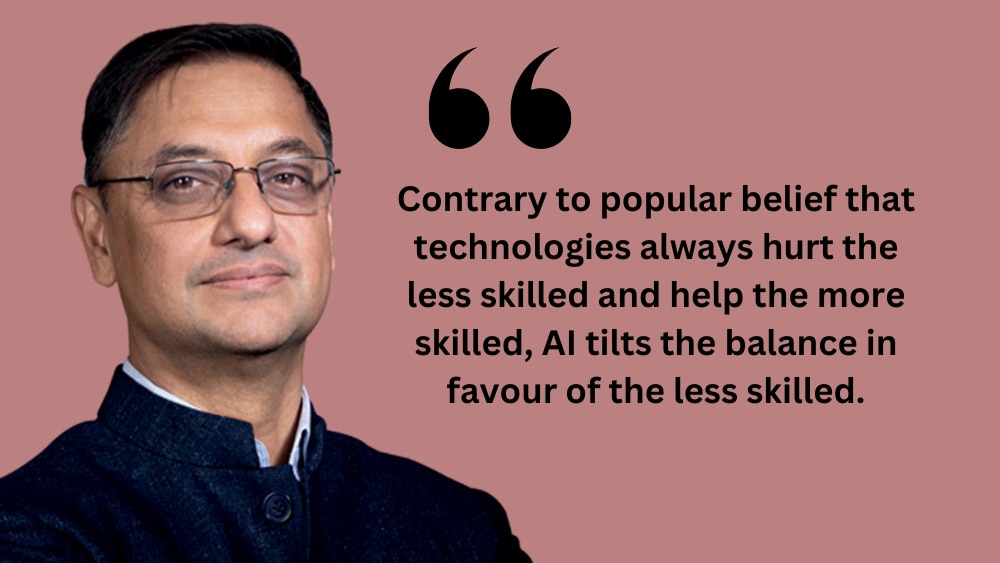
Fifth, by 2030, the socioeconomic impact of AI will be visible in many fields. This is not necessarily a thing to be feared if adopted and absorbed wisely. Contrary to popular belief that technologies always hurt the less skilled and help the more skilled, AI actually tilts the balance in favour of the less skilled. A person of modest education can now do things that earlier required specialised knowledge, such as drawing up a contract or making a presentation. Indeed, the ease of translation would make the flow of information radically smoother in a country like India. Whip out the phone, point it at some text, and listen to the translation in your language of choice. If the meaning is still unclear, ask the system to explain it in plain terms. Imagine the ease that an average Indian would suddenly enjoy, especially when it comes to understanding government rules and regulations, doing taxes, and so on.
Finally, the battle for global narratives and markets will have moved from media or even social media to the control of data that drives the default responses of popular AI applications. The importance of data is increasingly understood, but by 2030, there will be many competing information sets. In turn, this will mean that attention will have to be paid to the gateways that give “credibility” and “legitimacy” to the information being used by these models. These gateways range from international agencies, national governments, reputed consultancies, chartered accountants, academic institutions, and so on. Global power will be exercised by those who have the authority to generate and certify different kinds of data, standards, norms, and so on. So far, this power still rests in the North Atlantic. By controlling its internal information systems, China protects itself from the exercise of this external power but sacrifices its ability to certify the rest of the world. In contrast, India participates in the global certification game but on the terms created by the North Atlantic. As its economy grows, India should seek greater clout in the global certification arena.
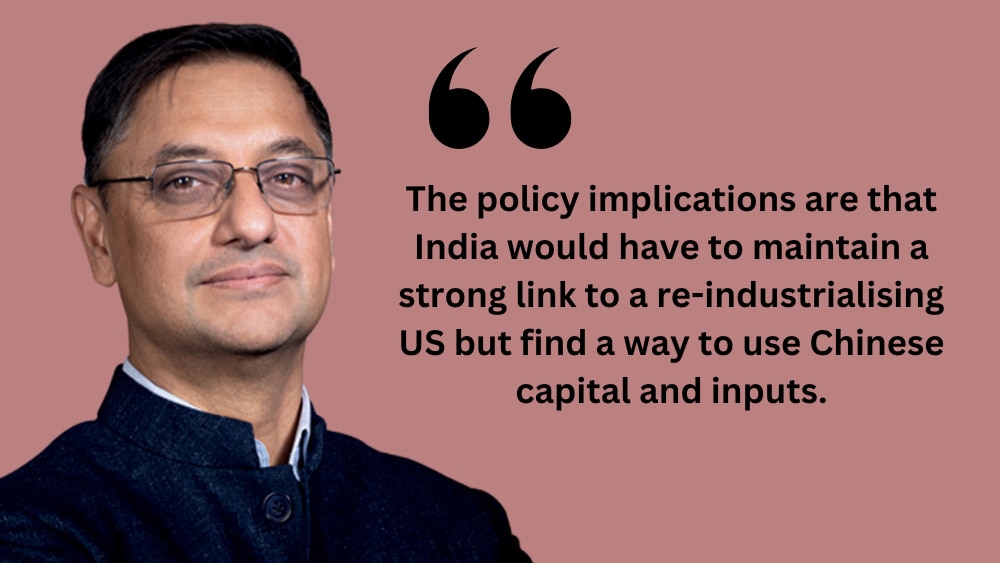
The above scenarios are no more than a guess based on current information. A complex world can flow down many unpredictable paths by 2030. Nonetheless, the policy implications over a large range of possibilities are that India would have to navigate between seemingly contrary pulls and pressures: maintain a strong link to a re-industrialising US but find a way to use Chinese capital and inputs to upgrade economic capability; introduce its low-skill workers to the latest tools in AI; and rather than "protect" itself like China in the global certification game, India should aim to be a major player.
Views are personal. The author is Sanjeev Sanyal - Member, Economic Advisory Council to the Prime Minister.


