It’s the latter half of September 2008 and the snowball that is the global credit crisis is rapidly beginning to gain in size and weight. Investment bank Lehman Brothers has filed for bankruptcy, Merrill Lynch has been bought out by Bank of America, insurance giant American International Group (AIG) is teetering and Wall Street is set to undergo a radical makeover.
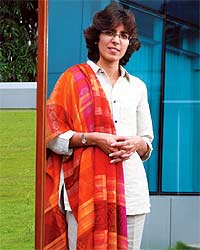
Back home, at the Pune headquarters of engineering giant Thermax, Chairperson Meher Pudumjee, 42, is just back from a CII meeting (she is a member of CII Young Indians). She wastes no time in hurriedly convening a meeting of the top management on the fifth floor of Thermax House. The top team is a bit suprised. After all, that’s not quite the style of the western classical songstress, who makes it a point to join her choir group every Tuesday—she’s rarely rushed, and isn’t prone to panic.
Yet, when Meher called for that meeting, the Non-executive Head of the Rs 3,300-crore energy and environment solutions major was, perhaps, responding with a swiftness few head honchos thought was required at that stage. For Meher, to whom the baton was passed on by her illustrious mother Anu Aga—before her, Meher’s late father Rohinton Aga was at the helm, and before him her grandfather A.S. Bhathena—the advent of the turmoil in the global credit market was easily her biggest test ever since she took over at the helm in October 2004. She responded in style—and in time. “We saw it (the economic slowdown) coming early as certain orders got cancelled,” says Meher.
MEHER’S FIVE Ss |
|---|
| The Service To capture the outsourcing opportunity in the lifecycle of equipment Thermax sells to various industries. The highmargin services arm would act as a profit centre. |
| The Synergy Thermax has a strong base of 20,000 boilers installed in the last 30-35 years for various industries. The company now wants to build high-end capabilities to service the existing as well as new equipment on an ongoing basis. |
| The Strategy Thermax recently added a service arm to each of its five business verticals. The idea is to find out and capture all the service possibilities in the lifecycle of any particular equipment. |
| The Skills The company plans to use the power of telecommunication - the mobile and the Internet - to monitor power plants online and act proactively to save a client’s time and money. |
| The Scale Services today contribute about 7% to total revenues. The target is to reach at least 15% by 2012. |
Now engineering and capital goods is a sector whose fortunes ride squarely on the health of the economy—it’s a sector that tends to get hit the hardest during a slowdown (and is one of the last to turn around when a recovery begins). That the manufacturer of industrial boilers and heaters and of equipment that caters to industries ranging from cement and power to refineries and pharmaceuticals was able to hold its own in the last fiscal (although the top and bottom lines barely grew) was thanks largely to its ability to aniticipate softer demand conditions.
To counter the crisis, Meher was quick to kick-start a project called “Ever-Lean” to conserve cash and improve operational efficiencies when the slowdown hit corporate India. At the same time, she decided to accelerate the pace of the company’s strategy to expand the services basket. This is being done to mitigate the risk in the capital goods segment— a bread and butter for Thermax, which accounted for 93 per cent of revenues last fiscal.
The energy piece, which accounts for 77 per cent of the revenue pie (sector-wise), fell by 4 per cent in 2008-09. “There is a cyclical risk in our capital goods business. We plan to enhance our services offerings to smoothen this risk,” says Meher, whose company today designs, manufactures and markets heating, cooling, power, water & waste management and air pollution control products.
As of today, services contributes about 7 per cent to total revenues, but there hasn’t been a dedicated focus to tap the various opportunities in the lifecycle costs incurred by the customers. Meher gives a number to highlight the potential that’s waiting to be tapped. “We have about 20,000 boilers installed in the last 30-35 years,” says Meher. Apart from supplying spare parts, the company never thought of the outsourcing opportunity as a full-fledged service business. “We are now looking at this business segment as a sustainable business proposition,” she adds.
Thermax hopes to address customers with innovative approaches in services like energy rentals, process efficiency tracking at boiler sites, equipment life extensions, and operation & maintenance of power plants; it is also exploring other service revenue opportunities. The internal target is for services to contribute 15 per cent by 2012. Says Misal Singh, an equity analyst who tracks capital goods at Edelweiss Capital: “While the services business can grow at a high rate, it is unlikely to contribute anything beyond 15-20 per cent of the sales over the long term.”
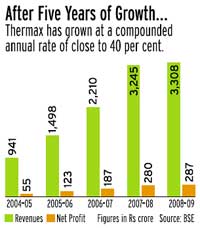
The economic slowdown may be Meher’s toughest challenge yet, but that doesn’t mean she’s a stranger to tough times. After joining the company as a trainee way back in 1990, Meher and her husband Pheroz Pudumjee took on the responsibility of managing a loss-making UK subsidiary. They turned it around in four years. In 2002, after being elevated to Vice Chairman, Meher was at the forefront of a restructuring of the portfolio, an exercise that included divesting some non-core businesses like software, electronics and surface coatings. That’s played a big role in helping the company grow at a compounded rate of 40 per cent annually over the past five years—from Rs 941 crore to Rs 3,300 crore last fiscal. “I took over at a time when the economy was in upswing,” says a modest Meher.
To be sure, Meher’s mettle will be truly tested as Thermax battles the slowdown. She has a target of a billion dollars in revenues, and jokes that when Thermax will get there “depends a lot on where the dollar stabilises”. More than numbers, however, Meher’s vision has a lot to do with building a sustainable business model for the longer term. “We are looking to see how we can build clean coal technology and a green portfolio,” says the chemical engineer from Imperial College of Science & Technology, London. The 43-year-old company has made a start by making the headquarters all green. The bricks of the five-storied building are made out of fly ash, a polluting by-product from the power industry, and all the water is recycled for gardening. And the hot water in the bathrooms comes from solar power.
The years ahead will see Thermax busy “greening” its energy portfolio, which currently uses “dirty” fuel, as most of it is thermal power business is coal-based. Meher says coal will remain the biggest fuel globally as it’s cheaper, but “balancing the green with the (dirty) fuels is something we are really thinking hard about”. Adds M.S. Unnikrishnan, MD & CEO, Thermax: “Our longer term thrust is on making existing darker technologies greener and also creating a fresh green portfolio.” Hopefully, as Thermax makes the shift towards a cleaner energy portfolio, it’s balance sheet will also take on that spick and span hue.