













There is nothing remarkable about raita. A staple across homes in North India, it goes by other names in different parts of the country. The base is curd, with some raw vegetables thrown in, seasoned with mint and coriander. Making it takes a few minutes, but when you are up against a fast-paced urban life, convenience is most important.
The management at Mother Dairy Fruit & Vegetable saw an opportunity to launch a ready-to-eat version of this humble dish. The R&D team and the innovation centre swung into action. The company launched bhuna jeera raita this summer after a year-and-a-half of intense work.
The story of custard is similar, to the extent that an upper-middle-class customer base had a latent need for the product. This time, too, Mother Dairy made the move, and came out with a tetra pak. That was three years ago. The product has held out well. “It is important to get it right on taste and deliver on the wow factor each time. Obviously, that’s not easy,” says Jayatheertha Chary, Managing Director, Mother Dairy. For dairy companies, such innovations go beyond changing eating habits to reshaping where profits come from.
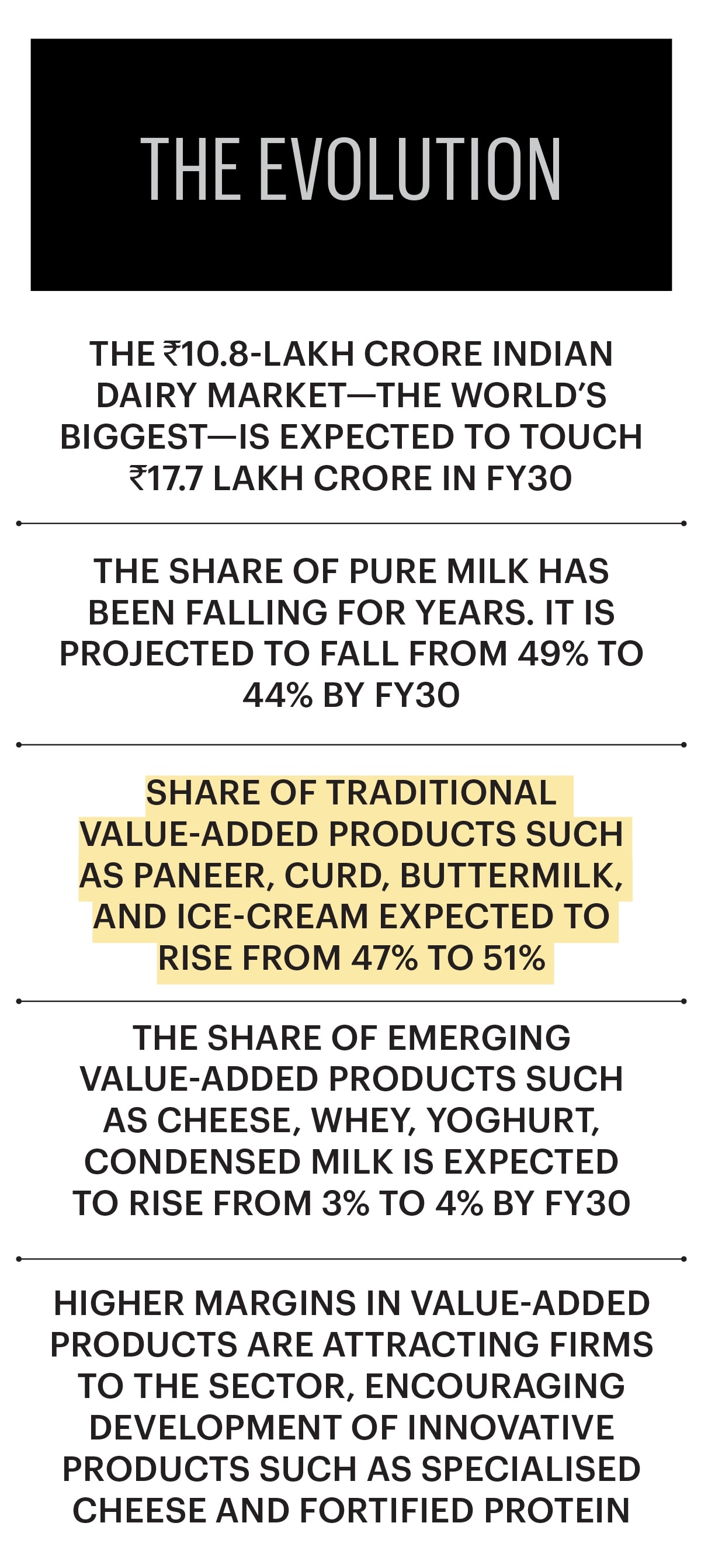
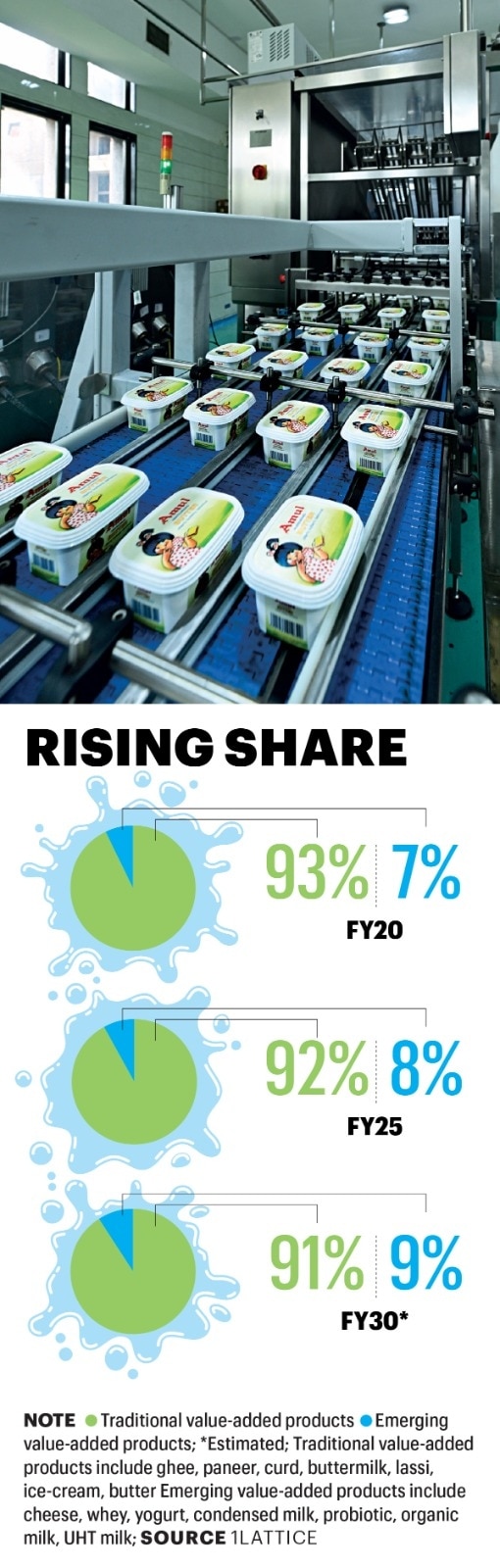
India has been a large dairy market for as long as one can remember. Almost 24% of global milk production comes from here, according to the Department of Animal Husbandry. The shift to value-added products is more palpable today—raita and custard are small examples in a large market—thanks to higher disposable incomes, a stronger cold chain network, and easier access through modern trade and quick commerce. For Mother Dairy, 70% revenue comes from the dairy business (the rest comes from Dhara edible oil, Safal’s retail chain of fresh fruits and vegetables), of which 28% comes from value-added products. Five years ago, that proportion was 15-17%. In FY20, the revenue from the segment was Rs 10,450 crore. It crossed Rs 20,300 crore in FY26.
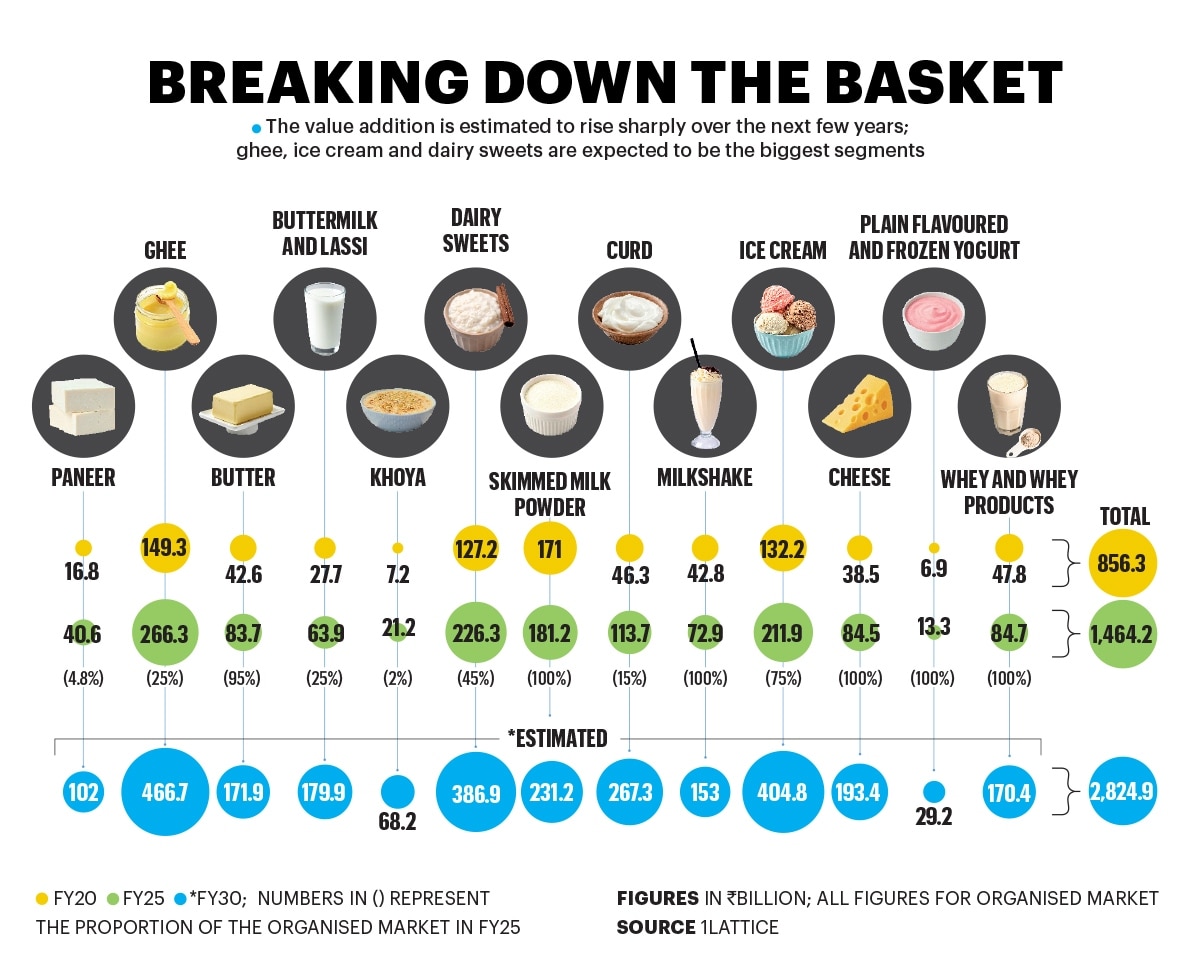
The size and potential of value-added products like ghee, buttermilk, and lassi, among others, is an indication of growth, both current and potential. In FY20, the size of the organised segment for these products stood at Rs 85,000 crore, and in FY25, crossed Rs 1.46 lakh crore, according to market intelligence platform 1Lattice. The transition from unorganised to organised is exciting the companies in the sector—for paneer, less than 5% is organised, while for ghee, buttermilk and lassi, it is 25%— apart from the potential in smaller segments such as cheese, yoghurt, and whey.
Milk is largely commoditised, making product differentiation difficult. Additionally, the presence of cooperatives reduces pricing power. Value addition involves more processing, giving companies more pricing power.
Breaking down milk
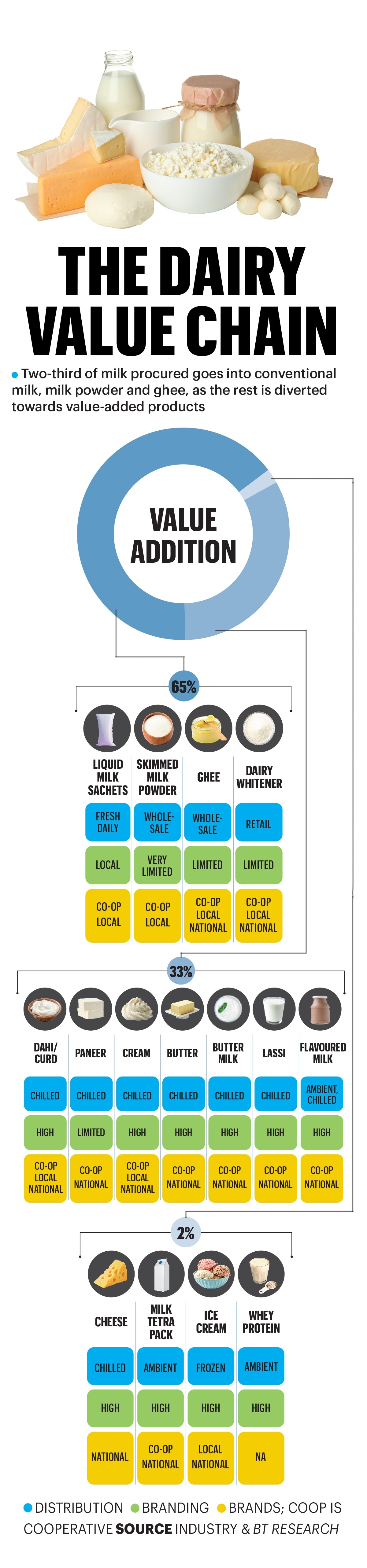
While companies increasingly focus on higher-value products, the industry itself has a broader definition of value addition.
Jayen Mehta, MD, Gujarat Cooperative Milk Marketing Federation (GCMMF), which owns the Amul brand name, thinks there is a misconception that there is no value addition in pouched milk or curd. “In fact, it starts there and then moves to butter, ghee, and so on,” he says. Mehta refers to the work done by Amul in yoghurt or the success with lactose-free milk. “These have worked out very well, and now, there is a big focus on protein.” That is a big market, especially post-pandemic, but let’s get to that in a bit.
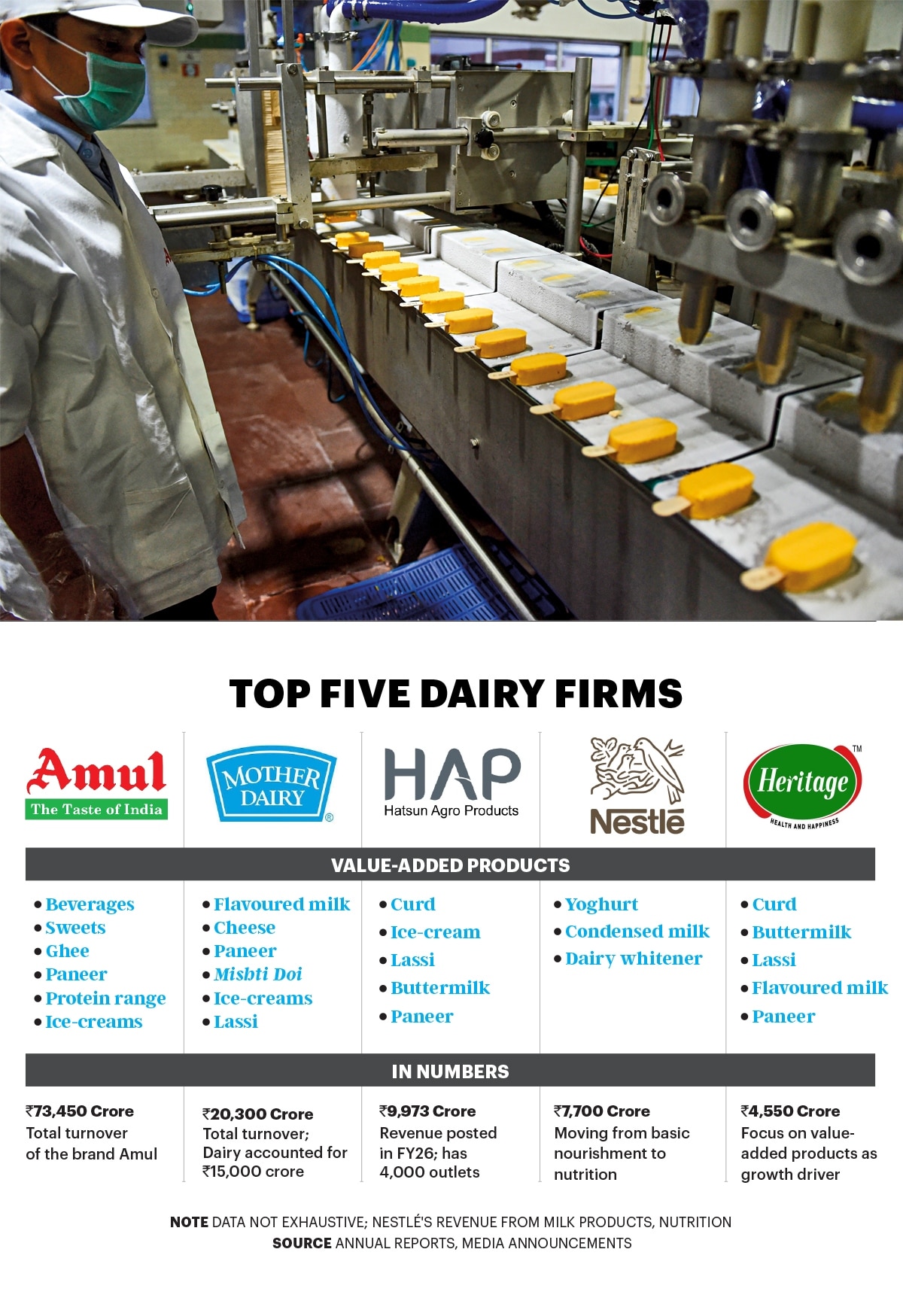
R. G. Chandramogan, Chairman, Hatsun Agro Product, has a simple definition for a value-added dairy product—it must be sold directly to consumers, and that is the way to make it profitable. His company, headquartered in Chennai, is the largest private sector dairy player (FY26 revenue was Rs 9,973 crore) with 4,000 outlets. “You must be dominant in a market. We have 23 factories across six states. It helps in reducing costs and reaching the consumer,” he says. There are no wholesalers. Nor are Hatsun’s value-added products sold to the hotels, restaurants and catering network. “The challenge there lies in deeper discounts and longer credit. It makes direct selling a much better proposition,” he says.
The approach is, in many ways, contrarian, but one that has worked well for the company. “We are among the top two ice-cream brands by value and Hatsun curd is the largest in the private sector. Ibaco is among the top two players in the ice-cream parlour segment,” he says.
In early 2025, Hatsun acquired Milk Mantra Dairy and its Milky Moo brand for Rs 233 crore. The aim was to get a meaningful presence in eastern India, two processing facilities and a product range that, apart from milk, has buttermilk, lassi, and paneer, instead of remaining just a south-based operation. “With manufacturing in Odisha, we have access to West Bengal and north Andhra Pradesh. New markets take time to build and can be done only if you have established markets outside,” says Chandramogan.

Money making
In markets where Mother Dairy and Amul have a presence in milk, EBITDA margins are typically in high single digits (8-9%). Some brands, through differentiation, can command 15%. Ghee and skimmed milk powder follow the global commodity cycle, and margins could be in single digits (8-9%) or even in the negative. Curd, buttermilk, and lassi offer double-digit margins (around 15%) and in some cases more than 20%. Cheese and ice-creams need sophisticated cold chain distribution systems (and are sold in limited outlets because of refrigeration requirements). As they are treated as high-value-added products, margins are typically in the 30-50% range. Whey, among the more sophisticated products, commands a premium based on factors like origin, test results, and purity.
K.S. Narayanan, an independent food advisor, says the western world has a larger base of value-added products, the prominent ones being cheese, ice-cream, and whey powder. The gains are clear. “Value addition will lead to investments in upgrading cold chains, livestock and its feed and, eventually, improve the quality of milk. One will also see the emergence of specialised functional categories within the dairy ecosystem to address specific consumer needs.”
For Nestlé India, milk products (dairy whitener, condensed milk, UHT milk, yoghurt, and baby food), with a revenue over Rs 7,700 crore, are the largest business, with a clear focus on value-added products. “Consumer expectations are evolving from basic nourishment to products that offer nutrition, convenience, taste, and premium experiences. This is shifting demand beyond milk to offerings such as yoghurts, condensed milk, and dairy-based beverages,” says Vineet Singh, Director, Milk Products & Nutrition, whose portfolio includes Everyday dairy creamer, a+ range of milk and yoghurts. “Our strategy is to respond to changing needs through science-based innovation, trusted brands and products that deliver nutrition, quality, and everyday relevance.”
Historically, India has had a huge demand for fresh milk, with limited shelf life. “The first stage of value addition (or primary processing) was to convert that into standardised processed milk. We have seen an explosion in its volume, led by the large national cooperatives,” says Narayanan.
As consumer needs become more complex, it is important to establish a long-term, robust business. Brahmani Nara, Executive Director, Heritage Foods, says her company looks at value-added products as a core growth business. “Liquid milk will always remain important, but it is not where our long-term margin strength comes from. Our focus on building a stronger value-added products portfolio gives consumers more reasons to choose us and also gives the business a healthier mix,” she says.
The managament of the Rs 4,550 crore company has taken a category-wise approach. In curd, paneer, and buttermilk, the portfolio was built around probiotic curd, probiotic buttermilk, and yoghurt. “More recently, there have been high-protein products aimed at the health-conscious consumer. The idea has been to move into categories where we can combine trust, repeat consumption and better economics,” says Nara.
In FY26, revenue from value-added products grew 18% on a year-on-year basis. “Its contribution to overall revenue was at 35.5% from 32.5% a year ago. It means the portfolio is becoming structurally stronger and not just larger.”
Success in dairy does not always come on the back of research. “The consumer can never articulate what he wants unless he is exposed to something. Buttermilk and dairy beverages are good examples, where a positive response saw the market take off,” says Hemendra Mathur, an agritech expert and investor. He says the next wave of demand will come from quality milk where Country Delight has already made its presence felt.
Picking the best bet
The value-added strategy for each player is markedly different. Milky Mist, synonymous with paneer, has stayed away from milk. “It is difficult to crack it since it is dominated by large cooperatives and private sector players,” says K. Rathnam, CEO of the company that is based in Erode in Tamil Nadu.
Plus, milk grows a modest 4-5% each year, with no change in consumption patterns. “Our focus, therefore, is on products. Earlier, technology was not easily available. Now, those who invest in it stand to gain,” says Rathnam. His company has a wide portfolio and aims to be a part of every meal. “Breakfast could start with UHT milk and butter, while paneer is for lunch, with a healthy Greek yoghurt as a snack. Dinner will have our curd.” In FY25, Milky Mist, which is looking to go public, had revenues of Rs 2,350 crore (net profit of Rs 460 crore). “We have been growing at 30% each year for many years,” he says.
The decision to invest in paneer was taken in the early 1990s. According to Rathnam, there were a couple of obvious reasons. One was that at least 90% paneer was coming from the unorganised sector, and the south was hardly exposed to the product. “Plus, at least half the population in the south is vegetarian. Non-vegetarian consumption is not daily,” he says. It made perfect sense to push paneer across South India, where Milky Mist is today the biggest player in terms of revenue.
Godrej Jersey— a company that Godrej Agrovet owns through the acquisition of Hyderabad-based Creamline Dairy Products—has a limited portfolio, primarily consisting of milk, flavoured milk, curd, buttermilk, lassi, ghee, paneer, and doodh peda. “It is a deliberate strategy, and we believe it has enough depth with existing categories and what we can potentially do with protein. If you look at the organised market for paneer, its penetration in urban India is at best 25-30%,” says Head of Marketing Shantanu Raj. Godrej Jersey’s approach to value-added products is based on three pillars—nutrition, convenience, and quality. Paneer is a big part of nutrition, while on convenience, its badam milk is the highest-selling flavoured milk in Andhra and Telangana, while for the south overall, chocolate is the clear winner. “The badam powder and mixes are something children have grown up on here.” Regional nuances play a role, and ghee in the south is an example. “It is associated with important rituals and has a bigger value-added play than perhaps butter,” explains Raj.
Each component of a strategy brings out interesting facets. Hatsun’s Chandramogan says his company’s focus on serving individual consumers through small-to-medium packaging has worked well. “We manage daily peak volumes of 18.2 million pieces with our factories. The objective is to prioritise high-margin replacement models over hotels, restaurants, and catering segment, very similar to a larger chunk of MRF’s business coming from the replacement segment rather than original equipment,” he says.

Going for it
A good presence in value-added products enables a company to position itself differently. Akshali Shah, Executive Director, Parag Milk Foods, believes that while the foundation has always been in dairy, they view themselves as a “nutrition-led food company that creates value across the entire ecosystem.” Her product portfolio, she maintains, reflects the changing way India consumes dairy. “Whether it is trusted house staples like Gowardhan ghee, premium single-origin farm-fresh milk through Pride of Cows, everyday cheese consumption through Go Cheese or high-performance sports nutrition under Avvatar, each addresses a distinct consumer need.”
The vicissitudes of commodity cycles are a reality that dairy companies deal with. “Long-term profitability comes from creating differentiated brands, building consumer trust, investing in innovation and strengthening the ecosystem that supports the business,” says Shah.
Protein has emerged as the next battleground. According to a report by the IMARC Group, India’s protein supplements market reached $912.9 million in 2025 and is projected to grow to almost $1.6 billion by 2034. Godrej Jersey’s Raj recalls that conversations with homemakers around three years ago would be around vitamins, minerals and calcium. “To my surprise, over the last six months, protein is top of mind. It is clear that there’s enough play in democratising protein,” he says.
The big moves are being made. Last March, Mother Dairy launched a new range of “pro” products, starting with milk. “Consumers are moving in that direction. The next decade will see more launches with shifting consumer preferences. We have to ensure there is no compromise in taste,” says Chary. Recently, it acquired land in Punjab and plans to roll out “a lot of whey-based products.”
In many ways, a thrust on innovation could make all the difference. Heritage Foods’ Nara thinks growth in dairy will not come from adding more volume but from creating new consumption patterns, better formats and products that align with changing consumer needs.
Like any industry, size does matter in value-added products, but that alone cannot guarantee success. For Amul’s Mehta, a clear advantage is scale. Amul procures upwards of 35 million litres of milk each day. In FY26, Amul became the first FMCG brand to hit a revenue of Rs 1 lakh crore.
The other players in this segment include Ahmedabad-based Vadilal Industries (primarily ice-creams) apart from FMCG biggies like ITC and Britannia.
Given where India is positioned in the dairy story, the massive opportunity is enough reason for companies to put their money into value-added products. Success in one of these segments could lead to a massive windfall. For instance, within yoghurt, Greek yoghurt has a small base, but it requires high-quality manufacturing and refrigeration at retail. As a result, it is completely organised and likely to sustain growth. According to 1Lattice, the overall yoghurt market has doubled between FY20 and FY25. Epigamia, an early entrant and a dominant player, is now facing competition from almost everyone in dairy and the likes of Akshayakalpa Organic and Sid’s Farm.
Meanwhile, Mehta is convinced that growth, even on his large base, is inevitable. “There’s so much more to be done. My own belief is that an Amul can be created in India every year,” he says in all seriousness. That’s some serious food (or perhaps milk) for thought.
@krishnagopalan


