We have said it in the past and will continue to credit Apple for reinventing the smartphone industry with its neat design, capacitive touch and the whole world of apps. While some players were quick in acknowledging the potential of Apple's new smartphone concept and its application eco-system, there were many who underestimated the company and continued on their own paths.
Google was quick to announce the open Android operating system with LG, Samsung, HTC and Sony adopting it. Android has since become the dominant smartphone platform globally. Microsoft first revamped its existing operating system and recently came up with a completely new, innovative interface. Nokia, for a very long time, ignored all the new happenings in favour of its Symbian OS before finally deciding to adopt Microsoft's Windows Phone. Similarly, BlackBerry initially tried to tweak its existing OS before putting all its might behind the new BlackBerry 10 operating system.
With four different smartphone systems in the market, two of them relatively new, this seems like the perfect time to evaluate which is the smartest of them all.
DEVICES:The competition today is first between the mobile operating systems and then between the brands.
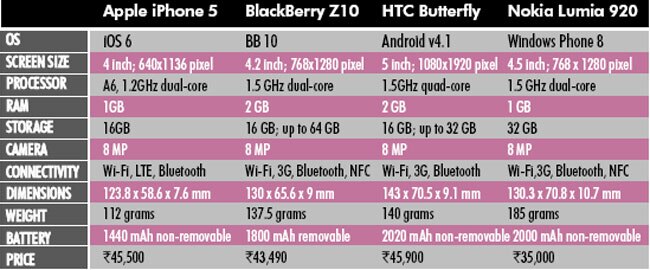
With iOS running exclusively on Apple devices, our obvious pick was the iPhone 5. BlackBerry (earlier Research In Motion) only has one device running the new BlackBerry 10 operating system. There are only a handful of devices running on Microsoft's new Windows Phone 8 operating system. After testing both the HTC 8X and Nokia Lumia 920, we decided to settle for the latter.
But the most difficult part was to choose a flagship Android. Although, we were tempted to choose between the Samsung Galaxy SIII and the Galaxy Note II, we chose the new Butterfly from HTC.
PARAMETERS:Smartphones are not just about processing power or displays. From design to the operating system, user interface to apps, there are numerous factors that come into play while testing them. We are evaluating these smartphones on five parameters.
The first is the hardware design followed by the performance that considers the operating system, user interface and productivity. We have clubbed imaging, music, video and gaming into one and labelled it as the Fun quotient. Considering applications today make a phone smart, this is an equally important parameter to consider.
Lastly, the battery backup of each device also helps in deciding how much these smartphones rate against each other. We will be scoring these smartphones on total of 100 marks with 20 as the maximum score on each of the five parameters. The total decides who the winner is.