In July this year, the world’s second-largest entertainment company, The Walt Disney Company, will be completing five years in India, but it seems it hasn’t had much of a go at one of the fastest-growing consumer markets in the world yet. Disney India still trails its global rival Turner in revenues and reach in India in the space that it is most visible: kids television programming. Its share in the Rs 150-160 crore kids advertising pie in 2008 was estimated at Rs 30 crore, and in reach and viewership it remains a poor second behind Turner’s Cartoon Network and Pogo channels.
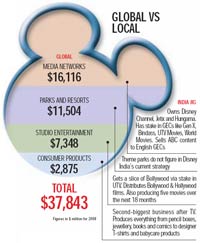
So, has Disney lost its script? Not really. “We have set up a great organisation in four years. We are clocking doubledigit growth. We do not want to be called just Walt Disney India but want to build the Disney India brand with all the Disney values. We are small and flexible, and have a lot of ground to cover to build the Disney brand,” says Mahesh Samat, MD, The Walt Disney Company India (WDCI). Disney has a total of eight companies in India, including WDCI and its various subsidiaries.Disney is looking to scale up through organic and inorganic growth as well as localisation of TV and film content and even in its kids retail (consumer products and publishing) business. In India, Disney is focussed on the first three of its four global businesses—Media Networks, Studio Entertainment, Consumer Products and Theme Parks and Resorts. Samat’s rationale: “India has 3.6 billion movie admissions, one of the largest in the world; there are 300 million kids below age 14 and there are 75 million pay TV households. These are the statistics that drive our thinking from a strategic standpoint.”
In the film and TV space, Disney has made strategic acquisitions (Hungama, 2006) and investments— it has acquired a 59.94 per cent stake in UTV for Rs 1,540 crore and invested $30 million in UTV Global Broadcasting, a UTV arm that owns channels like Bindass, Bindass Movies, World Movies and UTV Movies. In all, Disney is said to have pumped in about half a billion dollars to prime up its Indian entertainment business over the last one year.
Siddhant Khandekar, Research Analyst with Sunidhi Securities, says: “The investment in UTV will only be beneficial for Walt Disney in the long term. They are a young player in India and apart from the film space, which is mature in India, the other businesses such as TV, Kids Retail, Mobile Content, etc., where Walt Disney has interest, has some time to mature.”

Television is Disney’s biggest business globally, and accounted for 42.5 per cent of its $37.8-billion (Rs 1,89,000 crore) revenues last year. And so, in India, Disney is working hard to increase its reach and market share in the Rs 24,050-crore (ad and subscription) TV business through differentiation and localisation of content. Today, Disney channels reach over 50 million homes with STAR-DEN, a JV between the STAR Group and Digitial Entertainment Networks, as the exclusive distribution partner. Through the public broadcaster, Doordarshan, Disney Channel reaches over 122 million homes. In kids broadcasting, Disney Channel and Jetix in the last six months have garnered a channel share of 8 and 3.5 per cent, respectively. Hungama (19 per cent), too, has been closing in on Cartoon Network (26 per cent) and Pogo (22 per cent), according to TAM data.
“We have a very clear positioning for our three channels. Hungama is a fun and humorous channel, Jetix is targeted at boys aged 6-12 years and Disney Channel is a tween channel. Our aim is to sustain their positioning,” says Antoine Villeneuve, Senior Vice President & MD, Walt Disney Television International (India), a wholly-owned subsidiary of WDCI. Indeed, localisation has become a key strategy for Disney in India. Says Samat: “Outside the US, India is among few markets where Disney has invested in local production.”
Shows for older kids such as Dhoom Machaao Dhoom, Vicky Aur Vetaal and Mast Hai Life or The Cheetah Girls One World, which was the first Disney Channel’s Original Movie to be shot entirely in India, are part of the localisation effort in TV and films. In publishing, Disney is looking at regional language editions of a few of its magazines and comics; the latter is already available in Hindi. It may also consider launching more magazines such as Cars and Hanna Montana. “The launch of comic books in Hindi reinforces our commitment to localise our stories and connect with the Indian consumers,” says Roshini Bakshi, Director, Disney Consumer Products (India), a WDCI subsidiary.

Consumer products account for 7.5 per cent of Disney’s global income. In India, the consumer division is making a big push by launching everything from pencil boxes, designer jewellery and activity books to a couture label with designer Manish Arora and babycare products. According to Samat, in India, Disney’s consumer products business is its second-largest after television.
The business model is based on tie-ups with franchisees. Industry sources say the global kids retail market is expected to grow to $17 billion by 2012 from $12 billion at present. Sure, we can expect a lot from the animated world of Disney.