











In December 2025, the finance head of a pharma company resigned from his role citing air pollution in Delhi. A month later, former IMF Chief Economist Gita Gopinath, speaking at the World Economic Forum meeting in Davos, brought back the spotlight on India’s chronic air pollution and said it is a bigger issue for the economy than the 50% tariffs imposed by the US at the time.
These are not one-off developments. Neither is the haze of smoke and dust that engulfs the Delhi-NCR every winter, peaking around Diwali and somewhat abating around late February with rains from Western disturbances. Not just a winter phenomenon anymore, cities, especially Delhi NCR, are seeing high levels of dust pollution in summer. Several cities across the country, including Mumbai with its coastline overlooking the Arabian Sea, now have a problem of chronic air pollution, owing to a mix of emissions from construction work, industrial activities, transportation and household work. India was the sixth most polluted country in terms of PM2.5 levels in 2025, according to the World Air Quality Report by Swiss firm IQAir.
While health practitioners and environmentalists have for long issued warnings and called for stricter measures to control it, the impact on the economy is now becoming clear as it takes a toll on productivity of workers, bottom lines of firms, and investor sentiment.
NOT SEASONAL
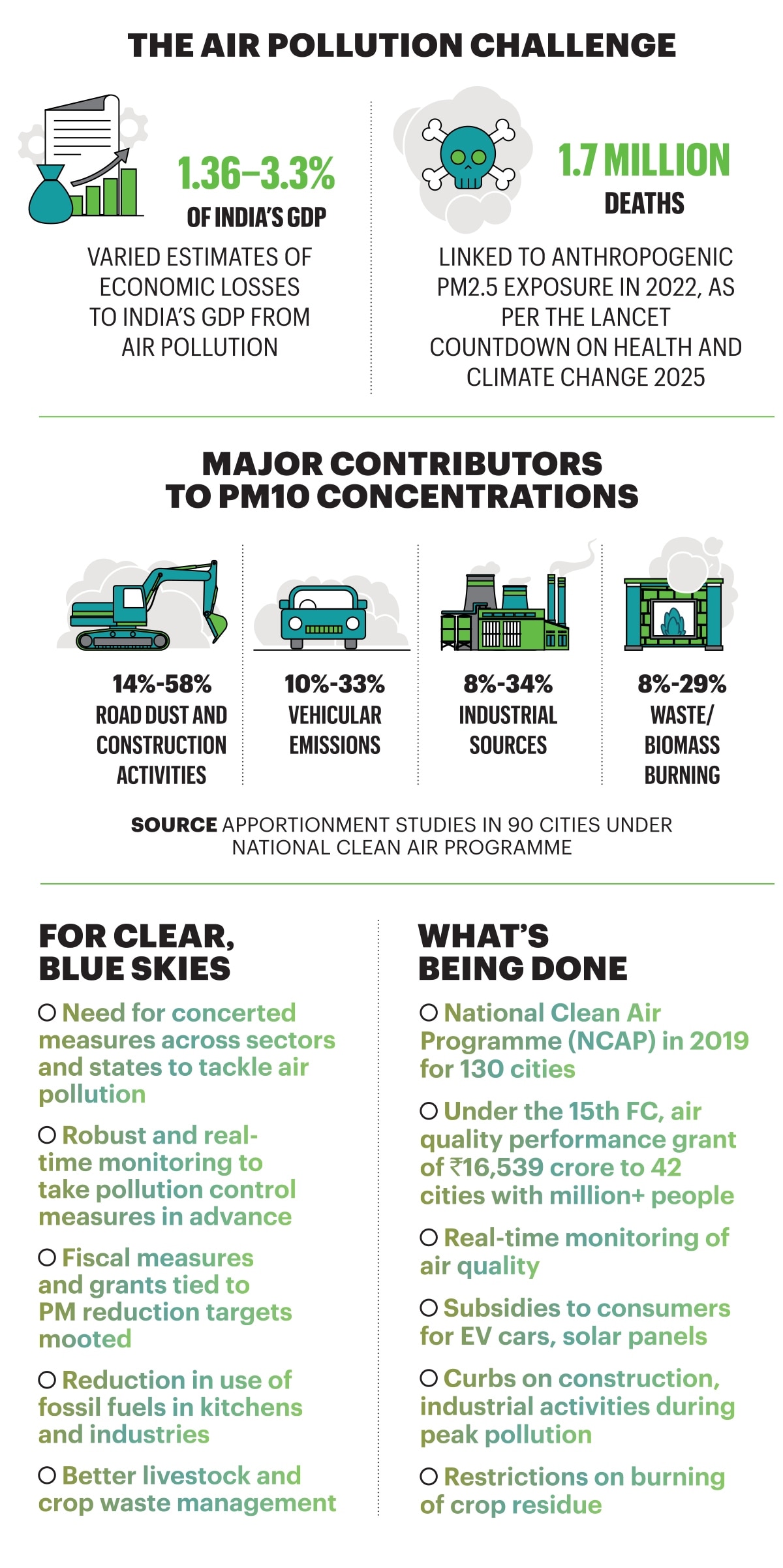
Consider this: A study by the Lancet Planetary Health estimated 1.67 million deaths were attributable to air pollution in India in 2019, accounting for 17.8% of the total deaths in the country.
The World Bank says lost output from premature deaths and morbidity attributable to air pollution accounted for economic losses of $36.8 billion in India in 2019, accounting for 1.36% of the country’s gross domestic product (GDP).
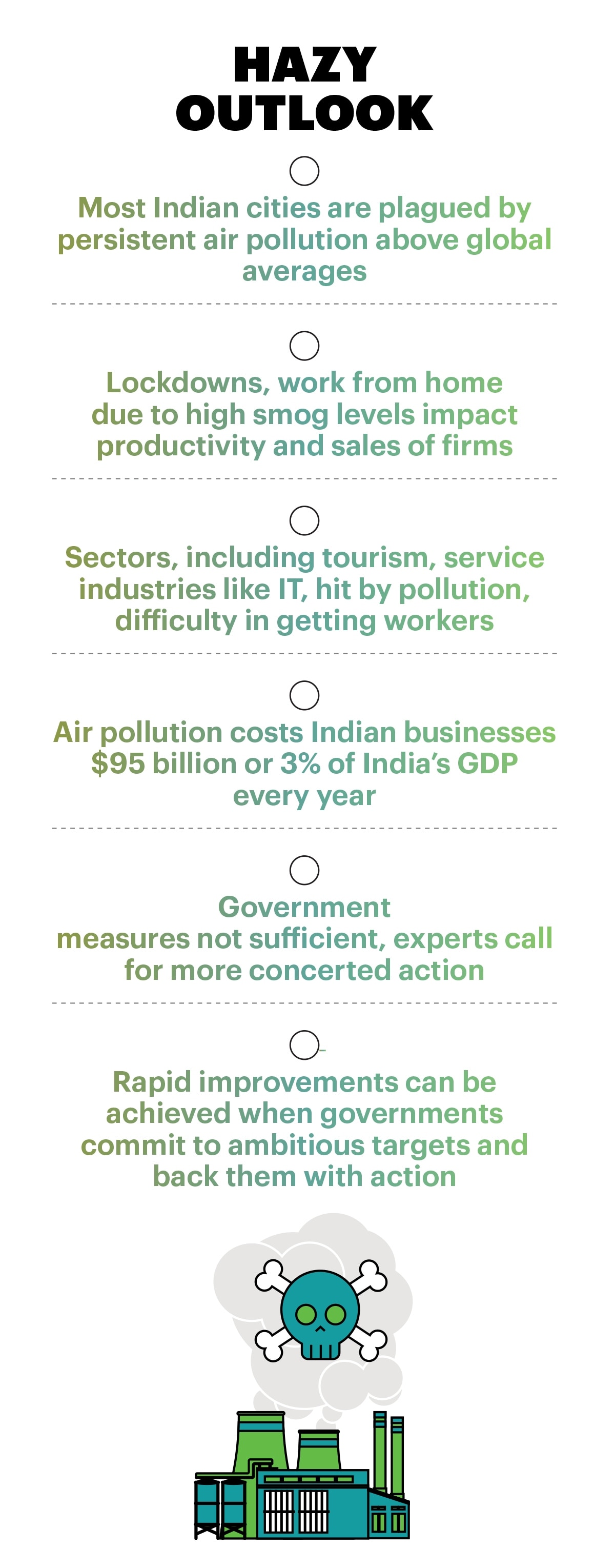
In another report commissioned by the Clean Air Fund (CAF) and developed in partnership with Dalberg Advisors, Blue Sky Analytics and the Confederation of Indian Industry (CII) from November 2020 to March 2021, the cost to the country’s GDP was seen to be even higher. It said that air pollution costs Indian businesses $95 billion or 3% of India’s GDP every year.
“The cost of air pollution manifests in six ways—lower labour productivity, lower consumer footfall, premature mortality, lower asset productivity, increased health expenses, and welfare losses. Out of these, employee productivity, consumer footfall and premature mortality impact businesses directly,” explained the report, titled Air Pollution and its Impact on Business.
The study pointed out sectoral losses as well. While the IT sector loses an estimated $1.3 billion, decreased consumer footfalls cost the economy $22 billion in 2019. Reduced tourist footfalls cost the tourism sector $1.7 billion every year, it said.
This is also corroborated by recent corporate reporting and commentary where several companies have said air pollution impacts their performance with pollution-led curbs and preference by consumers to stay indoors. For instance, leading department store chain Shoppers Stop, in its third quarter earnings release for FY26, attributed elevated air pollution in Northern India as one of the reasons for flat sales. “Sales remained flat due to inconsistent demand and pollution in Northern India, underscoring the vulnerability of consumption to environmental disruptions,” it had said.
Seema Arora, Deputy Director General and CEO, Centre of Excellence for Sustainable Development at CII, says understanding of air quality management and its direct and indirect impact on businesses is still evolving. “For companies, the biggest trigger point is when industrial activities are banned during times of high air pollution,” she says.
Air quality management has become a crucial factor when it comes to investment decisions, or when selecting locations for expansion, particularly for service sector companies such as those in tourism or IT. Attracting and retaining talent, especially for new-age companies, can be difficult as air quality is an important concern now, she says.
Pradeep Singhvi, Executive Director, Energy and Climate Practice, Grant Thornton Bharat, concurs and points out that Gurugram—the start-up hub of the north—has seen many start-ups move or expand to other cities due to air quality. “Many multinational corporations are increasingly favouring cities such as Hyderabad over highly polluted regions like Delhi NCR, recognising that air quality has a direct bearing on workforce health, productivity, and talent retention,” he says.

A Call for Action
While the Centre and states have taken measures to improve air quality and there has been some reduction in PM 2.5 concentration, we need to do much more. Air purifiers, sales of which see a sharp spike during smog season, can be afforded only by middle- and upper-income categories. Even that is not a sustainable solution.
Mumbai’s Brihanmumbai Municipal Corporation has also started enforcing pollution control measures. The city has deployed electric buses and checked construction activities to mitigate outdoor dust.
Companies too are taking stock of what can be done. Arora helped set up the India CEO Forum on Clean Air—an industry platform anchored at CII. Started in 2019 with just 17 members, it has 136 members today and works with subnational governments, urban local bodies, start-ups and small and medium enterprises to counter emerging air quality issues. It is working in crop residue management with farmers in Punjab and Haryana. In 2020, it started working on airshed management and improving air quality in Indore Metropolitan Region in partnership with the Madhya Pradesh Pollution Control Board, Smart City Indore.
Singhvi of Grant Thornton Bharat points out that several firms are making strong efforts to protect employees during high pollution periods, but these efforts are largely reactive and fragmented, addressing symptoms rather than the root cause.
The Centre had also launched the National Clean Air Programme (NCAP) in 2019 to address air pollution in 130 cities. Under NCAP and 15th Financial Commission air quality grants, a performance-based incentive grant of Rs 13,865.52 crore was provided to these cities to implement measures to control air pollution.
Lekha Chakraborty, Professor at New Delhi-based think tank NIPFP, believes in building on the 15th Finance Commission’s performance grants (outcome-linked fiscal devolution) tied to PM reduction targets in million-plus cities; a broader framework incorporating air quality metrics like PM2.5/PM10 reductions and airshed performance into tax devolution; and grants with multi-year commitments. “Sectoral measures could include pollution charges with revenues recycled into clean technologies, expanded PLI for EVs and abatement equipment, and support for crop residue management,” she says.

Well-designed fiscal tools can help by internalising externalities, rewarding measurable improvements, and strengthening accountability across states and cities. Green bonds offering a promising avenue, enabling states and municipalities to raise dedicated, low-cost capital for pollution control infrastructure, urban grants linked to enforcement and dust control, combined with an Airshed Fiscal Mechanism for transboundary coordination and robust monitoring and independent evaluation are some of the measures Chakraborty advocates.
A World Bank report in December last year had noted that nearly one billion people in the Indo Gangetic Plans and Himalayan Foothills breathe unhealthy air, resulting in around one million people dying prematurely every year.
It pointed out that international experience shows that rapid and sustained improvements can be achieved when governments commit to ambitious targets and back them with action. For example, China cut PM2.5 concentrations in the biggest urban agglomeration, the Jing-Jin-Ji region (comprising Beijing, Tianjin, and Hebei) by over 30% in just five years through significant multi-sectoral actions, and strong enforcement. Similarly, Mexico City was once amongst the most polluted cities in the world but managed to almost halve air pollution by adopting an airshed governance approach, transforming its transport system, tightening vehicle standards, and relocating heavy industry.
As the fastest growing major economy with hopes of becoming the third-largest economy in the coming years, India is depending heavily on its demographic dividend and investment climate. As is now evident, air quality will be a key monitorable for both.
@surabhi_prasad


