













It’s a war that broke out far from Indian shores, but its repercussions have quickly spread across the domestic economy and businesses, which are grappling with supply disruptions and price shocks.
The BT-C Fore Business Confidence Survey of 500 chief executive officers and chief financial officers for the first quarter of financial year 2026-27 (Q1FY27) reflects this grim mood. It reveals that corporate India’s outlook is bleak as fresh challenges from the war forced them to go back to the drawing board.
The Business Confidence Index (BCI) came in at 47.2 on a scale of 100 in Q1, reflecting the high degree of uncertainty in which companies are operating. A reading below 50 indicates a negative mood and severe stress for businesses. The reading for Q1FY27 is almost similar to the pessimism seen at the start of 2025 when the US, under President Donald Trump, began its trade war and the BCI fell to a 15-quarter low of 47.7 in Q4FY25. Prior to that, the BCI had touched an all-time low of 43.2 in the April-June 2021 quarter at the height of the second wave of the Covid-19 pandemic.
Started 15 years ago, the BT-C Fore Business Confidence Survey first captured the mood of India Inc for the January to March 2011 quarter. Over the years, companies were primarily asked about their confidence based on the previous quarter and outlook for the upcoming quarter.
The revamped survey now looks ahead and assesses confidence and plans of businesses in the upcoming quarter. While the aim and design of the survey remain largely the same, the BCI is now nimbler, to better capture the mood of India Inc in an era of rapid change and volatility in the global and domestic economic and political order.
The latest survey was conducted between March 24 and April 6 as the war between the US-Israel alliance and Iran had waged on for over a month. It revealed that confidence across businesses—be it size of industry or sector—was below the 50 mark for Q1. Among sectors, it was the lowest for light industries, comprising segments such as food and beverages, textiles, leather and paper, with a reading of 46.5. In terms of size, micro enterprises were the least confident, with a reading of 46.3.
Highlighting the challenges thrown up by the West Asia conflict, Finance Minister Nirmala Sitharaman recently said it has evolved from a regional security concern into a systemic tremor and is threatening the vital arteries of global energy and hardening the lines of a new, multipolar world order.
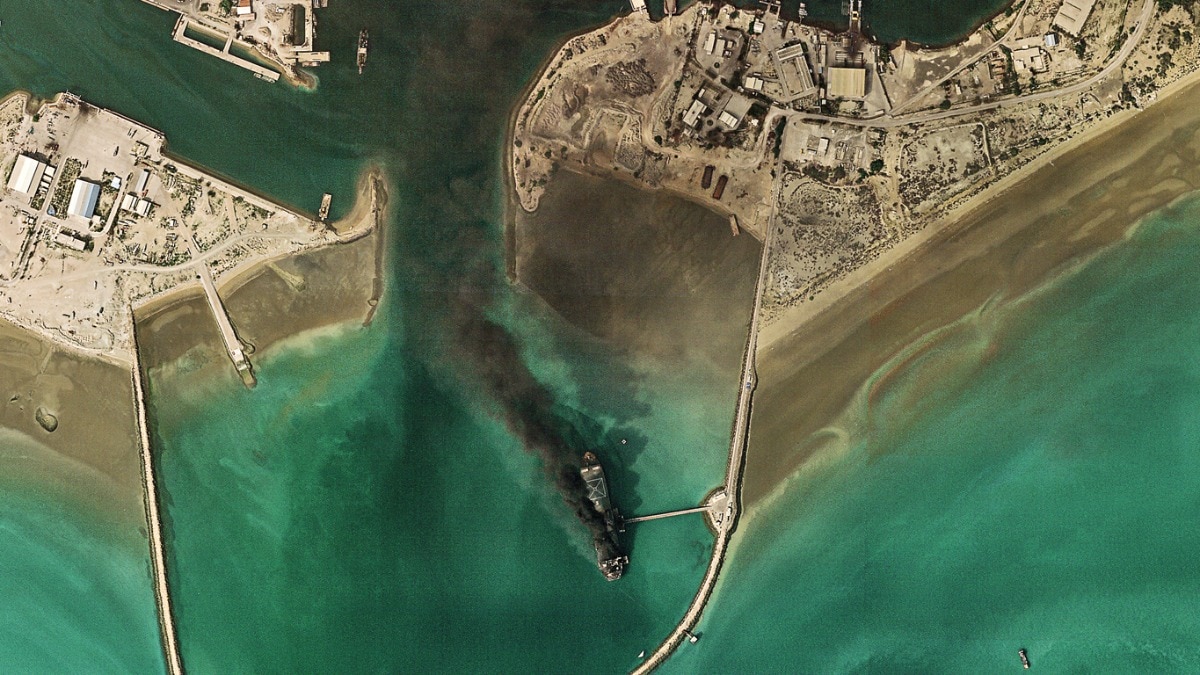
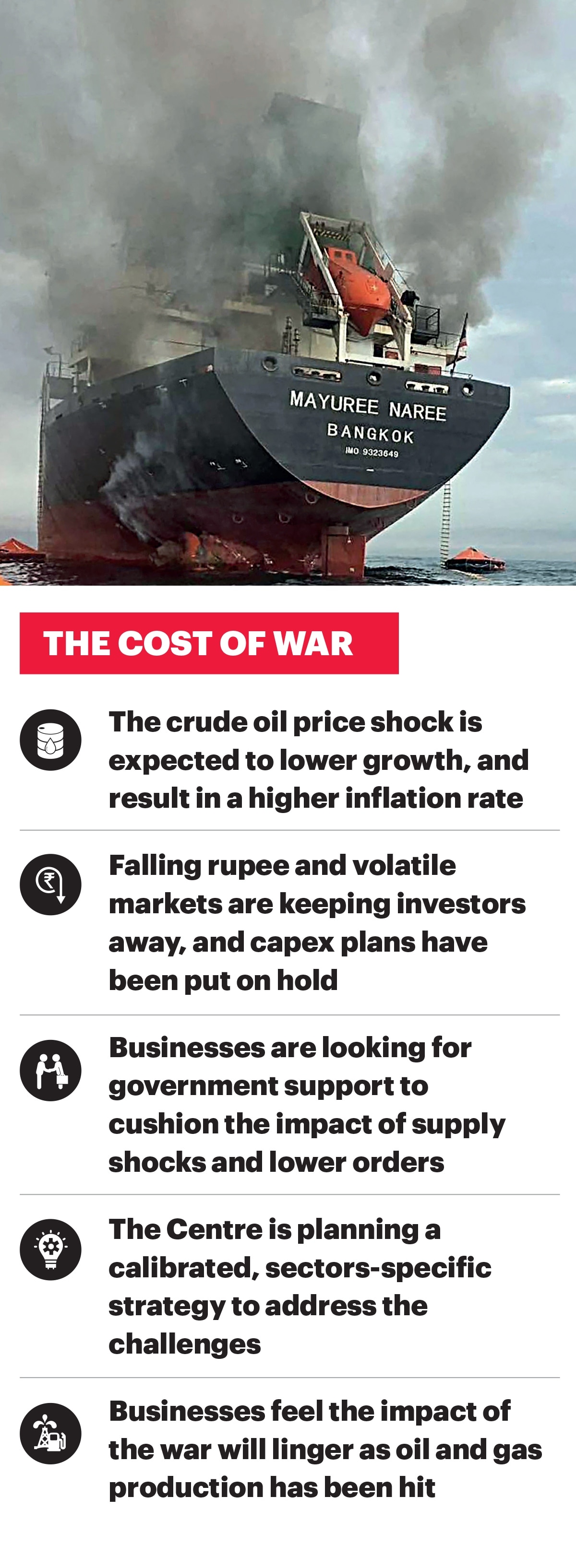
Starting with the blockade of the Strait of Hormuz that led to delayed shipments, the war quickly expanded into an energy shock as oil and gas imports from the region ground to a near standstill. Then there were disruptions in supplies of critical raw materials, including petrochemicals. While the government is striving to improve and normalise supplies, prices have risen, increasing troubles for India Inc.
Reserve Bank of India (RBI) Governor Sanjay Malhotra also noted that the conflict is likely to impede growth. “Higher input costs associated with increase in energy prices and international freight and insurance costs, along with supply-chain disruptions that would constrain the availability of key inputs for downstream sectors, would impair growth,” he said after the Monetary Policy Committee (MPC) meeting in April. The six-member MPC has lowered gross domestic product (GDP) growth projection to 6.9% for FY27 and hiked the retail inflation forecast to 4.6% from 2.1% in FY26.

High frequency data for March, including that of inflation and trade, already reflect the impact of the war with prices rising and both exports and imports dipping due to the blockade of the Strait of Hormuz.
Meanwhile, El Niño and a below average monsoon could impact growth and inflation and hit rural markets that have boosted private demand in recent years. The El Niño climate pattern adversely affects the monsoons.
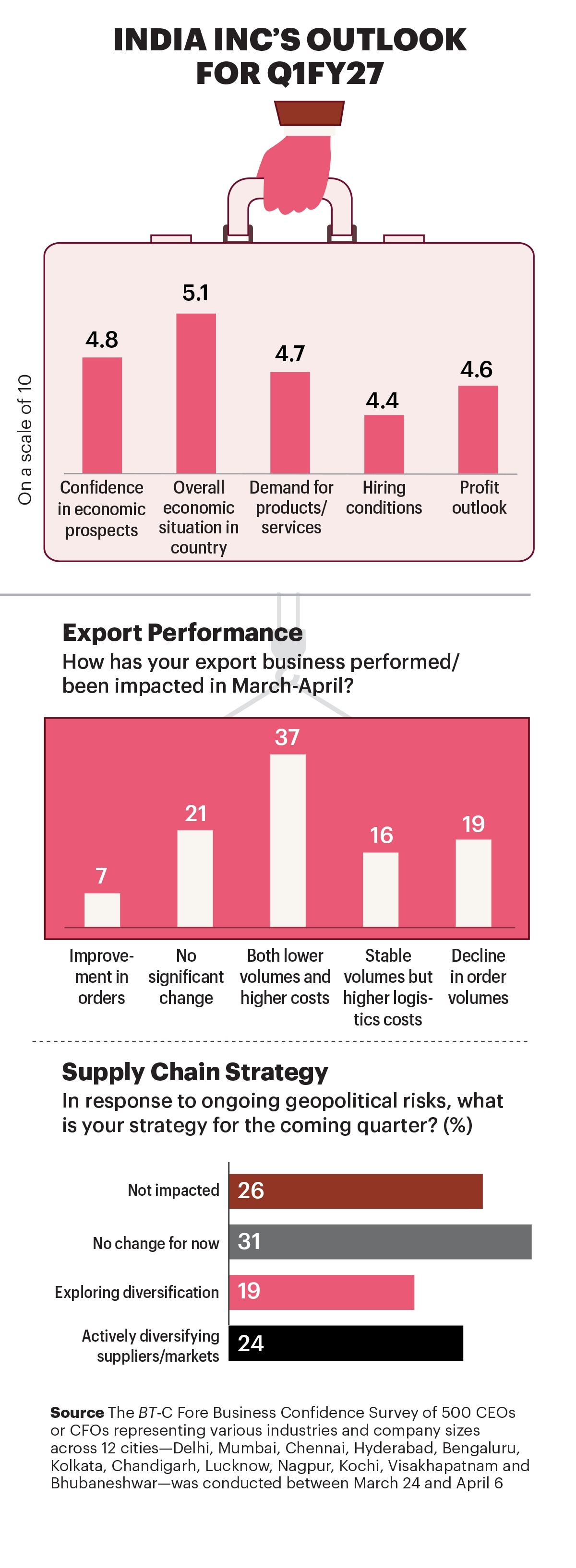
Experts highlight that uncertainty is always high during a war and India Inc’s outlook is no different. The BCI reveals that the outlook of businesses on overall economic situation, demand, hiring and profits remains muted. (See Graphic: Business Confidence Takes a Hit)
Madan Sabnavis, Chief Economist at Bank of Baroda, says the war is impacting businesses on two counts—supply shocks as well as demand concerns. “Companies that are dependent on petroleum and gas have been impacted due to supply shocks and have, as a result, cut down production, which in turn will have an impact on demand. A section of companies is also worried about demand going forward as people lower their spending during times of uncertainty,” he says.

Anil Bhardwaj, Secretary General of the industry lobby Federation of Indian Micro and Small & Medium Enterprises (FISME), agrees. He says business sentiments always dip during a war and discretionary spending is among the first to get impacted.
For MSMEs, it’s not a single narrative, Bhardwaj adds. “When the war started, the biggest problem was stuck or delayed shipments. This was eventually resolved through government efforts,” he says. There have also been challenges in supply of gas—many MSMEs depend on it for production—but that too is getting resolved now.
Further, MSMEs dependent on raw material like petroleum and chemicals from West Asia have faced disruptions in supply chains. While they have been able to procure from other countries, prices have increased and will eventually be passed on to end consumers.
There are also problems of cash flow and liquidity. MSMEs are hoping for some relaxations from the government, including a proposed Emergency Credit Line Guarantee Scheme dispensation on the lines of the one extended during the Covid-19 pandemic, as well as a longer timeframe in government supply tenders.
The BCI asked companies several pointed questions on how the war is impacting their plans and strategies for Q1 as well as the year ahead. While they are currently busy navigating the disruptions from the war, they remain watchful before finalising any plans for capital expenditure or diversification.
Most businesses that participated in the survey faced problems in operations due to energy constraints and supply chains for inputs due to the war.
To a question on whether energy availability affected their operations in March and April, 45% respondents said there was a mild impact with manageable adjustments, but 23% reported severe disruptions that led to production cuts and impacted their workforce, and 21% said they faced moderate disruptions. Only 11% said they were not impacted.
Similarly, 46% of respondents reported a mild impact of the West Asia conflict on their input supply chains, while 21% said they faced severe disruptions; 22% saw moderate disruptions.
Nearly two-third of the businesses surveyed said the conflict hit export orders in March and April. While 37% reported lower export volumes and higher costs and delays in shipments, 19% said there was a decline in order volumes and 16% had stable volumes but paid higher logistics costs or faced delays. Only 21% said there was no significant change in their export business. Interestingly, 7% reported an improvement in orders and execution.
Meanwhile, jittery markets and a fast-depreciating rupee, which temporarily breached the 95-mark against the US dollar on March 30, have also hit operations. As many as 28% respondents reported a net negative impact of the rupee’s depreciation on their business, while 12% said it had a mixed impact. However, 53% said it has had no meaningful impact.

Unlike previous years, when companies finalised business plans in March and April for the new fiscal year, the current uncertainties have made them hold on to their investment plans and strategies. As many as 46% said they plan to delay or hold back investments in Q1 and the whole of FY27, while 40% said they have put investments on hold.
On response to the geopolitical risks, 24% respondents said they are actively diversifying suppliers and markets, and 19% said they are exploring diversification. Meanwhile, 31% said they are not looking at any change for now and 26% said they have not been impacted.
The government has been working on a number of relief measures and officials underline that there is adequate fiscal space for more measures, when needed. It is also working to restore supplies of crude oil and natural gas as well as fertilisers and other petrochemicals; it is talking to several countries for purchases to ensure production returns to normal.
Experts are hopeful that this pall of gloom will lift over the next few quarters, especially once the festive season kicks in. “While business confidence is down now due to the uncertainties of the war, it is likely to improve in the coming quarters as supplies improve and businesses go back to full production,” says Sabnavis, but warns that inflation will remain a concern.
But as both the finance minister and the RBI Governor have underlined, the Indian economy’s fundamentals remain strong. Businesses will certainly hope that the remaining 11 months of the fiscal bring some respite.
@surabhi_prasad


