












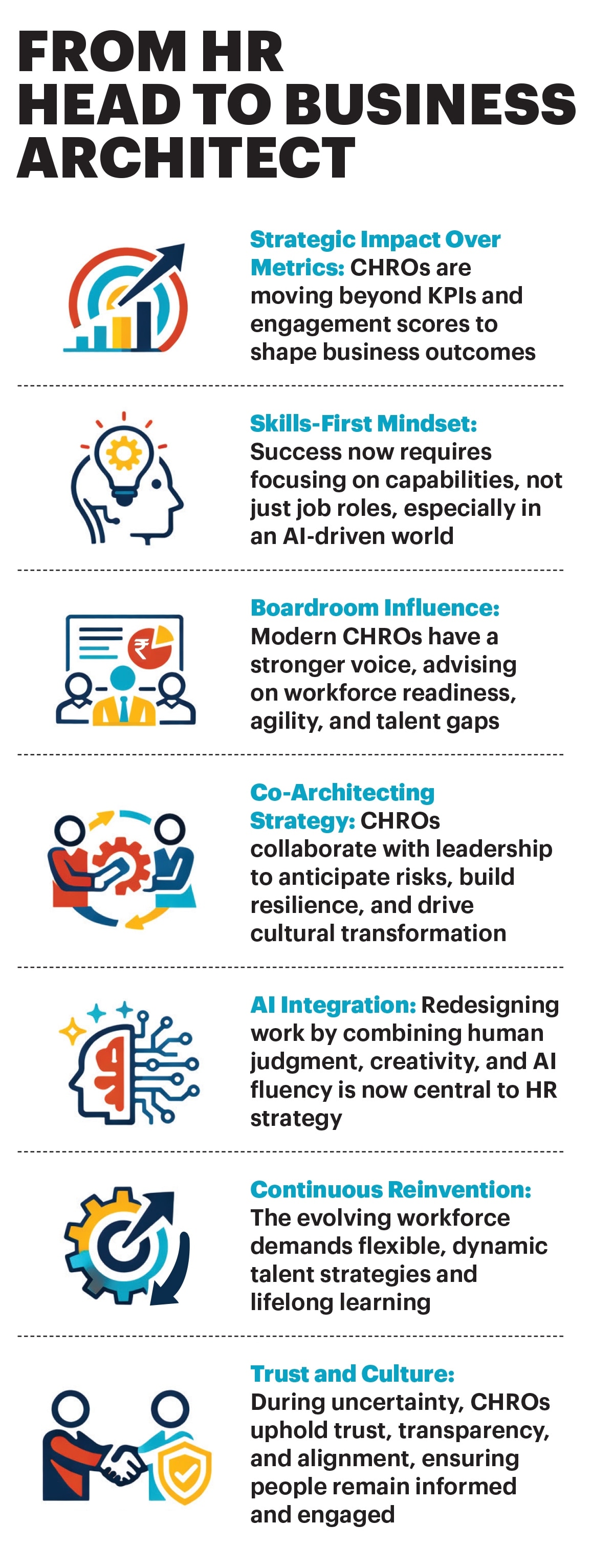


Not too long ago, the Chief Human Resources Officer (CHRO) was measured only by metrics: hiring numbers, attrition rates, engagement scores.
Today, that playbook is going through an overhaul.
In boardrooms shaped by the artificial intelligence (AI) disruption, economic volatility, and a workforce that refuses to wait, the CHRO is no longer managing people processes, they are shaping business outcomes. The role has moved from tracking performance to defining it, from supporting strategy to actively building it.
“The most effective CHROs are those involved early in decision-making. They are asking critical questions—do we have the right skills for the future, how do we stay flexible, and what kind of leadership do we need?” says Nishchae Suri, Managing Director, Cornerstone OnDemand India, a global provider of cloud-based talent management and learning experience solutions.
He emphasises that it’s not just about supporting decisions anymore, it’s about having a point of view, and being able to challenge, guide, and shape those decisions.
“Technology, talent and leadership are changing the way we work. Companies need to focus on skills, not jobs. Those who can make this change happen will define what the role of the CHRO looks like in ten years,” Suri adds.
Adding a business leader’s perspective, Sandip Ghose, CEO of MP Birla Cement and a corporate strategist, notes: “Much of the traditional CHRO role is now pushed down to line managers. The nature of work and the nature of the workforce have both changed.”
He further underscores the shift in value creation: “Earlier, HR was built around efficiency, KPI achievement, percentages, output. Today, the shift is towards impact. Impact must come with speed. Time horizons have collapsed. You can’t wait five years for success anymore.”
A Stronger Voice
Not long ago, HR discussions at the board level were largely limited to defined areas like compensation or succession, that was the lane. “Today, that has shifted quite a bit,” says Suri.
It’s no longer enough to rely on annual workforce plans or lagging indicators. According to Suri, boards want to know what’s happening now, where critical skills are being lost, where strengths are building, and whether the organisation is moving fast enough compared to the market.
Ghose reinforces the shift in strategic positioning: “CHROs absolutely have a seat at the table. But even succession planning today is no longer traditional. High turnover and changing expectations mean talent strategies have to be far more dynamic.”
From Co-Pilot to Co-Architect
Chandrasekhar Sripada, Clinical Professor (OB), Indian School of Business believes the CHRO’s evolution into a co-architect of business strategy is already underway in progressive organisations.
“The role of the CHRO has already been that of a co-pilot, with many companies treating the CHRO as a co-owner of business strategy and execution,” he says, while noting that many organisations continue to view HR as an administrative function.
He adds that the shift to business resilience leadership will be defined by a new set of capabilities. “A deeper understanding of the business, enterprise-wide thinking, and the ability to sense changes in the external environment in real time are among the most critical competencies for CHROs today,” he explains.
Rewiring Work
AI and automation are no longer future considerations but realities reshaping how work gets done. The shift, Suri, argues, begins with moving away from jobs to a skills-first mindset.
He also highlights the emergence of AI fluency as a new baseline. “It’s about learning to work with AI, knowing when to trust it, when to question it, and how to use it effectively,” he says.
Adding to this, Ghose points out the deeper shift in value creation: “Organisations are not managing headcount or workforce in the traditional sense they are managing intellectual capital. What matters is the ability to generate ideas, scale them, and stay ahead of the curve.”
He also highlights the talent challenge: “Even to leverage AI, you need a different calibre of people. Legacy workforces alone cannot drive that shift. CHROs must help leaders understand the kind of talent needed for the future not just manage the present.”
Lakshmi Chandrasekharan, Senior Managing Director and CHRO, Accenture in India, highlights that the biggest opportunity for CHROs lies in fundamentally rethinking how work itself is designed in an AI-driven world.
She explains that the starting point is to move beyond existing structures and redesign work by deconstructing jobs into tasks—identifying where human judgment, creativity, and empathy add unique value, and where AI can augment. According to her, work redesign must be the priority. Organisations can enable their workforce to continuously learn, unlearn, and relearn at scale.
Chandrasekharan also highlights the importance of bridging the human-AI integration gap. She believes that by equipping people with AI tools and training, organisations can encourage responsible experimentation, drive adoption, and build a culture where people thrive with AI.
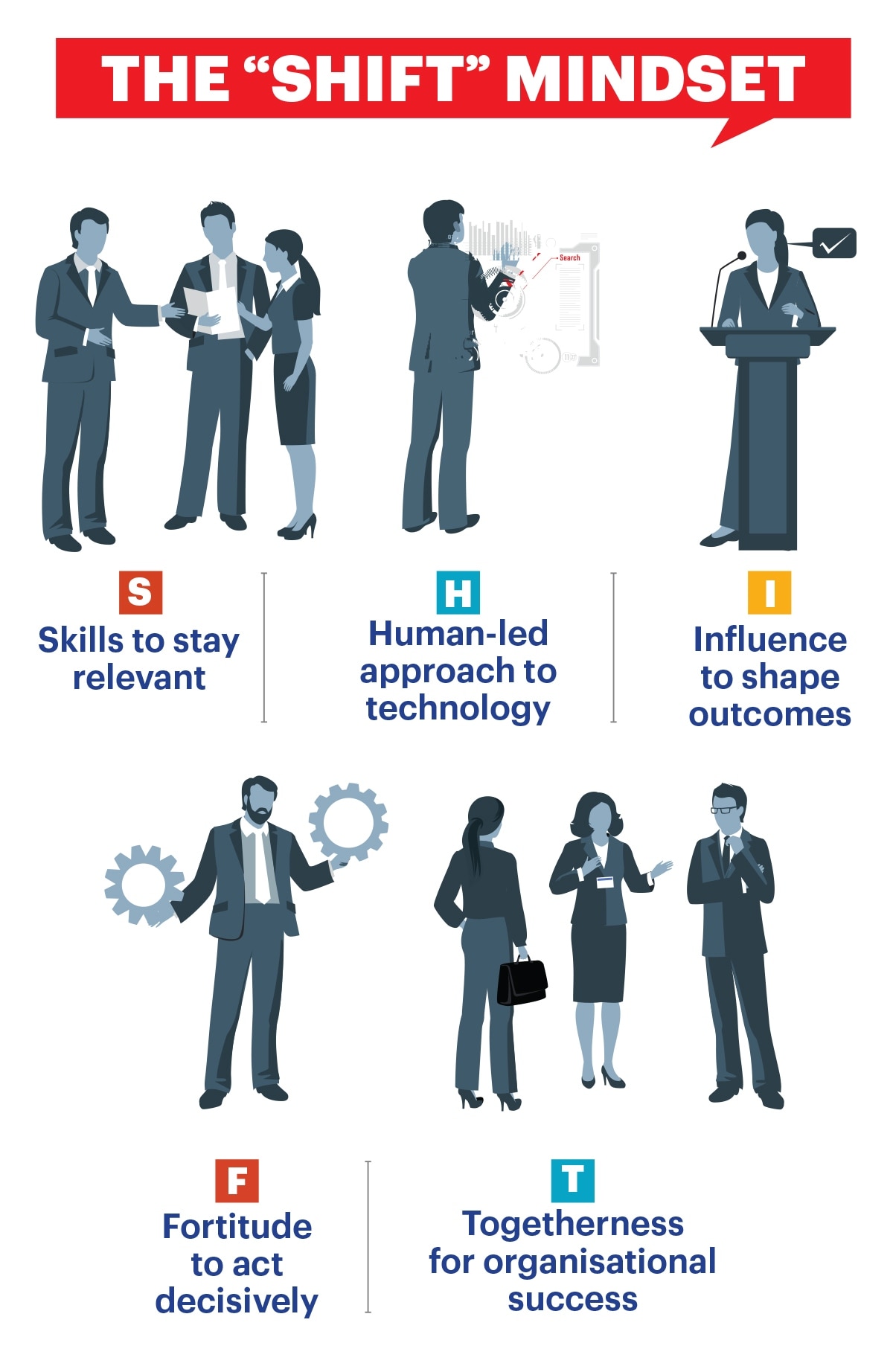
Chandrasekharan, on the other hand, says CHROs must adopt what she refers to as the SHIFT mindset—building Skills to stay relevant, taking a Human-led approach to technology, leading with Influence, showing Fortitude, and achieving success Together. This shift is already taking shape in practice.
Citing an example of her own company, Aarti Srivastava, Chief Human Resources Officer—India, Capgemini, says, “At Capgemini, HR works closely with business leaders to anticipate capability needs, embed continuous learning, and ensure that talent strategies evolve in step with technological innovation and client demands.”
Looking ahead, organisations are increasingly relying on forward-looking indicators such as skills readiness, learning agility, and internal mobility to assess resilience. “These metrics provide deeper insight into how prepared the workforce is for future opportunities and help ensure that talent strategies remain aligned with the pace of technological change,” Srivastava notes.
From Risk Anticipation to Business Readiness
The CHRO’s role must evolve from managing people processes to anticipating and mitigating talent risks before they impact business outcomes.
“A key shift is combining data with behavioural insight, while analytics provides direction, understanding people dynamics enables meaningful action,” says Niren Srivastava, Group CHRO, Motilal Oswal Financial Services Ltd. He points out that while culture is often underestimated, it demands the highest level of attention from HR leadership.
Srivastava emphasises that for CHROs to truly shape business strategy, they must focus on anticipation and readiness. “There is a never-before-seen need to continuously diagnose skill shortages and fix them—either by buying or building talent,” he says, adding that while AI may evolve, the constant remains the ability to identify and close skill gaps ahead of time.
He notes that people strategy becomes a true business driver when CHROs actively shape leadership behaviour, culture, and capability building.
Beyond Lag Indicators
Traditional HR metrics, like engagement scores and attrition, offer only a backward-looking view of organisational health.
“Many companies are still looking at what has happened, not what might happen next; it’s like driving while only looking in the rearview mirror,” says Suri.
“It starts with getting a much clearer view of skills not just what we have today, but whether those skills align with where the business is heading and where gaps are beginning to emerge,” he explains.
Organisational fluidity becomes a critical indicator. “Are people moving into new roles as needs change, or are they stuck? The ability to redeploy talent quickly is a big part of resilience,” he notes.
What matters is whether people are applying new skills in their day-to-day work, Suri opines. “That’s where CHROs create real impact by helping organisations move early, with clarity, instead of reacting when it’s already too late.”
The Cultural Shift
Ghose highlights how shifting workforce expectations are redefining the CHRO mandate. “Today’s workforce is highly transactional. People are not thinking about lifetime careers. If you tell someone what they will be 15 years from now, they are not interested. They want to know what’s on the table today,” he says.
He adds that this shift places a new responsibility on HR leaders to prepare organisations internally. “CHROs need to prepare line managers to work with the next generation of employees. There is often reluctance among leaders, and HR must bridge that cultural gap.”
Ghose points out that traditional HR priorities are no longer differentiators. “Diversity and engagement initiatives have become baseline. The expectation now is to deliver impact and scale. Young HR leaders are beginning to think beyond traditional frameworks, which is encouraging.”
He leaves CHROs with a clear mandate for the future: “You must continuously re-engineer yourself. If you don’t reinvent, you risk becoming irrelevant. Staying relevant requires constant evolution both at an individual and organisational level.”
Holding the Line on Trust
When organisations hit tough periods, the instinct is often to pull back, control the message, or say less. In those moments, the CHRO’s role is about holding the line on trust and creating a sense of stability when everything else feels uncertain, notes Suri.
“My experience has taught me that people can handle tough times if they feel respected and informed. They understand that businesses go through cycles. So, the role of the CHRO in those moments is really about holding the line on trust. That means being open, even when the message is difficult. It means giving people clarity on what’s happening and what it means for them.”
However, he cautions that communication alone is not enough. “It’s also about action and creating an environment where people feel informed, respected, and supported, even in uncertainty.”
Rethinking HR Education
As the CHRO role evolves, HR education is struggling to keep pace.
Curriculum design, Sripada argues, needs to evolve in real time integrating cutting-edge research with real-world experiences to build true people-centricity in an age shaped by AI and automation.
Importantly, he emphasises that the shift is not just about adding new competencies such as data or technology skills, but about fostering deeper mindsets and worldviews.
“Business schools must prioritise stakeholder-centric thinking beyond shareholders, social responsibility, particularly the responsible use of automation and the ability to balance the triple bottom line of planet, people, and profits.”
It’s those who reinvent themselves that soar!


