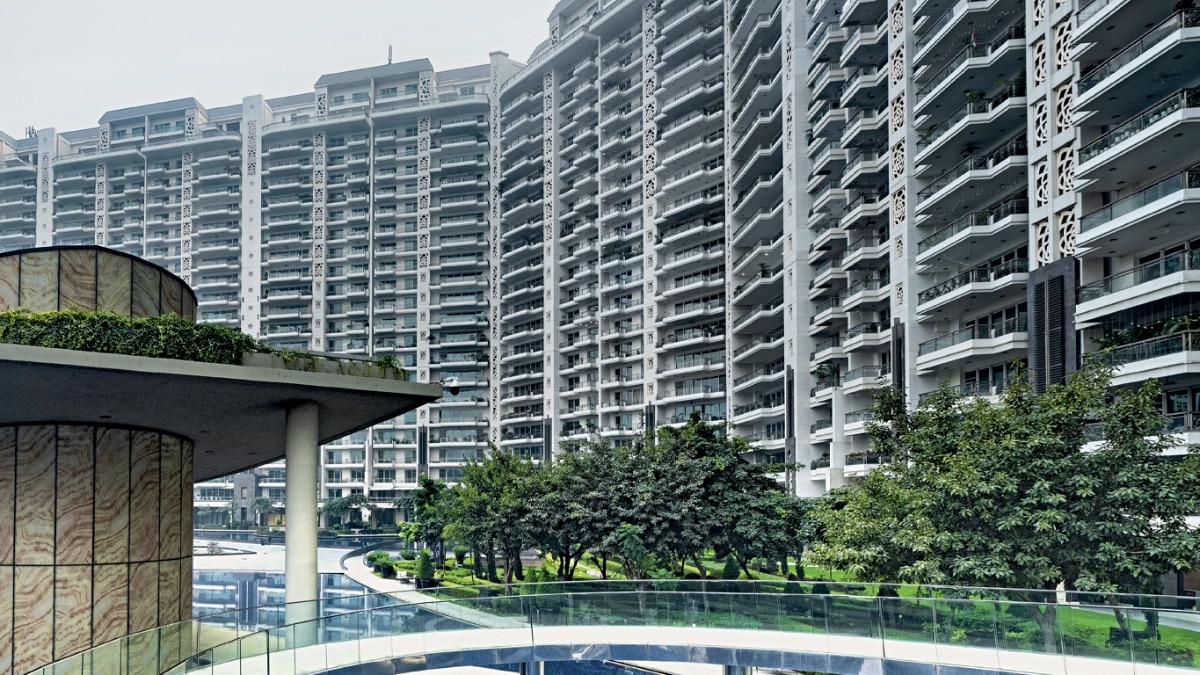
The year 2025 was marked by homebuyers lapping up luxury houses and developers moving away from mid-segment homes, in pursuit of higher margins. DLF, India’s biggest real estate developer, made headlines by selling over half its super luxury project in Gurugram—The Dahlias—before the launch. “The main launch will happen in April 2026. We sold over 55% units in the pre-launch phase,” Aakash Ohri, Managing Director and Chief Business Officer at DLF Home Developers, tells Business Today. Ohri expects buyers’ changing aspirations to fuel demand for ultra-luxury and luxury housing in 2026. He believes the IPO rush, which has created many new millionaires, will fuel demand, illustrating how interconnected most markets are. Aakash Ohri, Managing Director and Chief Business Officer at DLF Home Developers“Over the next five-ten years, we will see a reasonable amount of wealth creation. The two asset classes that will benefit will be gold and real estate,” he says, adding buyers’ aspirations have risen. “They are not waiting to buy the next iPhone 17 or the bigger car. They are doing it today. Similarly, people want better and bigger homes,” he says. While luxury homes have the full attention of big developers, the affordable and mid segment housing has been forsaken, reflecting in a decline in home sales this year. Sales in the top seven cities witnessed a 14% year-on-year decline in 2025, with around 3,95,625 units sold in the year against 4,59,645 units in 2024, according to ANAROCK Research. However, the sales value rose 6% from around Rs Rs 5.68 lakh crore in 2024 to over Rs 6 lakh crore in 2025. But some of these trends may change in 2026. Bengaluru-based builder Prestige Group expects mid-segment homes to make a comeback in 2026. “At Prestige, we will plan a lot more launches in the mid-segment (Rs 1.5 - Rs 3 crore ticket size),” says Praveer Shrivastava, Sr. Executive VP, Residential, Prestige Group. “We have seen that in the last couple of years, developers, buoyed by the momentum in housing sales, have veered towards the larger 2,000-6,000 sq. ft. format. The next year, a majority of our products will come with 1,500-2,000 sq. ft. dimensions,” he says. “Most customers prefer Rs 2-3 crore houses. Ticket size is a function of the area and pricing per sq. ft. While the pricing per sq. ft. has gone up by 60% over the last four years, the area of the houses has also increased. To stay in the Rs 2-3 crore bracket, the area will have to be optimised; 1,500-2,000 sq. ft. is the optimum area that can be done in the ticket size of Rs 1.5-3 crore. This is where most customers are. We have to design our products around that.” Unlike DLF’s Ohri, Shrivastava is not convinced that the uptrend in the luxury segment will continue. “Luxury is always a niche market. Volumes will not come for any developer if we continue to supply only for the luxury market. Therefore, for volumes, and resultant sales value, people will have to move back to the mid-segment. It’s a cycle,” says Shrivastava. He, however, agrees that affordability has taken a hit due to high construction cost and land prices. “Offering an affordable product is very difficult. Expectations of landowners are high. That is driving up costs. Developers continue to work on modest margins. The challenge is to ensure that the pricing remains affordable.” Anshuman Magazine, Chairman & CEO—India, South-East Asia, Middle East & Africa at CBREBuilders are focusing on luxury because land prices and construction costs have gone up, says Anshuman Magazine, Chairman & CEO—India, South-East Asia, Middle East & Africa at CBRE. “When you combine the increase in the cost of land and the cost of construction, it’s not easy to do affordable housing. Land prices have gone up in top cities such as NCR, Mumbai, Bengaluru, Chennai, Hyderabad, and Pune.” Affordable homes sales have gone down due to supply-side problems, says Shishir Baijal, Chairman & Managing Director at Knight Frank India. “Most of the affordable homes are in the periphery of cities where there is not much infrastructure.” Premium and luxury homes accounted for 20-25% of India’s residential market before the pandemic while the affordable segment was over 50%. In 2025, premium and luxury homes have jumped to 55%, far exceeding the affordable and mid-housing segments, he says. DLF’s Ohri says the developer can’t afford to have apartments in the mid-segment because of the “mammoth amount of resources and cost that we incur on everything.” “Whether we make something for Rs 1 crore or Rs 100 crore, our efforts, energy, and time are the same,” he says. DLF will not touch a project unless it meets the company’s margin parameters, he says. At DLF’s home turf in Gurugram, property prices have skyrocketed. On Golf Course Road, where The Camellias and The Dahlias are located, per square feet prices are giving Mumbai’s posh sea-facing locales a run for their money, where prices go as high as Rs 1 lakh per sq. ft. Ohri says the buyers of these super luxury homes are business families, top executives, NRIs. “The concept of a home has changed. Earlier, the glamour quotient was not that high. That has changed to a dramatic level. Home is something where they want more indulgence. Golf Course Road is the super luxury story,” he says. After entering the Mumbai market in 2025, DLF is looking to launch a Goa project in 2026. On the company’s plans for Noida, which has also seen an uptick in luxury launches, Ohri says, “we will definitely do something.” There is another big trend—real estate has become geography-agnostic. “If I launch in Mumbai, buyers come from across states. Residents of Tier II and Tier III cities have also started investing in DLF properties,” says Ohri. Strong participation of NRIs has also helped. “NRIs contribute 25-28% to DLF’s total sales,” says Ohri. Baijal says NRIs account for about 15% of industry sales. He says the rupee’s fall against the US dollar is making homes more affordable for NRIs. “Though NRIs are not always end-users, it will bring more homes in the rental market, which will ease the housing shortage”. CBRE’s Magazine, however, has a different viewpoint. While the return on investment in real estate in India has been higher than in the other countries, the recent depreciation of the rupee vis-à-vis dollar is a deterrent for NRIs and foreign investors, he says. On the headwinds for the realty sector, Prestige’s Shrivastava says, “On the supply side, approvals not come in time.” On the outlook for 2026, Shrivastava says as Global Capability Centres, or GCCs continue to set up shop in India, job creation will keep happening and, therefore, the influx of skilled workers or IT professionals into major markets will continue. “As long as that happens, home sales will also boom,” he adds. Falling interest rates will also keep the demand going, according to CBRE’s Magazine. “This does not mean that the residential prices will keep going up. But demand on the residential side will keep the momentum going,” he says. The year 2025 has also been good for office leasing, says Magazine. “India’s GCC story is very strong. That will continue to fuel the commercial real estate market in 2026,” he says. Real estate in India is increasingly owned by institutions and not individuals. With REITs, more institution and PE money is coming into real estate than in the past. “Majority of office buildings are owned by REITs. We are seeing the same thing in retail malls, logistics warehousing, and data centres,” he says. Baijal expects real estate prices to plateau next year, something that is much needed for first-time homebuyers after a multi-year bull run has made buying a home out of reach for the most. The next chapter of the story is yet to be written. @karandhar11