











When IndiGo faced a sudden leadership churn earlier this year, the spotlight wasn’t just on who would take charge, but on who was ready.
With CEO Pieter Elbers stepping down amid operational challenges, Founder Rahul Bhatia stepping in as an interim measure, and a global search bringing in Willie Walsh, the current Director General of IATA and former CEO of British Airways to take over later in 2026, the episode has unfolded like a real-time case study in succession.
It raises a simple but uncomfortable question: When leadership transitions happen, is there truly someone next in line?
At Air India, recent leadership transition conversations have once again highlighted how difficult succession becomes during large-scale transformation. CEO Campbell Wilson’s decision to step down has triggered a leadership transition at a time when the airline is grappling with operational disruptions, rising costs, and the fallout from the 2025 Ahmedabad Dreamliner crash that severely impacted the carrier. While Wilson had reportedly informed Chairman N. Chandrasekaran about his intent to step down as early as 2024 and continues to remain in the role until a successor is identified, the airline has now constituted a board-led committee to oversee the search. The episode underlines a growing reality for organisations globally: even when transitions are anticipated, building a truly ready-now leadership bench during periods of transformation and crisis remains one of succession planning’s toughest tests.
Globally, Apple’s transition from Steve Jobs to Tim Cook remains one of the rare examples where succession planning worked almost exactly as intended. Jobs may have appeared irreplaceable, but years of internal grooming ensured continuity long before the crisis forced the transition.
Closer home at Infosys, the board is maintaining a calibrated approach. They aim to ensure continuity amid industry disruption while giving the board time to execute a smoother, more deliberate leadership transition, rather than facing an abrupt churn.
At the Tata Group, the turbulence surrounding Cyrus Mistry’s abrupt exit exposed how leadership transitions can quickly turn into governance flashpoints, despite strong institutional structures. The group later moved towards a more formalised succession approach under Chairman N. Chandrasekaran, reflecting how even highly respected organisations are forced to rethink continuity after disruption.
A recent CEO & Board Confidence Monitor by a global executive search and consulting firm, Heidrick & Struggles, highlights this disconnect clearly. While more than two-thirds of leaders express strong confidence in their executive teams’ ability to deliver on the strategic plan, that confidence drops sharply when it comes to long-term continuity. Only four in ten respondents believe their CEO succession planning adequately positions the organisation for the future.
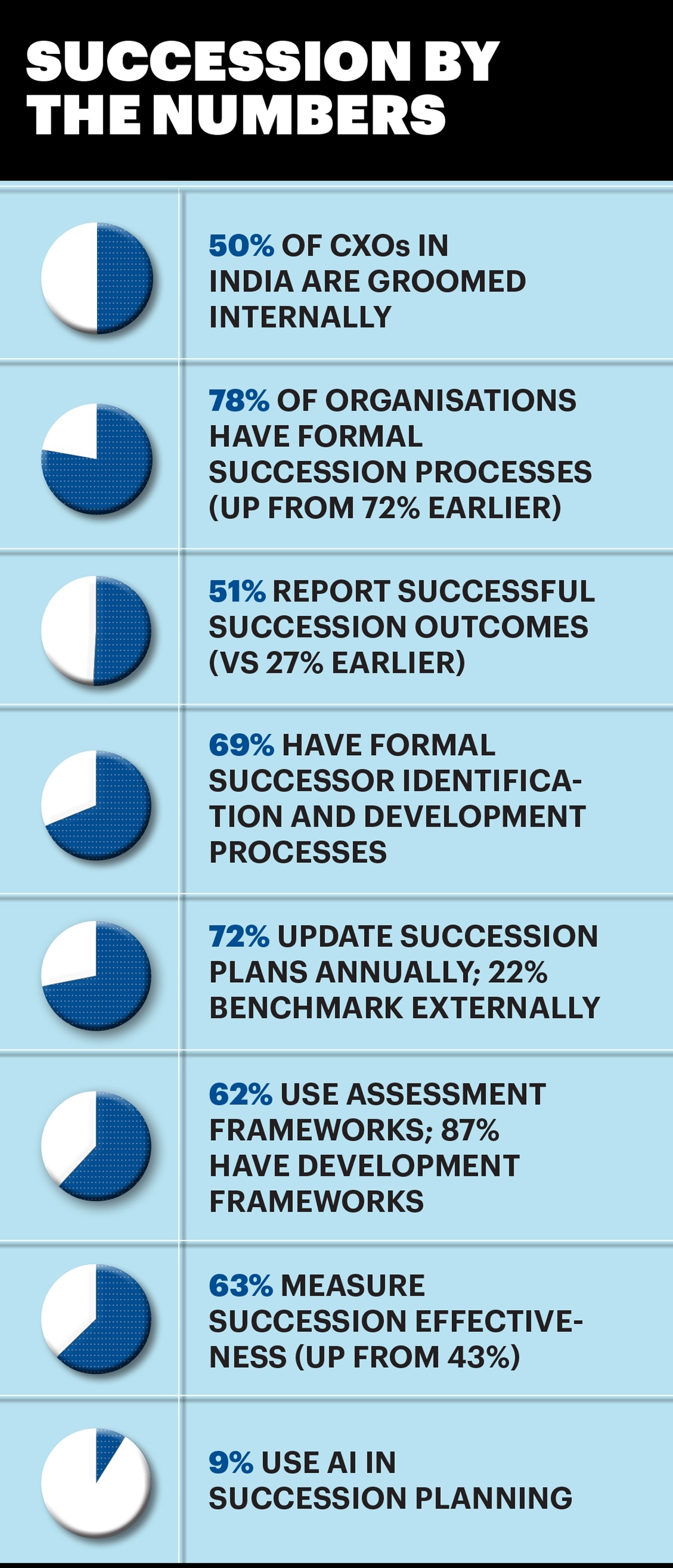
A 2025 Talent Readiness Study by Deloitte India offers a slightly more optimistic view on structure, but not necessarily on outcomes. It finds that 78% of organisations in India have institutionalised succession planning frameworks for leadership roles, with 50% of CXO positions filled through internal talent. At the same time, the study highlights a parallel shift in family businesses, where 57% of the next generation enters between ages 24–27, 60% hold postgraduate degrees, and 59% of spouses are actively involved in the business ecosystem.
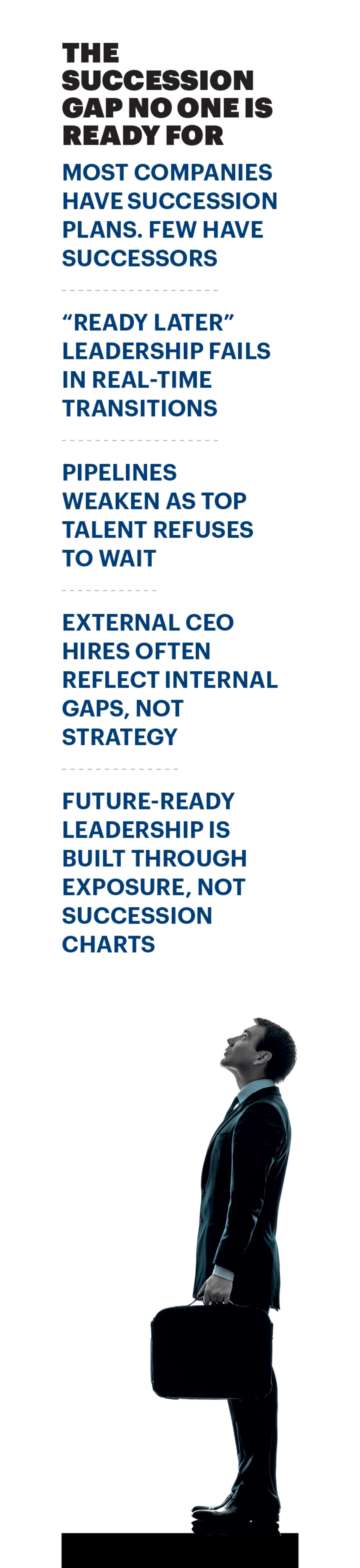
The signal is clear: succession is more formalised than ever, but ‘ready-now’ leadership remains elusive.
MATURE FRAMEWORKS
The gap rarely lies in frameworks, but in how they translate into reality.
“On paper, most mature organisations have robust succession grids, talent reviews, and identified successors. But when a real transition moment arrives, three cracks typically show up,” says Sumit Mitra, CEO, Tesco India and Tesco Business Solutions, the global business services division of British multinational retailer Tesco.
First, readiness is often overstated. Many successors are “ready in 12–24 months,” not “ready tomorrow.” “The capability may exist, but contextual exposure, running a P&L, handling board pressure, leading through ambiguity is often missing,” he explains.
Second, breadth of experience is too narrow. Leaders are still developed within silos, without enough cross-functional or enterprise-wide exposure. “In today’s environment, the ability to connect technology, customer, and commercial outcomes is critical, and this is where many pipelines fall short,” he adds.
Mitra also points to a cultural challenge. “In many organisations, there is still an over-reliance on trust and familiarity. Leaders often default to those they know well, which can limit bench strength and delay the development of newer, diverse leaders.”
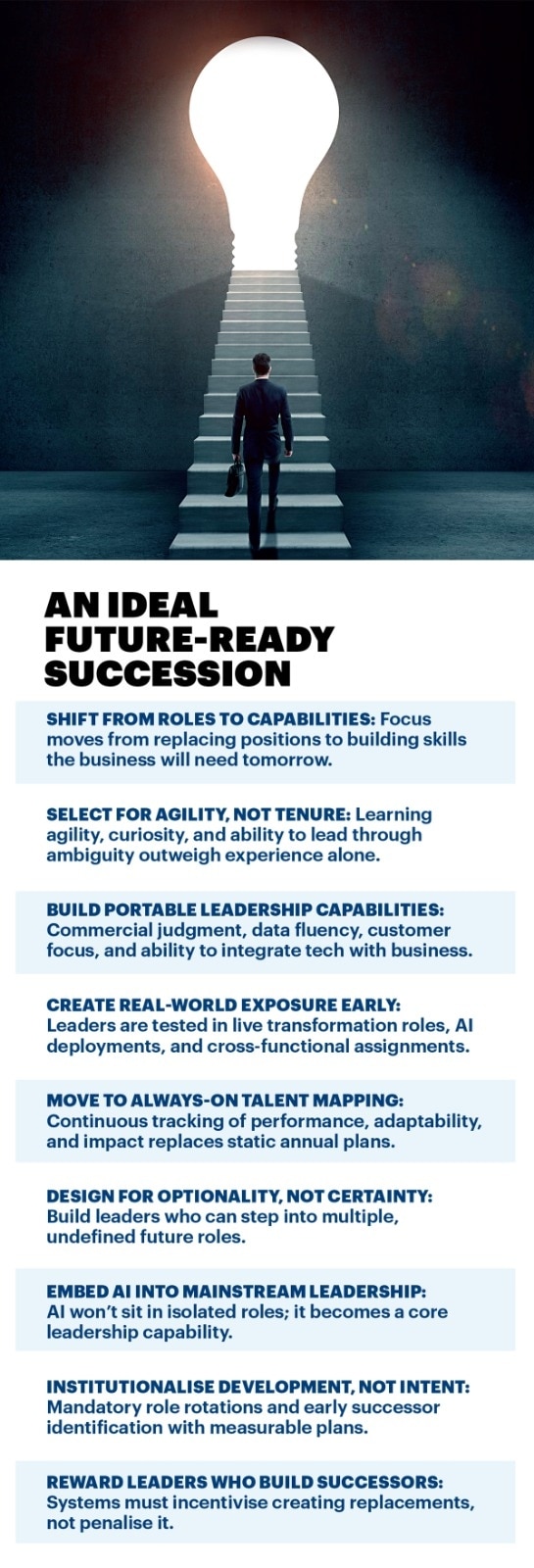
The organisations that get this right shift from replacement planning to capability building. They create real-time visibility of talent, rotate leaders across roles, and expose them early to enterprise-level decision-making. “Succession then stops being about ‘who is next’ and becomes about ‘who is continuously being prepared,’” he says.
Sandeep Bhalla, Senior Partner & Head Consulting at business management consultant firm, Korn Ferry India, says succession challenges are fundamentally a pipeline and readiness issue. “Too often, succession is treated as a moment in time rather than a continuous, board-led process. While organisations build functional and technical leaders effectively, far less attention is given to developing enterprise leaders who can step into CEO or C-suite roles with credibility from Day One,” he says.
What appears as a capability gap is often driven by weak pipeline building, limited cross-functional exposure, and an overestimation of who is truly ready. “In many cases, it is not the absence of talent, but the absence of disciplined preparation,” he adds.

NEED TO LOOK OUTSIDE
Succession planning is a priority for most organisations, but execution remains the biggest challenge.
Mark Braithwaite, Managing Director—Asia Pacific at global executive search and leadership advisory firm Odgers, notes that as organisations navigate ongoing global disruptions, leadership movement will continue.
“The intent to build strong internal pipelines is clear, but the reality is more complex. High-potential leaders, by nature, are ambitious and unwilling to wait indefinitely for the top role. You can’t expect someone who is ready to be a CEO to sit in line,” says Braithwaite.
Traditionally, organisations have relied on grooming internal talent, rotating leaders across roles and building exposure over time. While this approach has worked for large organisations, it is far from foolproof.
As a result, many companies turn outward. External hiring, says Braithwaite, is often driven by the need to bring in fresh perspective. “If organisations were completely confident about an internal successor, they likely wouldn’t initiate a search in the first place,” he says.
There are also structural challenges. Functional leaders, such as CFOs, may be considered potential successors, but not all transitions translate effectively into broader CEO roles. The leap from functional expertise to enterprise leadership is not always seamless.
Ultimately, the biggest disruption to succession planning is unpredictability. While plans are often built around orderly transitions, reality rarely follows that script. In such moments, the absence of a ready successor becomes starkly visible and urgency leaves organisations with little choice but to look outside.
Mitra says the instinct to hire externally is understandable, but over-reliance often signals that internal depth hasn’t been built early enough. He also emphasises structural shifts. “Organisations need an internal talent marketplace where careers are non-linear across functions. This builds both speed and depth.”
Bhalla, on the other hand, believes external hires are typically far more disruptive than boards anticipate, culturally, politically, and operationally.
FUTURE-PROOFING SUCCESSION
Forward-looking organisations are rethinking beyond job titles to focus on future-critical capabilities.
“The emphasis is shifting to agility, adaptability, judgment, and the capacity to lead transformation in uncertain environments,” says Bhalla.
In a world of dynamic changes, Bhalla says he has seen this shift earlier with strategy and digital roles, and believes AI is following a similar pattern. “Only a small number of companies will create dedicated AI leadership roles at the top. For most, AI capability will be embedded into mainstream business leadership, with technology leaders enabling the shift and business leaders owning the transformation,” he adds.
Mitra says this shift is already changing how leaders are prepared on the ground. He adds that leading organisations are also rethinking how they track and evaluate leadership readiness.
Hidden Gaps
Organisations often overestimate how ready the successors chosen by the companies are.
Experience is necessary, but it is only the entry ticket. “Many organisations still equate tenure, domain expertise, or P&L exposure with readiness for the top job, when senior leadership demands something much broader. What matters most at that level is leadership maturity, judgment, gravitas, resilience, and the ability to align stakeholders through uncertainty,” says Bhalla. He adds that the deeper issue is understated. “The more uncomfortable truth is that many companies are not just misjudging readiness, they are overstating it.”
“The gap is usually visible, but not acted on because confronting it can unsettle the incumbent or force difficult succession decisions earlier than the organisation wants,” he notes.
Family vs Corporate Process
Succession planning in India, particularly within family-led enterprises, often operates in silence unspoken, informal, and deferred.
As Rajiv Gupta, Chairperson, School of Family Business, Masters Union, puts it, “Ask any promoter what happens if something happens to them tomorrow. That silence is the answer. In most cases, that silence itself is the succession plan.”
While professional firms at least articulate succession through frameworks and policies, family businesses often bypass formalisation altogether. Succession is assumed rather than designed, typically following traditional inheritance patterns.
Across both models, successors are often protected rather than tested, leaving readiness presumed rather than proven. What works, according to Gupta, is far more deliberate. Structured job rotations, mandatory identification and early development of successors, and critically a system that rewards leaders for building replacements rather than penalising them.
Ultimately succession must be owned at the very top. Without CEO or promoter-level commitment, it risks becoming a compliance exercise. Even with structure, intent can falter.
In most cases, though, succession failure extends beyond governance. It impacts employees, destabilises organisations, and ripples across the broader ecosystem. As Gupta frames it, leadership transition is less about planning for replacement and more about building continuity before it is urgently needed.
The question is not ‘who is next?’ It’s whether anyone is truly ready when it matters.


