













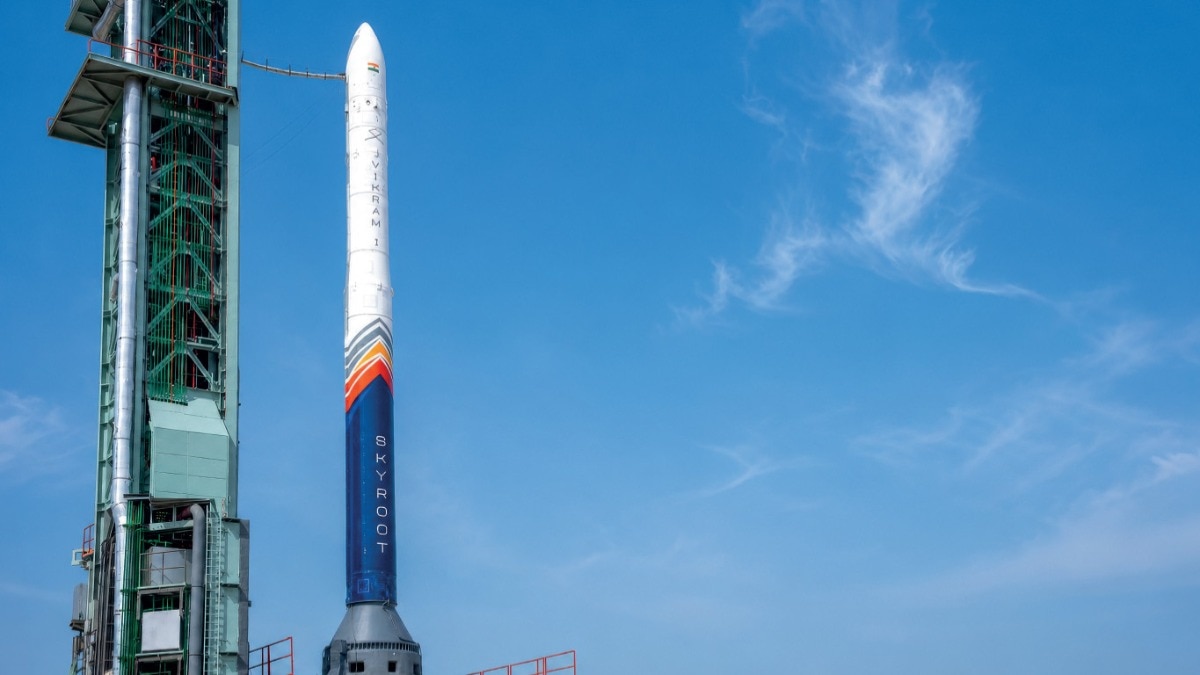
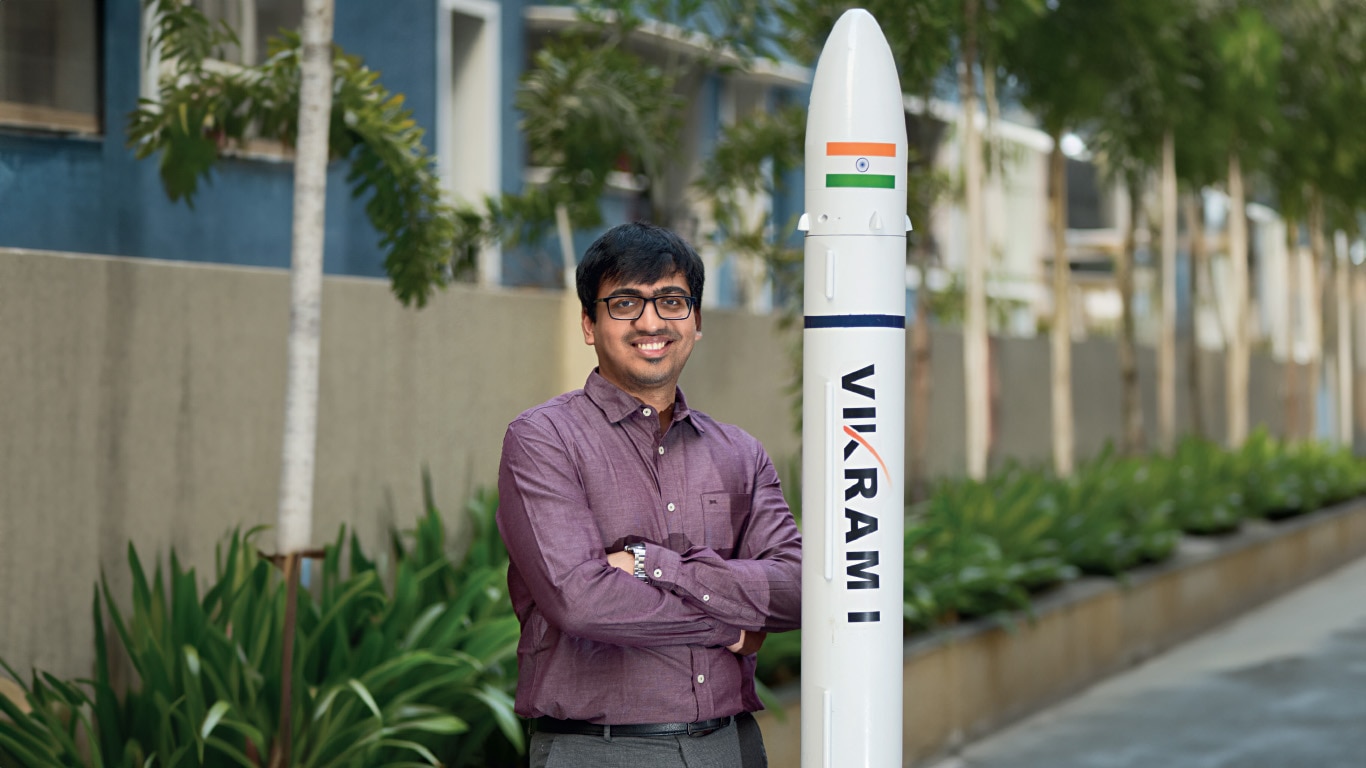
Skyroot aerospace’s maiden test flight of Vikram-1 on July 18, 2026, was the first time an orbital-class rocket, fully designed and developed by a private player, lifted from Indian soil. “It is the biggest step we have taken. In just over four years we have gone from Vikram-S, India’s first private rocket, on a suborbital demonstration, to attempting orbital launch. That is a large leap,” Co-founder and CEO Pawan Kumar Chandana tells BT in an interview.
A mechanical engineering graduate from IIT Kharagpur, Chandana joined Indian Space Research Organisation (ISRO) as a scientist in 2012, spending nearly six years working on India’s launch vehicle programmes. In 2018, he took the entrepreneurial plunge with Co-founder Naga Bharath Daka, launching Skyroot Aerospace at a time when India had neither a private space policy nor an established funding ecosystem for space start-ups.
Unlike Vikram-S, Vikram-1 is a multi-stage orbital rocket. “Vikram-S validated the foundation. It proved our propulsion systems, our composite structures, and that a private Indian team could build and fly a rocket,” says Chandana.
“Vikram-1 is a completely different challenge. It has multiple stages. It has to reach orbital velocity. It is heavier and far more complex. Successfully launching Vikram-1 means proving our actual commercial product. It shows that we can reliably take a customer’s satellite and place it in the intended orbit. For customers, that changes us from a promising team into a launch provider they can trust. For investors, it de-risks our path to higher launch cadence and sustained revenue,” he says.
Vikram-1’s first test flight is a data-gathering mission. “We will be getting real-flight data from every system, which no ground test can give us, and which feeds straight into the vehicles that follow. This will be significant for us and the national space ecosystem,” says Chandana.
Skyroot’s plan is to establish commercial readiness quickly, through a short series of test flights, and then build cadence.
The second Vikram-1 rocket is already under production. Across Skyroot’s two Hyderabad campuses, the company has built manufacturing capacity for one Vikram-1 rocket every month, positioning itself for regular commercial launches.
Skyroot expects about two-thirds of its demand to come from international markets. “Roughly two-thirds international and one-third India today, and we expect the international share to remain the majority in the near term, mainly from the US, Japan, Europe and Southeast Asia,” says Chandana.
On being asked if Indian space-tech start-ups are competing with ISRO, Chandana says private players are complementing the state-run agency. “Governments have played a major role in sustaining every successful private launch company. You can see this across advanced spacefaring nations. This is how the ecosystem works. We exist because ISRO built the foundation that makes a private launch industry possible,” he explains.
Skyroot Aerospace raised nearly $60 million in a funding round in May to become India’s first spacetech unicorn with a pre-money valuation of $1.1 billion.
When Srinath Ravichandran, co-founder and CEO of Agnikul Cosmos, was growing up in Chennai in early 2000, he wanted to become an aerospace engineer. But with few opportunities in India’s space sector at the time, he took a more conventional path, studying electrical engineering instead. After working in India for a few years, he moved to the US, driven by a desire to make money on Wall Street, where he spent nearly a decade in finance. Yet, despite the successful career, Ravichandran realised that his heart is still in aerospace. He went back to school for a second master’s degree—this time in aerospace engineering—and even before graduating, relocated to Los Angeles, the heart of the space-tech industry. Convinced that India could build this future, Ravichandran returned home to start Agnikul Cosmos, a space-tech start-up that aims to make rocket launches for small satellites commercially viable. He roped in rocket scientist Satyanarayanan Chakravarthy from IIT Madras. Co-founder Moin SPM used to run a contract manufacturing business in Chennai.
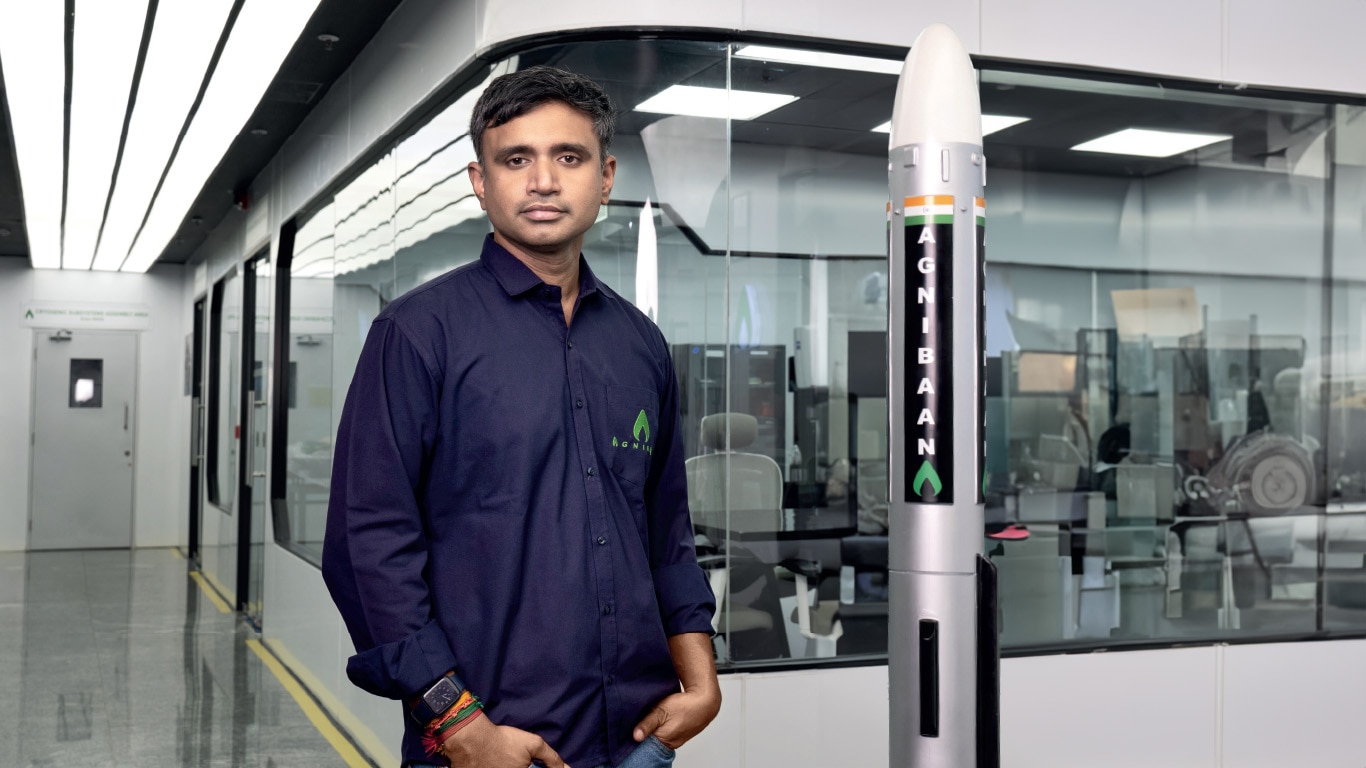
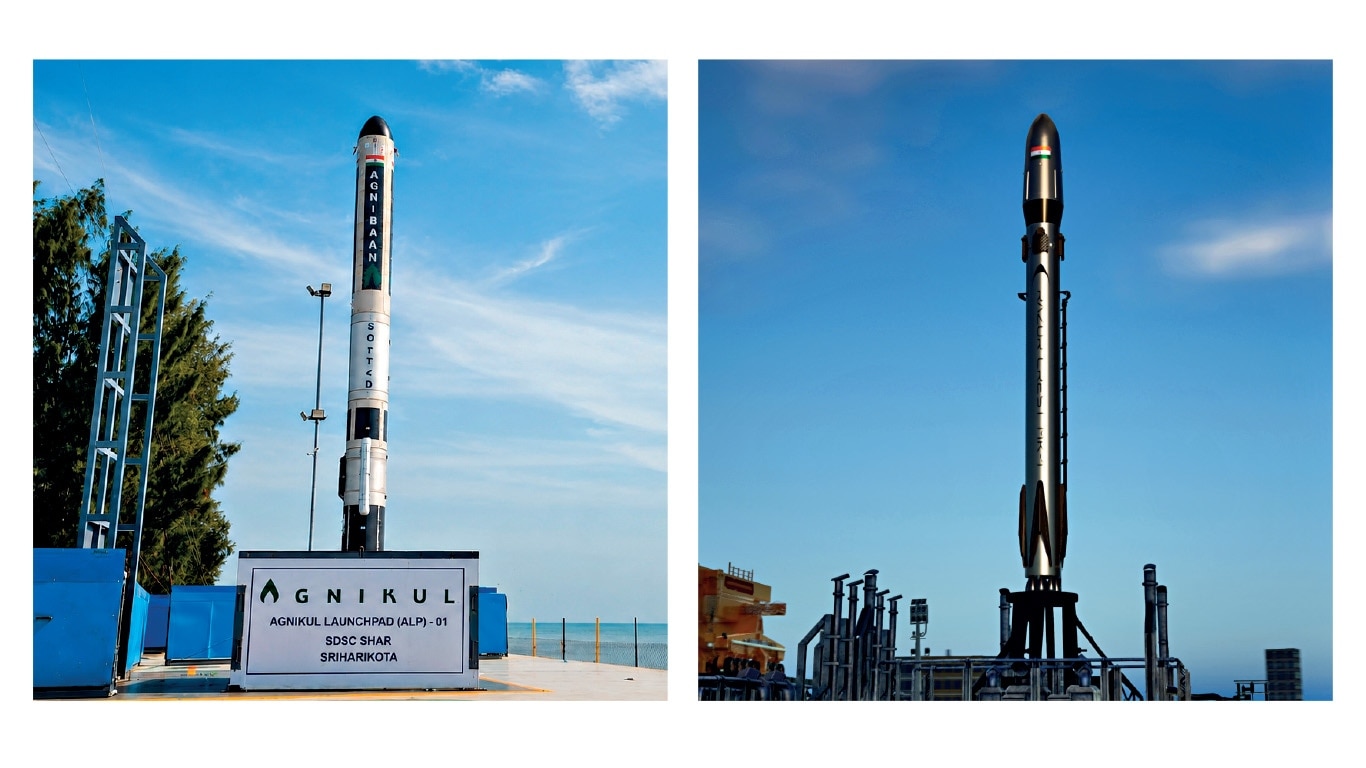
“The idea was to enable small satellites to go to space efficiently. We set out on a journey to build new technologies for this,” Ravichandra tells BT. “What we quickly realised was that existing technologies of rocketry were optimised for larger rockets, so we couldn’t apply that directly to smaller rockets,” he adds.
Agnikul Cosmos, which has raised $60 million so far, completed its first test mission in May 2024 to demonstrate everything that it built. “Now we are onto the commercial space. It will happen by early next year,” says Ravichandran.
Like SpaceX pioneered reusability for big rockets, Agnikul wants to do it for smaller rockets.
Agnikul’s first commercial orbital mission, which it expects to undertake as early as next year, will carry customer satellites while also attempting to recover the rocket’s first stage and keep the upper stage operational in orbit, marking the company’s first step towards reusable launch vehicles. “This mission will prove reusability for us,” says Ravichandra, adding that no company has attempted recovery yet.
In 2024, the IIT Madras-incubated start-up launched the world’s first rocket with a single piece 3D printed engine from Sriharikota with the help of IN-SPACe and ISRO.
Beyond launch services, Agnikul plans to evolve into a full-stack space company by expanding into satellite propulsion services. The company sees significant opportunity in the underserved small satellite launch market, where customers often face delays, higher costs and compromises when flying as secondary payloads on larger rockets.
At 27, Manu J. Nair, co-founder and CEO, EtherealX, is attempting something few aerospace companies in the world have dared to pursue: building a fully reusable medium-lift rocket capable of competing with SpaceX’s Falcon 9-class launch vehicles. Founded in 2022, the start-up grew out of an informal dinner conversation between Nair and his co-founders Shubhayu Sardar and Prashanth Sharma. “I was supposed to move to the US, Prashanth had an offer from Rocket Lab, and Shubhayu was in ISRO where I had joined as a project associate right out of college for a brief six-month stint. The dinner conversation was about access to orbit still being a luxury. We went down that rabbit hole of why it was the case and found out that most were building small rockets while the market was shifting towards larger constellations,” Nair tells BT.

Reusable medium-lift rockets offered far greater economic advantages than small launchers. “From a customer perspective, satellite operators would ideally have most of their constellations go up in a single go rather than paying a higher cost per kg in a smaller rocket and doing multiple launches. We realised that the single advantage of a small rocket was that it could be launched on demand or frequently. But that advantage was only relevant until reusability was not there in the picture. When reusability came into existence, the frequency advantage got wiped away,” says Nair.
However, replicating SpaceX’s model was impossible due to its vertically integrated operations, Starlink revenues, government contracts, and massive manufacturing scale.
“That’s when we realised that if there has to be another successful launch company, then you should be able to operate in this class of payload while retaining the cost and frequency advantage,” says Nair.
While Skyroot and Agnikul are working in small satellite rocket segments, EtherealX’s rockets will have a 20-tonne capacity, the same as SpaceX’s Falcon 9 class. “Differentiating us from SpaceX will be full-stack reusability,” says Nair.
But there are challenges. “The infrastructure for testing rocket engines is not there.”
EtherealX aims to launch its first rocket by February 2028. In January 2026, Ethereal Exploration Guild (EtherealX) announced a $20.5 million Series A funding round.
Bellatrix’s journey began in 2011, when co-founders Rohan M. Ganapathy and Yashas Karanam were engineering students looking to build an innovative satellite technology that could earn them a patent and help them secure admission to Ivy League universities.
Initially, the team experimented with rocket engines but soon realised the economics of reusable launch vehicles made the business impractical for a young Indian start-up. Building a competitor to SpaceX would have required hundreds of millions of dollars in investment.

“As a company, way back in 2014-15, getting $300-500 million in India was an insane thought,” Karanam tells BT in an interview. Instead, they shifted focus to satellite propulsion, where they believed they could create differentiated technology.
The turning point came when Rohan’s research paper on water-based satellite propulsion was selected for a NASA conference, where he met astronauts Neil Armstrong and Buzz Aldrin and visited NASA propulsion facilities. The project also caught the attention of former President A.P.J. Abdul Kalam, who encouraged the founders to build the technology in India and offered a recommendation letter.
“That letter somehow helped us raise money through industry CSR funds as use of water in electric propulsion of satellites was very novel,” says Karanam.
Their next milestone came when ISRO agreed to validate the technology and eventually awarded Bellatrix its first contract. The company was formally incorporated in 2015 to execute that order.
There was no turning back. After working with ISRO, the founders travelled internationally to meet satellite manufacturers and understand emerging market needs.
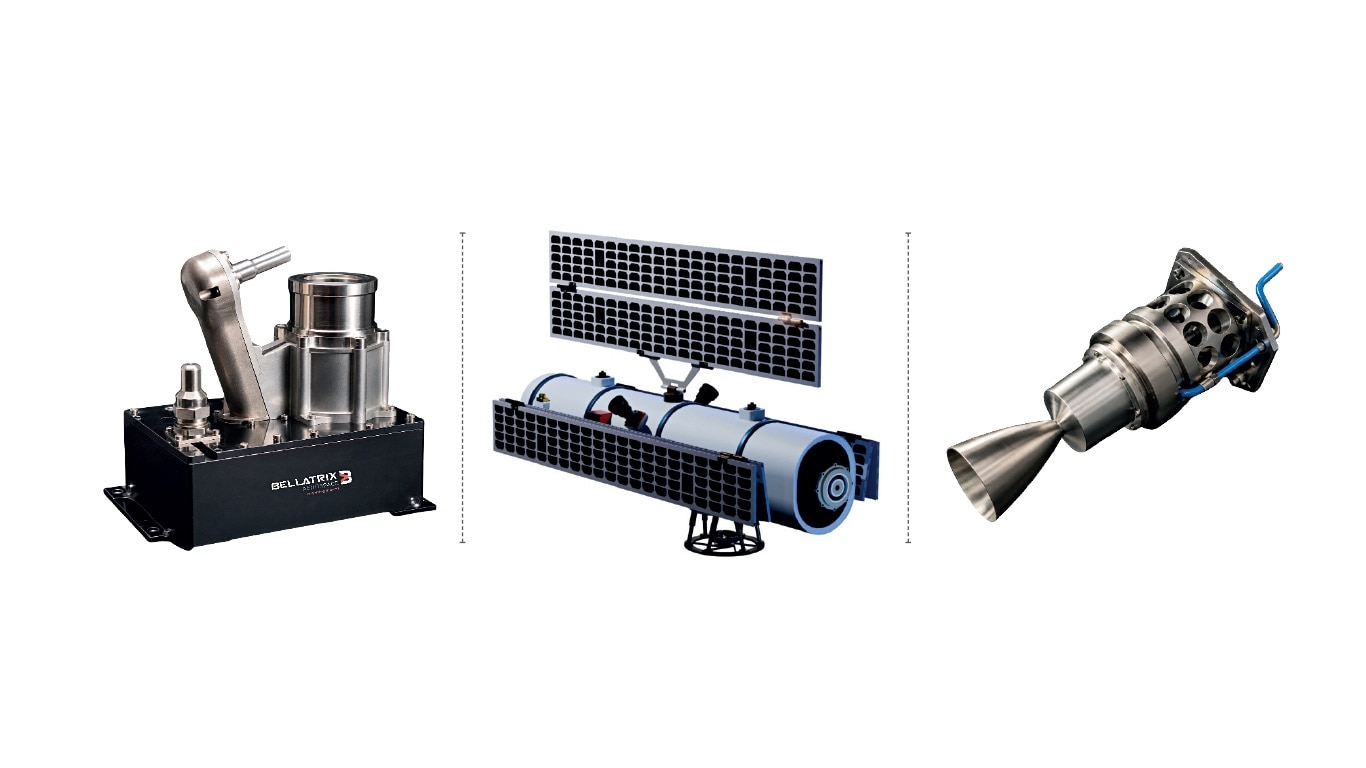
They observed that the satellite industry was rapidly moving from large geostationary satellites to smaller satellites operating in Low Earth Orbit (LEO) at altitudes of 600-1,000 kms.
Existing propulsion systems were designed for an earlier generation of satellites and were often bulky, expensive and heavy. Bellatrix decided to build a portfolio of compact propulsion systems tailored to this new generation of satellites.
One of Bellatrix’s major goals has been replacing traditional toxic propellants with environmentally safer alternatives. “We wanted to move from hydrazine-based propulsion systems to green propulsion systems,” says Karanam.
Bellatrix earns most of its revenue from exports, supplying propulsion systems directly to satellite manufacturers around the world. The Bengaluru-based start-up has raised approximately $31 million in funding so far.
@karandhar11


