












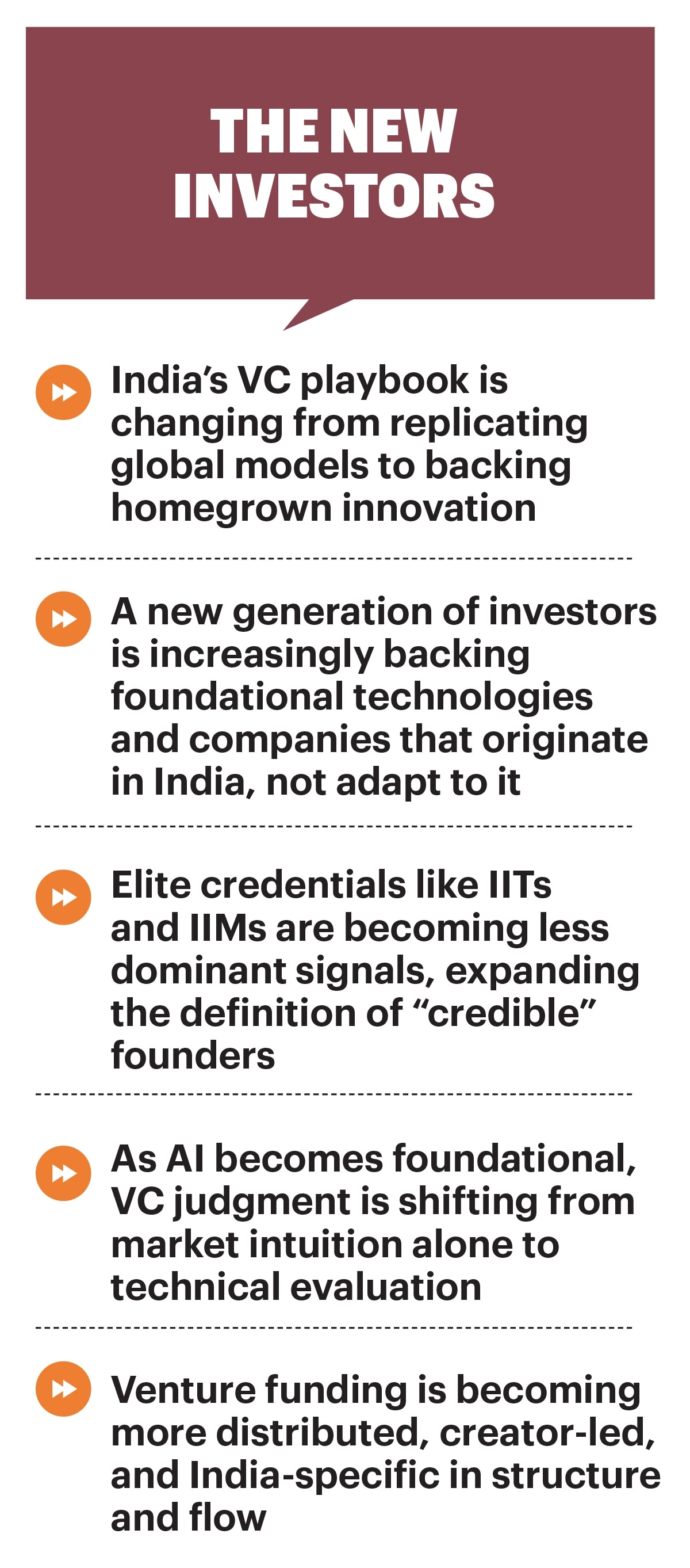


To the first generation of Indian venture capitalists (VCs), global playbooks offered the clearest reference points to start-ups they replicated at home—in ecommerce, food delivery, ride sharing, or for that matter, in any consumer internet category.
Those investors also put great store by the pedigree of start-up founders; to them, someone with an IIT or IIM degree was special.
All that is changing, as are the requirements of the VCs themselves, who now, more than ever, need to assess unfolding technological innovations with acumen and foresight.
Past generations of VCs looked overseas for concepts that had scaled and could be adapted to the Indian market, be it ridership giant Uber or online retailer Amazon.
The underlying logic was replication, localisation and scale in a rapidly expanding digital market.
In contrast, as millennials and investors in their 30s gain influence in VC firms and angel networks, they are not looking at what has worked elsewhere and can be brought to India. They are instead focusing on what can be built in India without a global template. They are expanding the definition of venture investing itself.
At the moment, capital is flowing towards AI, deeptech, advanced manufacturing and strategic technologies (quantum computing, augmented analytics, autonomous things), areas VCs believe will define the next phase of India’s economic transformation.
These millennials, who have witnessed India’s transition from scarcity to abundance, are allocating capital differently.
“We have grown up seeing the scarcity that India has lived with since independence. And then, within our own lifetimes, we have seen a remarkable shift,” says Pranav Pai, Managing Partner at 3one4 Capital.
Pai is recalling a time when each school had just one computer, typically used only by the teacher and guarded like a museum artifact. Now, a computer sits in every pocket; it is called a smartphone. From a technology viewpoint, it has been a miraculous 30 years.
Digital Leap
This shift is being shaped by a generation that has grown up alongside India’s digital vault from scarcity to scale, from limited telecom connectivity to near-universal access.
Having witnessed how quickly technology adoption reshaped daily life and the markets, Pai says young VCs are now backing founders who are focusing less on importing proven models and more on identifying foundational technologies that can originate from India.
Pai, who has a master’s degree in electrical engineering from Stanford University, co-founded 3one4 Capital in 2016 after working at online learning platform EdCast as a Senior Product Manager in San Francisco.
The start-ups he has backed include AI-powered HR management platform Darwinbox, remote patient monitoring company Dozee, deeptech start-up Agnit Semiconductors, air ambulance and taxi maker ePlane Company and online meat shop Licious.
Many of today’s emerging investors are former company founders, operators and product leaders who have grown alongside India’s digital economy.
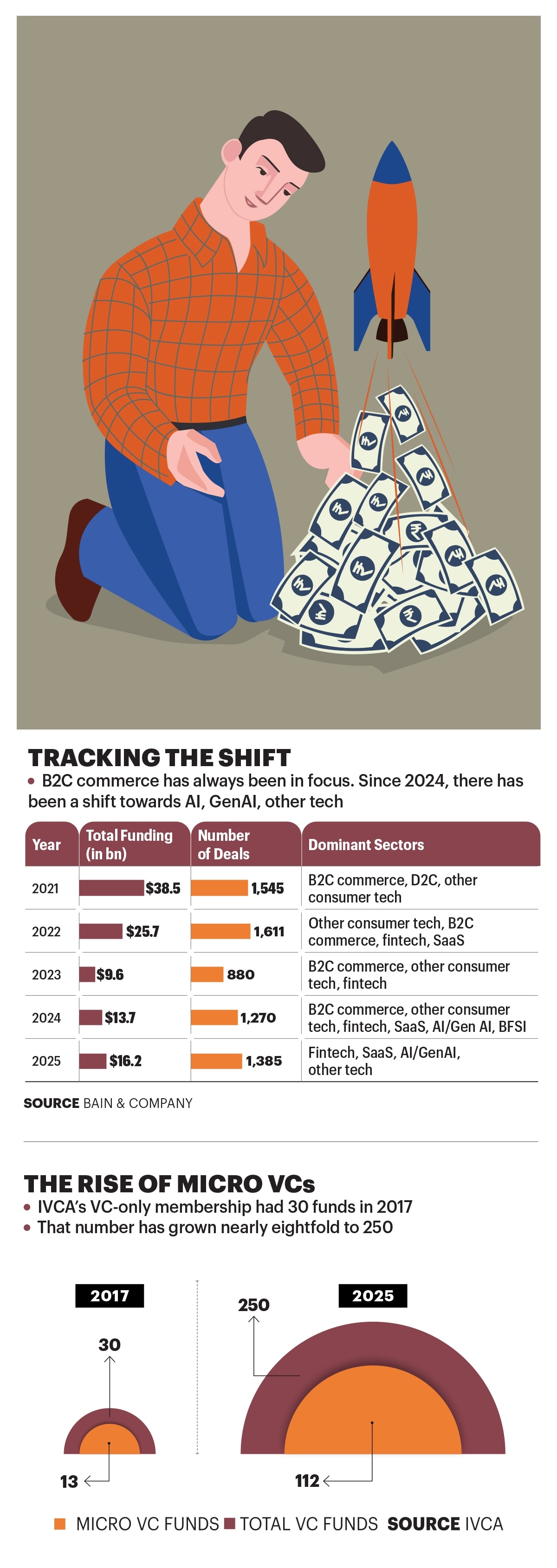
India’s VC ecosystem has undergone a decisive structural shift over the past decade, and nowhere is this more visible than in the rise of micro VCs , says the Indian Venture and Alternative Capital Association (IVCA).
According to the IVCA, the association’s VC-only membership was 30 a decade ago. Today, that number has grown nearly eightfold to 250 venture capital firms. Close to 45% are micro VCs.
Valley of Death
These funds play a critical role in bridging the Valley of Death—the phase start-ups experience as they burn through initial capital in the process of developing products and markets.
These start-ups work across emerging sectors such as GenAI, climate tech, deeptech and consumer platforms.
In this emerging playbook, venture capital is not just financing business models, but participating in the creation of new ones that align with India’s ambition of moving from a $4-trillion to a $10-trillion economy over the coming decade.
The first wave of India’s venture capital boom, which gathered momentum after 2008-09 and helped create the likes of Flipkart and Zomato, was shaped by a fairly familiar founder profile.
Many entrepreneurs came with elite educational credentials—often IITs, IIMs or global universities—and strong professional pedigrees built at multinational companies or consulting firms.
Today’s investors like Aditya Singh, co-founder of All in Capital who was also the Founding Principal of Stride Ventures, argue that those filters are becoming less relevant.
“A non-IIT student also gets funded. Back in the day, it was borderline impossible,” says Singh, an MBA from IE Business School in Madrid.
The change is partly generational, says Singh. “We are young. We don’t relate with someone who has 40 years of experience. We feel someone new will come and change it. So, we start backing younger folks.”
All in Capital is operating its second fund with a corpus of `250 crore and has backed start-ups like PierSight, which is building satellites to enable persistent ocean monitoring; home decor and furnishing start-up Vaaree; and AI-powered fuel station aggregator Nawgati.
Not Exceptions
To be sure, there have always been notable exceptions. Entrepreneurs like Ritesh Agarwal, CEO of hotel room aggregator OYO Rooms, and Kunal Shah, founder of payments firm FreeCharge and credit-card bill payment rewards company CRED, defied expectations and built category-defining businesses despite not fitting the mold of the traditional venture-backed founder.
They were outliers.
Increasingly, venture investing requires the ability to assess the underlying technology, the quality of research talent and the pace at which innovation is unfolding.
Sathya Nellore Sampat, General Partner at BoldCap Ventures, which focuses on AI investments, says, “If you truly want to invest in AI, especially frontier intelligence, it is hard to do so without technical abilities to understand what is being built.”
BoldCap is a seed-stage fund backing founders of artificial general intelligence (AGI) companies.
The VC ecosystem has largely been about identifying market opportunities, understanding customer behaviour and backing teams capable of capturing demand, says Sampat, who has a master’s degree in science from New York University.
While those fundamentals remain important, the rise of AI has introduced a new variable that needs technical depth.
Outperformers
Deeptech investment has seen an exponential rise over the years. According to a report compiled for investor consortium India Deep Tech Alliance by data provider Venture Intelligence, in 2025, capital flowed decisively towards technology-led sectors.
Total VC investment in India held steady at about $10 billion, but within that headline number, AI and deep tech outperformed, even as overall venture activity moderated.
The shift is unfolding alongside another change in India’s venture ecosystem—the rise of founders-turned-investors.
As the first generation of start-up founders creates wealth through exits, acquisitions and IPOs, many are returning to the ecosystem as angel investors and fund managers, bringing operating experience plus capital.
“We have reached a phase where the first generation of internet companies has gone through a full cycle. Some have sold, some are scaling, some are IPO-ing. The value created is being ploughed back into the ecosystem,” says Arjun Vaidya, founder of V3 Ventures.
Founders-turned-investors often bring greater empathy and a deeper understanding of the entrepreneurial journey than traditional financial investors, says Vaidya, who holds a bachelor’s degree in international relations and economics from Brown University in the US.
Becoming More Indian
Vaidya started his D2C brand Dr Vaidya’s in 2016 to take over his family’s 150-year-old Ayurvedic heritage and later sold the business to the RP Sanjiv Goenka Group.
The new generation of VCs is emerging at a time when venture capital itself is becoming more Indian, says Vaidya.
Successful IPOs and exits have begun convincing domestic investors that start-ups can create value, spawning a flywheel of local capital backing local entrepreneurs.
While deeptech investments are rising, for Vaidya, consumer internet is an evergreen sector that will continue to attract investments.
Vaidya has invested in companies like audio app KuKu FM, skin care brand Deconstruct and online plant store Ugaao.
Today’s investors, through social media, content creation and online communities, are engaging directly with founders and discovering opportunities beyond conventional venture circles.
If the first phase of the Indian VC ecosystem was defined by a singular pursuit of scale, the new generation appears more comfortable with multiple routes to value creation.
Some are backing AI and frontier technologies that require years of research before commercialisation.
For Pai, the opportunity lies in building for an India that is still in the midst of a once-in-a-generation economic expansion.
Sampat sees the shift through a technological lens. In the era of AI, venture investing is becoming less about spotting market trends and more about understanding technical breakthroughs, he says.
Vaidya believes the ecosystem itself is becoming more diverse and the pathways to entrepreneurship and funding are broadening.
Together, these shifts suggest that India’s venture capital players are not united by a single investment thesis. What binds them is a belief that the next generation of breakout companies may emerge from places, sectors and founders that earlier playbooks may have missed altogether.
@PalakAgarwal64


