














For nearly three decades, Smitha M. V. (54) has built her career by doing something many professionals stop doing after reaching senior positions: starting over. From product engineering at Wipro to digital skilling at NASSCOM, start-ups, the gig economy and now Artificial Intelligence (AI), every transition demanded new skills and a new way of thinking. “Experience becomes valuable only when it evolves with the changing needs of business,” she says.
Her observation captures the dilemma facing millions of experienced professionals today. Companies say they value experience more than ever, yet many senior employees worry whether they are becoming less relevant in an AI-driven workplace.
“Technology evolves, industries transform, customer expectations shift, business priorities change,” she says. The ability to understand these shifts and adapt quickly is becoming more valuable than deep expertise in a single area.
AI is the latest example. Experienced professionals do not need to become AI experts, she says, but they do need to understand how AI is changing work—and how it can create greater business value.
“The bigger lesson was that relevance comes from continuously understanding the context around you and adapting your skills to it.”
Rethinking Retirement
For Jamuna Ravi, CEO of Vayah Vikas, the conversation goes beyond employment. Vayah Vikas is a tech-driven community ecosystem that supports senior citizens through healthcare, digital literacy, financial independence, and active post-retirement engagement.
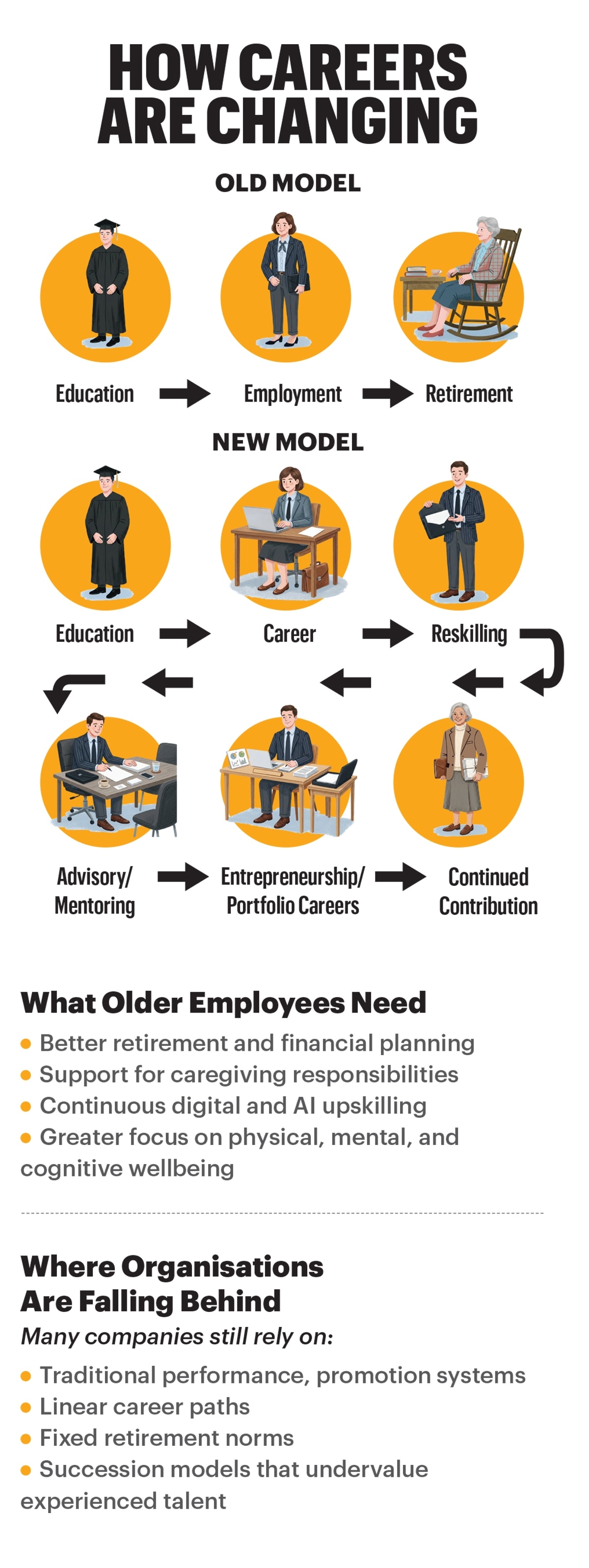
“Retirement marked the end of one’s primary professional identity for decades,” she says. “With longer life expectancy, better health and changing aspirations, that model is becoming increasingly outdated,” says Ravi.
Rather than retirement planning, Ravi advocates “life progression planning,” where the focus shifts from stopping work to continuing to grow, contribute and find purpose.
She believes one of the biggest misconceptions about experienced professionals is that they are less adaptable or less interested in learning. “Most experienced professionals have already adapted through multiple waves of technological change—from computers and the internet to smartphones and cloud platforms. AI is another significant shift, but it is not the first,” she says.
Ravi believes one of the biggest misconceptions about experienced professionals is that they are less adaptable or less interested in learning. Most have already navigated multiple waves of technological change from computers and the internet to smartphones and cloud platforms. AI is simply the next transition, not the first. “What worries many people more is not learning new technology, but the fear of becoming less relevant,” she says.
Rather than viewing generations in competition, she sees them as complementary. Younger professionals bring digital fluency, curiosity and fresh perspectives, while AI adds analytical capability. Experienced professionals contribute judgement, context and perspective.
“The organisations that succeed,” she argues, “will be those that combine the innovation of younger employees, the judgement of experienced professionals and the analytical power of AI.”
The Confidence Gap
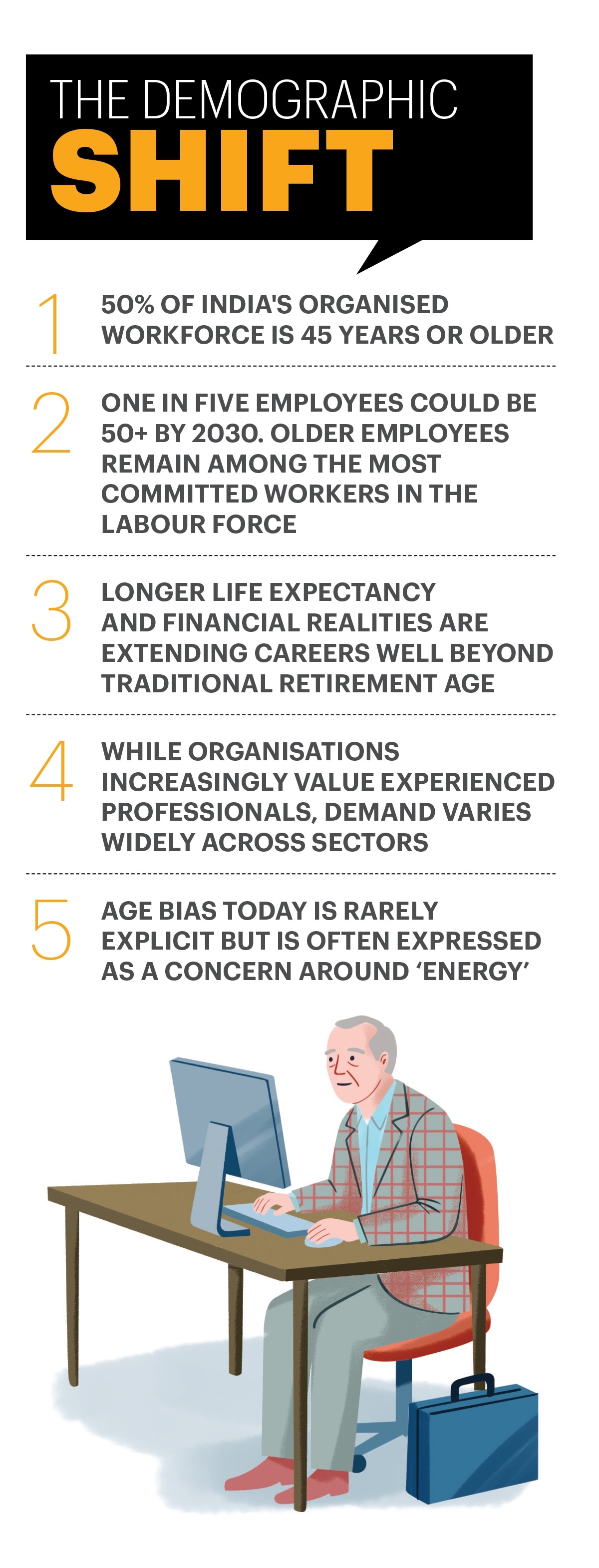
Older employees remain among the most committed workers in the labour force. According to ADP’s People at Work report, workers aged 55 and above are just as likely as younger colleagues to find meaning in their work, report high levels of engagement and least likely to be planning to quit.
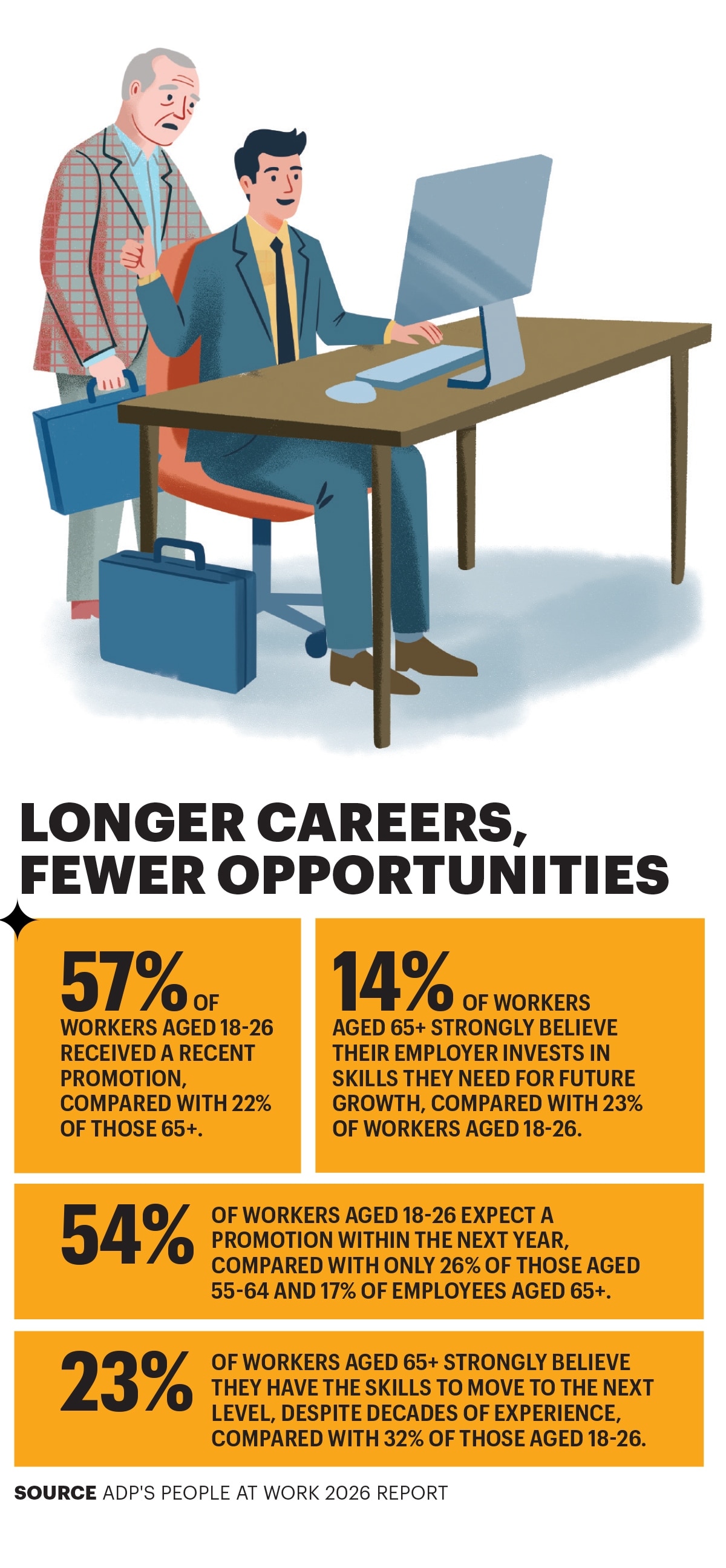
Yet that commitment is not matched by confidence about the future. Confidence about career progression steadily declines with age, regardless of education level. Among college-educated employees aged 18 to 26, nearly one in three (32%) strongly believe they have the skills needed to move to the next level in their careers. That falls to 27% among employees aged 40-54, 22% among those aged 55-64 and 23% among workers aged 65 and above.
The decline extends beyond self-belief. Only 13% of college-educated workers aged 55-64 and 14% of those aged 65 and above strongly believe their employer is investing in the skills they need for future career growth, compared with 23% of employees aged 18-26.
Career progression reflects the same trend. Nearly 57% of college graduates aged 18-26 report receiving a recent promotion, compared with 40% of employees aged 40-54, 30% of those aged 55-64 and just 22% of workers aged 65 and above. Expectations of future advancement decline just as sharply, from 54% among younger graduates to only 26% of employees aged 55-64 and 17% among those over 65. The uncertainty extends beyond career progression to the external job market.
Nearly half (47%) of college-educated employees aged 65 and above believe changing jobs has become harder over the past year, compared with 43% of workers aged 18-26. While 16% of younger graduates believe changing jobs has become easier, only 4% of workers aged 65 and above agree.
Four in ten college-educated employees aged 65 and above believe job opportunities are neither improving nor worsening, suggesting they see the labour market as increasingly static rather than expanding.
Experienced professionals remain committed to work yet feel increasingly uncertain about their future both within organisations and in the broader labour market.

Experience and Hiring
If older professionals are growing less confident about their career prospects, employers appear to be moving in the opposite direction. Neeti Sharma, CEO of TeamLease Digital, says age is gradually becoming less of a hiring barrier, although it has not disappeared entirely.
“Today, employers are looking less at someone’s age and more at whether they can adapt, learn and stay relevant,” she says. “Skill shortages are making companies value the experience, stability and mentoring that senior professionals bring, particularly in areas such as AI, cybersecurity, Global Capability Centres and consulting.”
Age bias has not disappeared. Around 15-20% of professionals still report experiencing age discrimination. But Sharma believes the hiring conversation is shifting from years of experience to the ability to evolve. That shift is reflected in the growing demand for business transformation, governance, advisory and fractional CXO roles, where judgement and leadership matter as much as technical expertise.
“As AI changes the way businesses work, companies are realising technology alone isn’t enough,” Sharma says. “They also need people with sound judgement, leadership experience and ability to manage change. That’s why many forward-looking organisations now see experienced professionals as a strategic advantage rather than a cost.”
Experience Is in Demand
While organisations increasingly value experienced professionals, demand varies widely across sectors, says Sonal Bahl, Partner at global executive search and leadership hiring firm Positive Moves. She points out that private equity-backed firms actively seek seasoned CEOs and board members who have navigated multiple business cycles, transformations and periods of uncertainty.
The picture is different in consumer technology and new-age start-ups. “Companies such as Zomato, Swiggy, and Flipkart have built leadership teams around younger founders and executives who closely mirror the customer base they serve,” she says. Even FMCG firms are increasingly handing digital businesses to younger leaders with contemporary consumer insights and digital-first capabilities.
Even as boards value experience and judgement in an AI-driven world, Bahl believes those qualities are often difficult to assess in hiring processes that remain focused on measurable KPIs and short-term outcomes.
“Judgement and resilience are prized in principle, but they are hard to quantify in a hiring process built around measurable KPIs and short-term impact metrics. Often, these intangible strengths lose out to tangible, recent and quantifiable wins.”
Age bias today is rarely explicit, she says, but often appears as concerns around “energy” or “pace” that never make it onto a formal scorecard.
Many leadership mandates are widening age brackets because resilience, sound judgement and pattern recognition built over multiple business cycles are increasingly scarce among younger candidates.
The Business Case for Experience
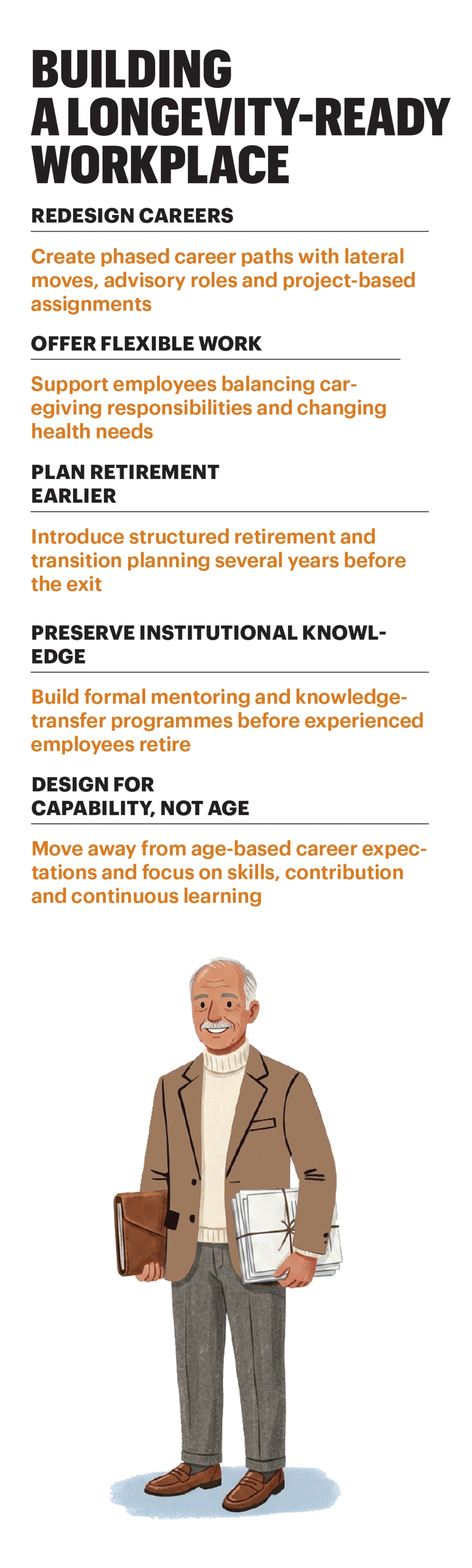
For organisations grappling with AI, the challenge is no longer choosing between younger digital talent and experienced professionals. Increasingly, business leaders argue that competitive advantage will come from combining both.
Neha Sharma, Chief Human Resources Officer at Vedanta Group, says organisations, particularly in asset-intensive sectors such as mining, metals and energy, cannot afford to lose decades of operational knowledge even as they accelerate digital transformation.
“As AI, automation and digital technologies reshape industries, the real competitive advantage will not come from choosing between experience and digital talent, it will come from combining both,” she says. “For sectors like ours, decades of operational knowledge are as critical as digital capability, making multigenerational workforces a strategic advantage.”
AI may prove to be one of the first technologies that increases the value of experienced professionals rather than diminishing it, says Prof. Saravanan Kesavan, Dean at BITSoM, provided they are willing to keep learning.
“Earlier technologies largely favoured younger people. AI is different because it favours domain expertise. To use AI effectively, you need subject knowledge and judgement. Those are capabilities that experienced professionals typically possess in greater measure.”
The bigger risk, according to Kesavan, is not age but resistance to learning.
“If someone doesn’t want to upskill or learn AI, their career lifespan will be limited. But for people in their 40s or 50s who are willing to learn, this may be the best time ever to re-enter the workforce.”
Kesavan believes AI training must start at the top. “If CEOs and senior managers don’t understand AI, they may reject good ideas simply because they don’t understand them.
That becomes a barrier to innovation.” But he warns against neglecting younger talent, saying organisations that invest only in experienced employees risk creating a “broken ladder” with too little entry-level hiring.
In an economy where people may work well into their seventies, the question is no longer whether experience matters, but whether it continues to evolve. AI may be rewriting jobs, but it is also redefining what makes experience valuable. For professionals willing to keep learning, longevity may become less a liability than a competitive advantage.


