














The financial services arm of engineering and construction giant Larsen and Toubro, L&T Finance, has seen strong growth over the last few years, amid its transition towards a retail-focused NBFC.
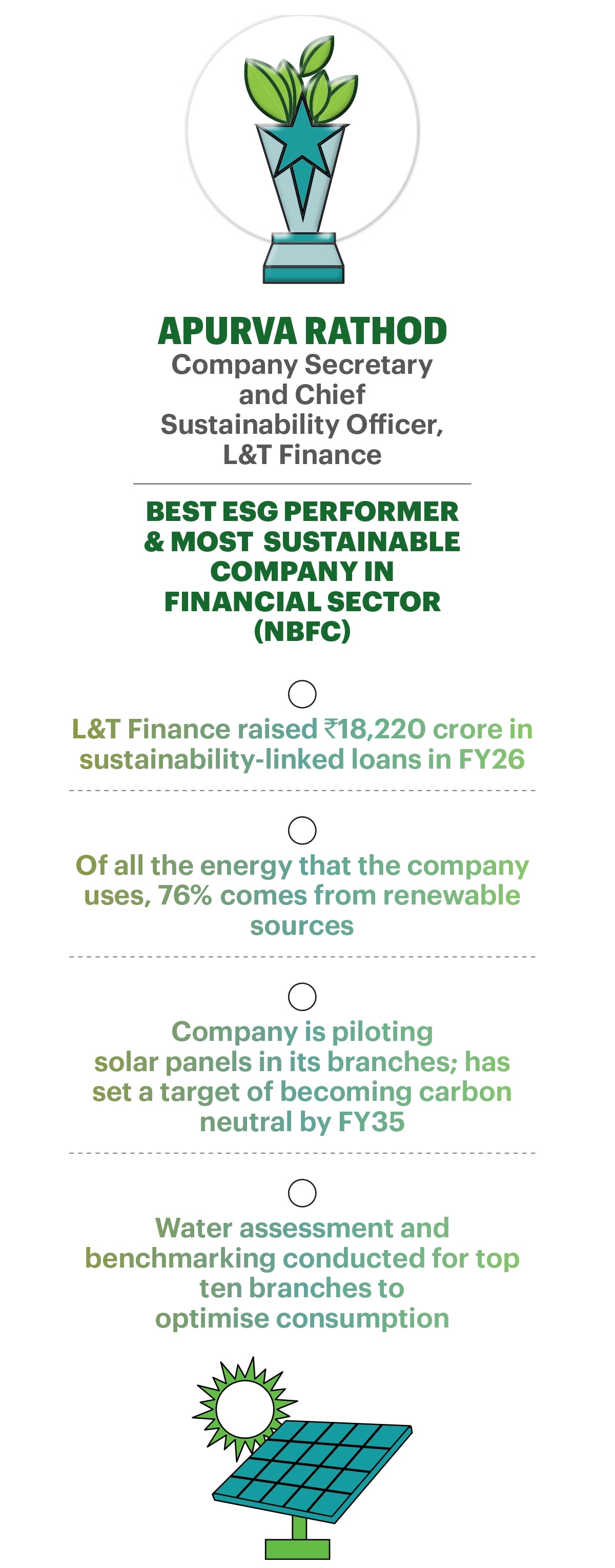
The company has been recognised as the Best ESG Performer and the Most Sustainable Company in the Financial Sector (NBFC) in this year's BT India's Most Sustainable Companies.
But a few things stand out. Around 40% of the company’s portfolio is rural focused; its rural book was over Rs 47,000 crore at the end of March 2026 with active customers across 200,000 villages.
In a way, the business is intertwined with the ESG (environmental, social and governance) framework, as it penetrates underserved geographies, generates sustainable livelihoods, promotes rural entrepreneurship and enables financial inclusion moving rural communities from unorganised to organised financing.
L&T Finance has hired over 27,000 people from rural India, and women entrepreneurs and farmers account for more than 18 million customers. According to the company, 40% of its loan book finances sustainable livelihoods.
According to Apurva Rathod, Company Secretary and Chief Sustainability Officer, L&T Finance sees sustainability as an enabler. “Each of our core portfolios has a direct sustainability link—rural business finance drives upliftment of rural women, farmer finance improves rural livelihoods, and EV two-wheeler finance contributes to India’s green economy,” says Rathod.
In FY24, the Mumbai-based company launched the sustainable finance framework, which clearly defines what qualifies as a green or a social loan.
“The framework provides a structured governance and monitoring mechanism that promotes transparency, accountability, and disciplined use of proceeds. It enables us to systematically track allocation, monitor key sustainability KPIs, and measure both financial and impact outcomes across our financing portfolio,” says Rathod.
In FY26, L&T Finance raised Rs 18,220 crore sustainability-linked loans. It financed more than 62,000 EVs during the year.
“We have expanded our sustainability-linked funding through strategic partnerships with leading global development institutions such as the Asian Development Bank and the Japan International Cooperation Agency, enabling targeted funding towards women borrowers, rural livelihoods, and climate-aligned financing,” says Rathod.
These arrangements, she says, incorporate clearly defined sustainability-linked performance indicators, and that ensures alignment between financial growth and the ESG piece.
While the company is expanding sustainable finance, it is also trying to do it in a way that it is environmentally responsible. For instance, 76% of the energy that the company uses now comes from renewable sources. L&T Finance is piloting solar panels in its branches and has set a target of becoming carbon neutral by FY35.
Rathod says they have already achieved water neutrality. The company also has an e-waste disposal policy.
L&T Finance recently unveiled Lakshya 2031, which envisages transforming into a tech-first, AI-enabled retail financier. The AI-led initiatives and digital credit assessment tools are not only improving efficiency and enabling faster decision-making but also supporting the company’s broader paperless transformation.
It has also implemented AI-based energy assessment of more than 500 branches across the country. The company says 100% of its employees have been trained on the sustainability module to build organisation-wide awareness.
According to L&T Finance, over 100,000 people have benefited through comprehensive disaster relief measures in flood-affected regions. Rathod also points that its flagship CSR ‘Digital Sakhi’ programme has reached 818,000 women this year with digital and financial literacy support, with over 1.7 million total beneficiaries across all the CSR work.
In December 2025, the company received an ESG rating of 70 from CRISIL, categorised as ‘strong.’
The rating can be attributed to the strong performance on key environmental and social parameters, including control over the intensities of scope 1 and 2 emissions and energy consumption, as well as improved performance on attrition, diversity and inclusion, according to Crisil. It has also undertaken various climate-related projects such as water assessment and benchmarking for its top ten branches to optimise consumption. L&T Finance claims 265 lakh kl of rainwater was harvested through Project Jalvaibh. Separately, through Project Prakruti, 1,521 tonnes of carbon was sequestered.
@TheNachiket


