













Cities in India are being reshaped by the need for redevelopment. The challenge for urban planners, developers and policymakers is releasing land for modern precincts. A series of experiments is creating replicable models.
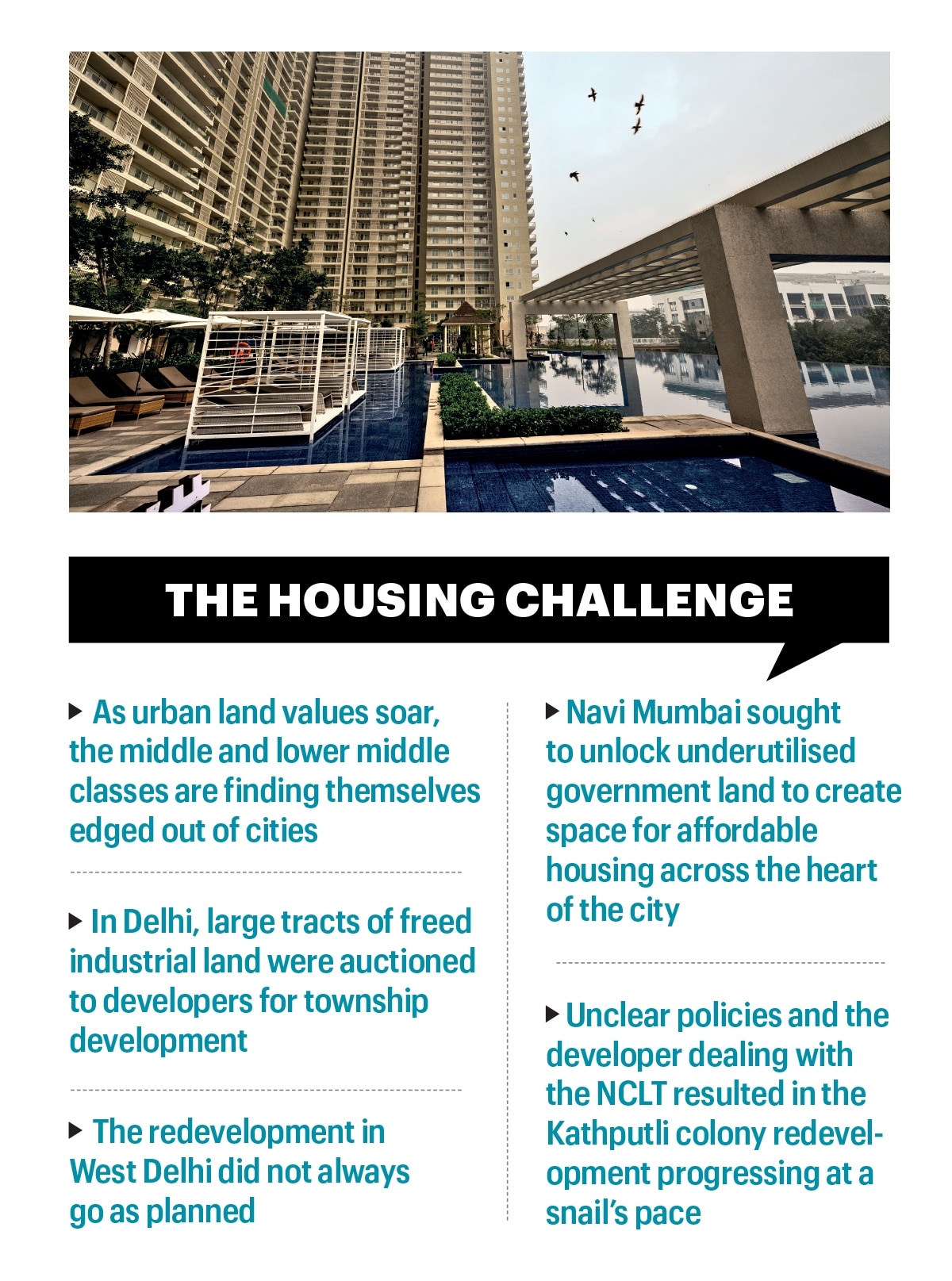
As urban land values soar, the middle- and lower-middle classes are being edged out of the city, to its peripheries. A NITI Aayog report on affordable housing in India has come up with a solution. “Ensure ways to defray the cost of land for affordable housing projects and improve the supply of serviced land.” This is often easier said than done.
Underutilised Land
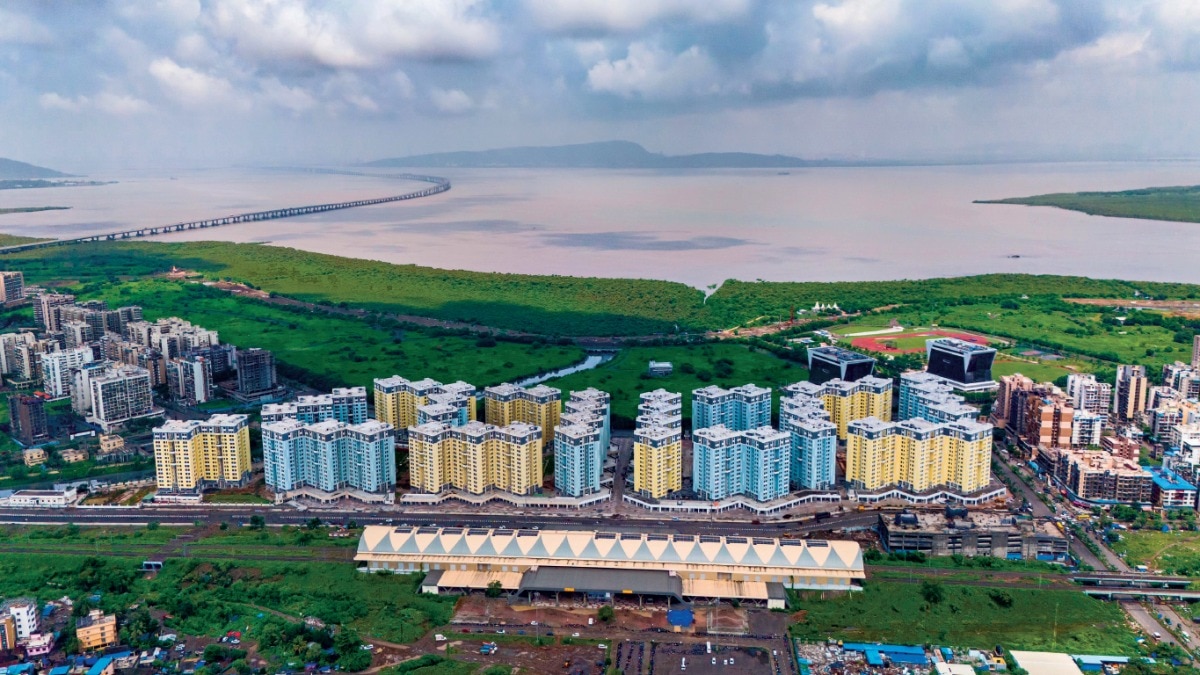
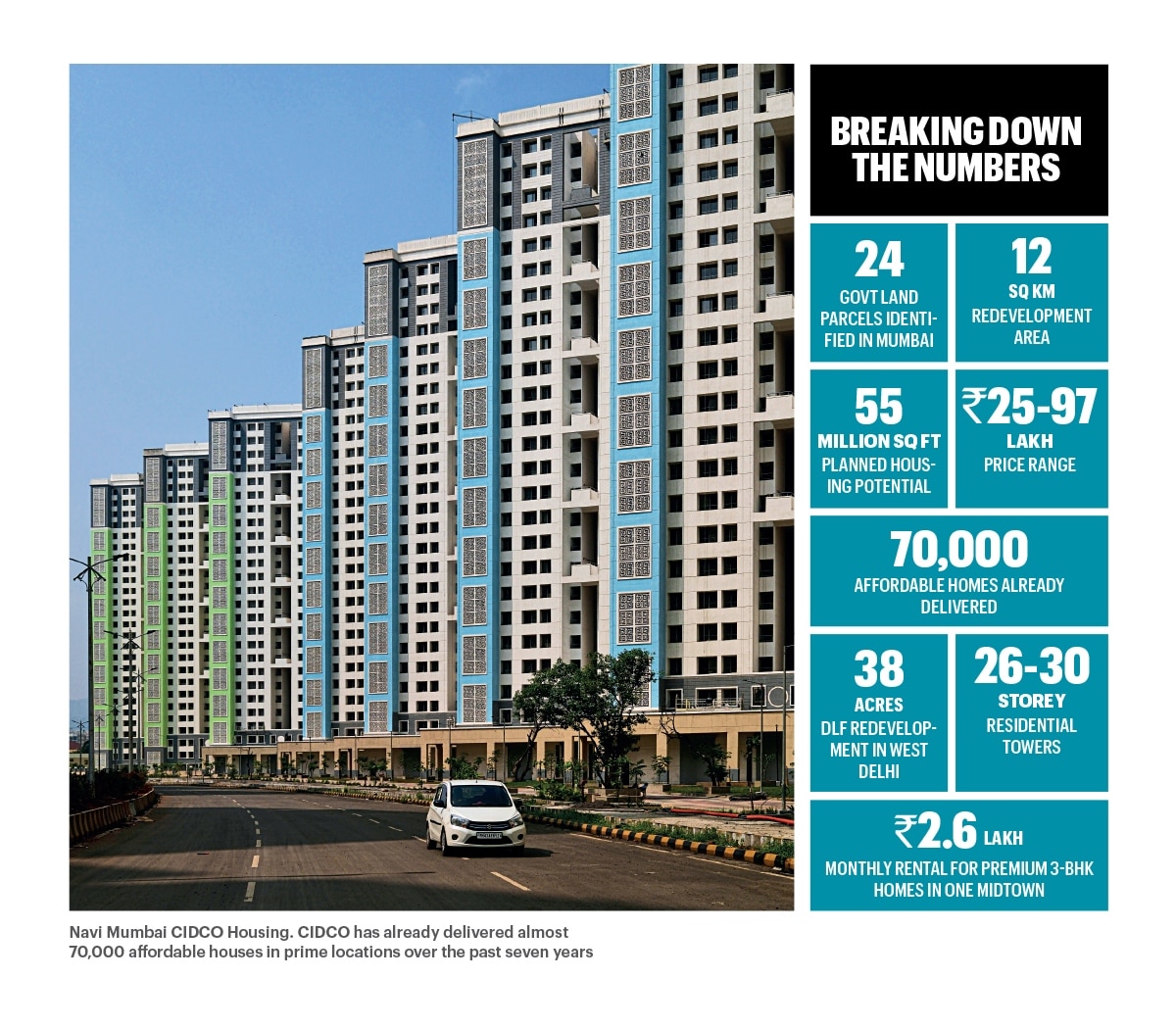
Navi Mumbai sought to unlock underutilised government land to create space for affordable housing across the heart of the city. Working with architect Hafeez Contractor, it set an ambitious target to deliver over 55 million sq ft of the Pradhan Mantri Awas Yojana (PMAY)-compatible housing in core city areas. Contractor’s proposal to the City and Industrial Development Corporation of Maharashtra (CIDCO) focused on identifying 24 under-utilised state-owned sites that span 12 square kilometres across Navi Mumbai. From Taloja to Bamandongri, the sites vary in geography, shape and size, while remaining close to transport hubs.
Contractor’s input was six models of affordable housing units of 27-55 sq metre each. The right model was chosen for each land parcel. This included greenfield plots and underused depot forecourts. The affordable units so created were right on the transport nodes and offered easy access to new dwellers. CIDCO has already delivered almost 70,000 affordable houses in prime locations over the past seven years.
West Delhi Model
Delhi mandated relocation of industries to the periphery between the 1990s and 2000s. It auctioned large tracts of freed industrial land to developers for township development. DLF secured a 38-acre land parcel from DCM Shriram and the Lohia Group in Moti Nagar for Rs 1,675 crore in 2007. Its value proposition was the proximity to central Delhi. The target customers were the wealthy scions of industrial families who wanted to remain in modern high-rise apartments in the neighbourhood.
It started with DLF Capital Greens 1, 2 and 3 towers from 2009 onwards, housing over 2,700 families in high-rise apartments in an area that was traditionally low-rise bungalows. This culminated in the ultra-premium One Midtown, with 913 units, supplemented with luxurious add-ons such as sustainable and comfort features within the homes, unparalleled views of open areas, metro and railway hubs and 128 acres of DDA greens.
Featuring double-height atriums, air-conditioned lobbies, high-speed lifts and a modern clubhouse, the project has redefined the locality. Today, a 3 BHK here rents for around Rs 2.6 lakh a month.
However, redevelopment in West Delhi did not always do so well. When the Raheja group secured the Kathputli colony redevelopment in 2008 as a public-private-partnership project, it had to deliver over 2,800 units of EWS housing to existing residents in a multi-storey format; the rest of the land was to be released for premium development. The deadline for the project was June 2026. But with unclear policies, and the developer facing financial problems and dealing with the National Company Law Tribunal, the project is progressing at a snail’s pace. The relocated residents are struggling in transit camps even after 10 years. However, thanks to DLF’s project, many others such as Raheja Leela and The Sky Villas have evolved into premium lifestyle projects with private pools in every unit, in the same environs. The premium tag for Moti Nagar is now here to stay.
Urban Regeneration
Redevelopment can be an effective solution to urban regeneration. The backbone of governance alone can make it succeed every time. Mumbai appears to have got this right with Development Plan 2034, which declares the intent of the city’s urbanisation, and makes it easy for the private sector to follow the plug and play model. Organisations such as Modi’s Navnirman and Meghna Realty have chosen to stick to redevelopment projects and have even been listed on stock exchanges and remained debt-free.
Maharashtra has spent decades perfecting redevelopment as a tool to unlock the value of premium land that has been encroached on for decades because the city did not plan for its poor. Today, the affordable units are in the same location as the premium ones.
“The buildings that get older are a health risk. There is also a socio-economic gap that gets developed because of the kind of building you’re living in,” says Krish Sheth, design head of Meghna Realty. “When an old building sits right next to a new building, the kind of gentry between the two buildings is different, and that’s what causes a rift in that locality. So, when all the buildings in a lane are redeveloped, the gentry gets normalised.”

Contractor believes that “every Indian deserves to get a good house in a place of his choice.” Affordable housing has traditionally been built on city outskirts, increasing travel costs. In Navi Mumbai, the sites were chosen “for their proximity and access to major transit hubs.” The houses cost between Rs 25 lakh and Rs 97 lakh per unit, depending on location and size.
Reusable Formats
Standard PMAY-compliant models can be reused across locations and states. There is currently a proposal to do something similar in Surat in Gujarat as well.
When private spaces are small, the common areas around have to offer more public space. The houses were in high-rise buildings of 26-30 storeys with square footprints, except where aviation laws restrict them to linear mid-rise buildings. Planned green areas have come up between towers and provide the much-needed environmental relief to residents of small housing units.
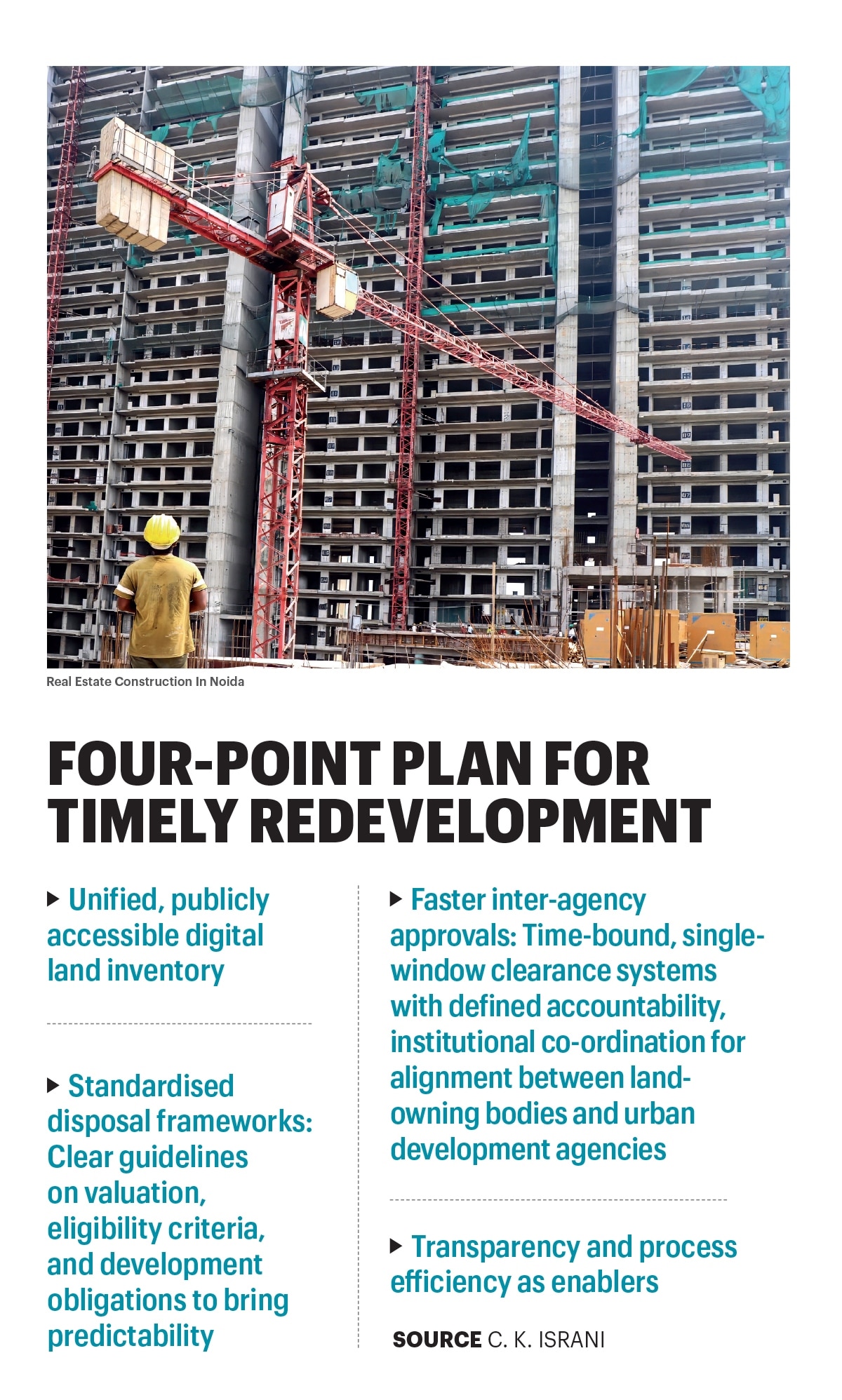
Working with the government was a good idea to reduce the cost of units, says C.K. Israni, promoter of the C.K. Israni group that specialises in Engineering, Procurement and Construction government contracts. “Affordable housing is fundamentally driven by efficiency, standardisation, and speed of execution,” he says.
The scale of Contractor’s projects in high-rises allowed them to aim for economies of scale, allowing premium contracting companies such as Larsen & Toubro, B.G. Shirke Construction, Shapoorji Pallonji, and Capacite Infraprojects, to undertake execution. Scale and standardisation improve speed, quality and cost efficiency.
Unified Vision
This unified city-wide redevelopment vision took shape with the Bandra Bay project in the island city of Mumbai in 2025. The city allowed an entire neighbourhood with a similar land-lease structure to allow holistic redevelopment into a premium precinct. The existing elements are not razed to the ground but included in the newly evolving plan. This brings modernism to ageing, crowded cities, using small urban planning tweaks, allowing today’s needs to reshape yesterday’s master-planned neighbourhoods.
This is possible when the leasing structure is the same, explains Harshul Savla, a legal expert specialising in the sector. When the lease was with an urban improvement trust, it was easier to allow redevelopment of the entire precinct on common grounds.

Niranjan Hiranandani, one of seven developers who chose to participate in the premium Bandra Bay project, says, “Infrastructure has been the silent catalyst behind India’s housing boom. …From metro rail to expressways, every new connectivity node has transformed micro-markets into high-demand residential hubs. When infrastructure leads, real estate follows—with speed, scale, and sustained value.” Normally, the housing that comes up is in the upper middle class and premium categories because access raises land prices. In the case of Navi Mumbai, since the intrinsic land value was unlocked for a social cause through municipal intervention, it could be used for affordable housing.
In Delhi, DLF’s 38-acre land parcel on the fringes of central Delhi has a current value of Rs 24,000 per sq ft. The One Midtown project, in collaboration with GIC of Singapore, sold Rs 1,500 crore worth of inventory within days of launch in 2022. It also benefited from various social and infrastructure projects such as metro and rail connectivity and flyovers, as well as schools and hospitals.
Larger Picture
What does it take to make this a reality in other towns and cities? It starts with political will and structured planning. In the Kathputli colony near Shadipur Bus Depot in Delhi, poor planning and unclear strategies made it a political hot potato for the ruling government.
Aggregating individual projects to create scale is what planned redevelopment is all about, says Amit Sathe of Meghna Realty. “Most of the roads in Bombay are just six metres, nine metres, 12 metres wide at best. There’s a rule now that every road has to be nine metres. ”
Getting it done is a task in itself. When a redevelopment happens, the developer, along with the Brihanmumbai Municipal Council (BMC), makes that happen. “When road widening occurs, developers receive a higher Floor Space Index. And by taking that initiative, the entire area improves because the road is widened, the traffic is better, things get better,” he says.
The Gains
Steady volumes keep the business model alive for decades, and the new players come with the promise of efficient completion. Sheth says there are tangible benefits from this redevelopment.
“Not only does the new real estate get an advantage, but because of displacement, there’s a lot of rental consumption that happens in that area. In the last five years, the number of renters in Bandra has increased by nearly 100%. So, a 1 BHK, which used to be available for Rs 4,550 per sq ft, is now being rented out at Rs 90,000. So automatic appreciation of real estate has happened. Similarly, the Versova market jumped from Rs 35,000-40,000 per sq ft to about Rs 80,000 per sq ft within a couple of years of the sea link announcement taking place.”
The proof of CIDCO’s success is that it has now launched the 2026 edition of its affordable housing project. Its track record of delivery gives buyers confidence. And costs in the range of Rs 25-Rs 97 lakh are affordable in a city like Mumbai.
Contractor believes this is a model replicable across cities. For cities like Pune, Bengaluru and Chennai, which are upgrading their metro infrastructure, Mumbai’s model of completing existing projects to unlock the value of land becomes a format that works.


