













India’s electric vehicle market appears to be nearing an inflection point as consumers shift faster from internal-combustion engine (ICE) vehicles to green mobility. Elevated fuel prices in the wake of the West Asia conflict, increasing product choices and expanding charging infrastructure are nudging price-sensitive buyers to look at EVs in a more serious manner.
The trend is visible in sales numbers. Electric car penetration hit record highs for three straight months through June—6% in April, 7% in May and 8% in June. That marks a sharp jump from FY26, when EVs made up 4.2% of passenger vehicle sales, with 2,00,000 EVs sold out of total sales of 4.7 million.
India’s largest electric carmaker, Tata Motors Passenger Vehicles, recorded a threefold jump in EV bookings recently. “There has been a significant increase in demand post the West Asia crisis. Bookings have jumped three times from January and a year ago,” Shailesh Chandra, Managing Director and CEO of Tata Motors Passenger Vehicles, said at the launch of the automaker’s latest electric offering, the Sierra EV.
Road to electric
EVs now account for nearly one-third of Tata Motors’ new car bookings, forcing the automaker to ramp up capacity. “If I see the last two-three months’ trend, which has been triggered mostly due to the West Asia war but also because of some launches that we had since February, our EV bookings are trending at 33% of our total bookings,” said Chandra, adding that the company can meet only half its EV demand.
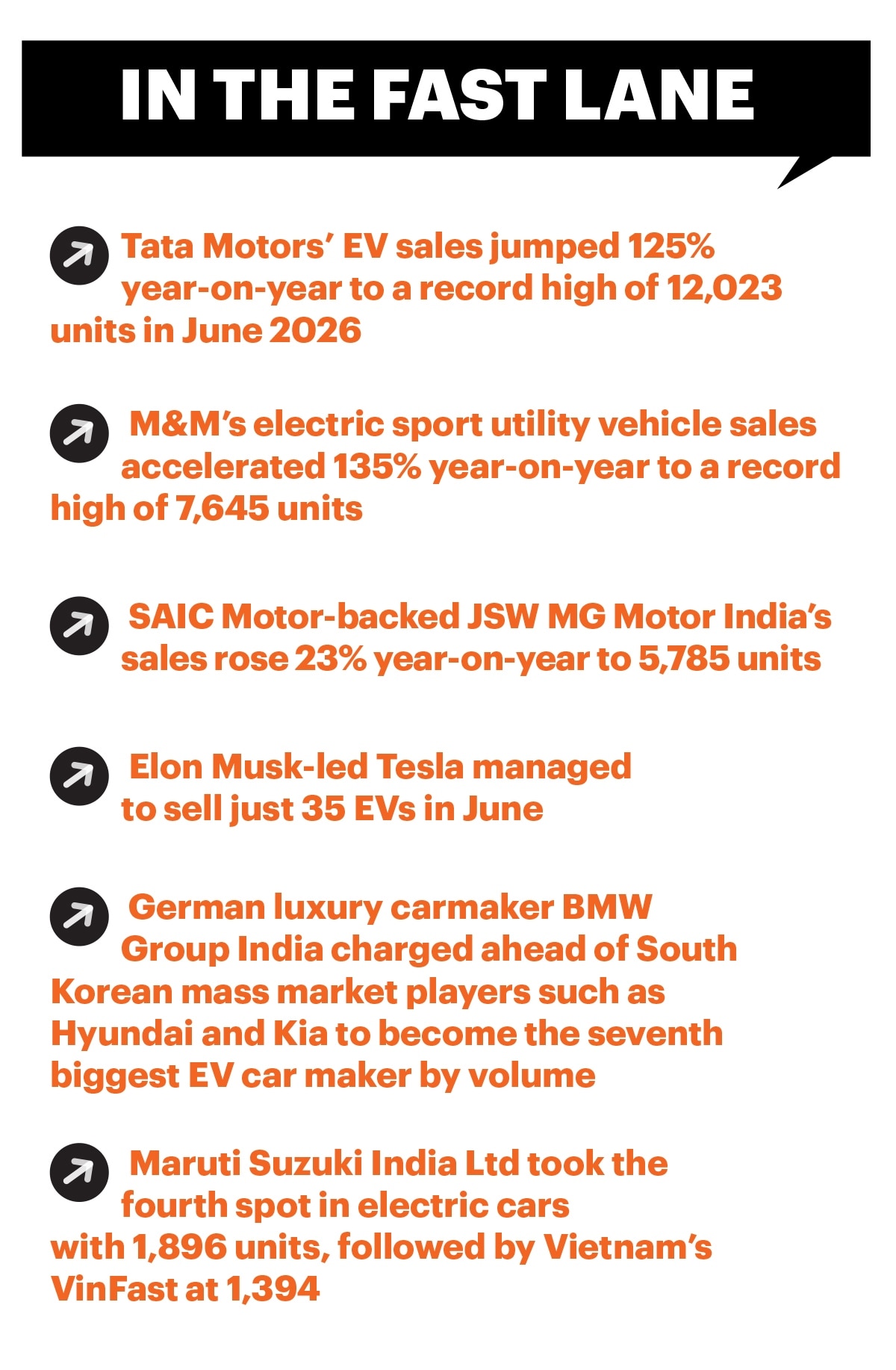
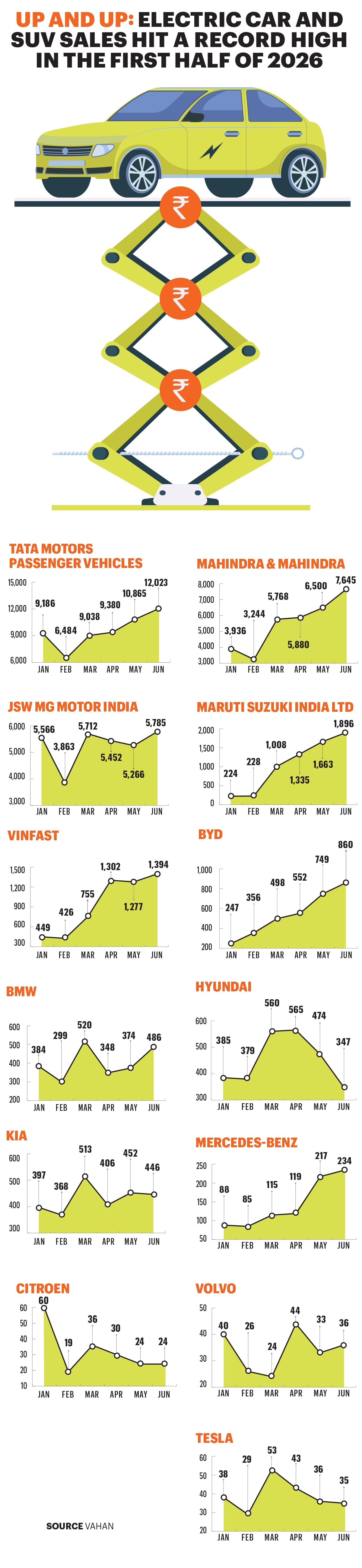
Tata Motors PV and Mahindra & Mahindra (M&M) more than doubled their electric car sales in June. Tata Motors’ EV sales rose 125% year-on-year to 12,023 units in June 2026, from 5,355 units a year earlier, according to VAHAN registration data.
M&M’s electric SUV sales rose 135% year-on-year to 7,645 units in June, helping it widen its lead over JSW MG Motor India, the country’s third-largest electric carmaker by volume. SAIC Motor-backed JSW MG Motor India’s sales rose 23% to 5,785 units.
Maruti Suzuki India Ltd took the fourth spot by selling 1,896 eelctric cars, followed by Vietnam’s VinFast, at 1,394 units.
Tata expects momentum
According to Chandra, the momentum is here to stay. “We wanted to wait a bit to see if there was some level of moderation in EV demand in case there was a truce after the West Asia crisis. Still, I would believe that the demand has shifted to a level of permanency, which will be 25-30% of our sales,” he says.
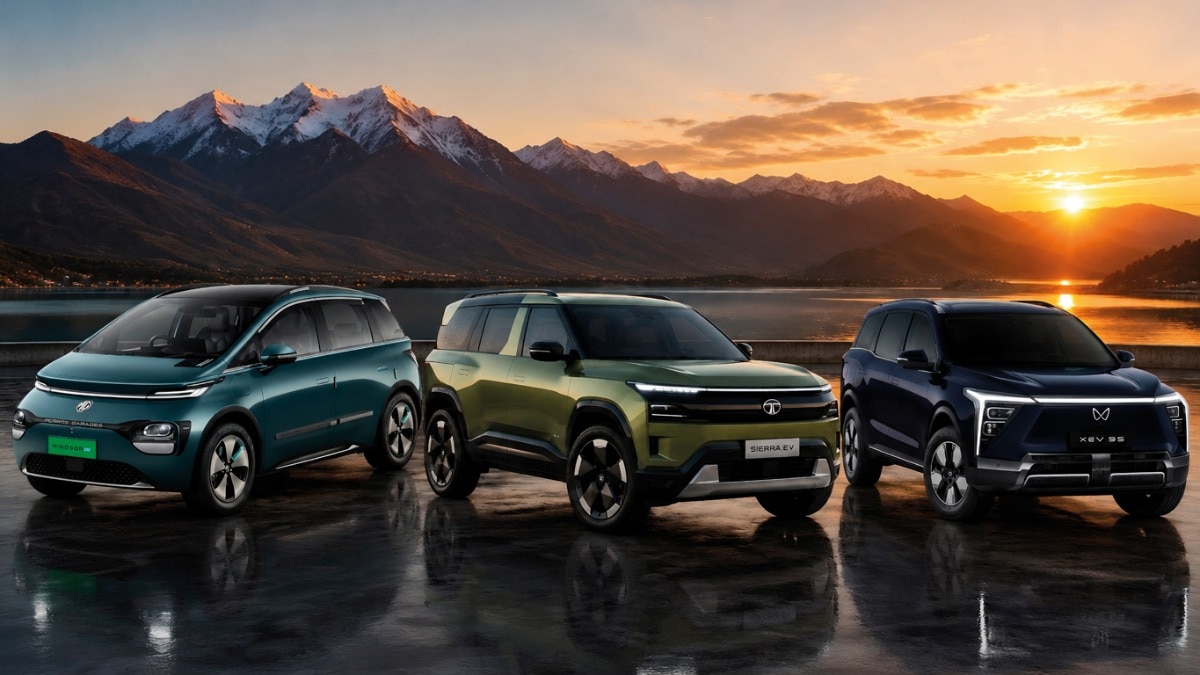
Tata Motors has the widest EV portfolio of seven models: hatchback Tiago EV, subcompact SUV Punch EV, entry-level sedan Tigor EV, compact SUV Nexon EV, mid-size SUV Curvv EV, premium SUV Harrier EV and the newly launched mid-size SUV Sierra EV.
To stay ahead, Tata Motors has kept refreshing its EV portfolio. It is planning three new EV nameplates by FY31, including the Avinya EV, which will use the Freelander platform derived from Jaguar Land Rover’s Chinese joint venture partner Chery.
While Tata Motors PV leads the EV volume race, M&M is ahead in value. The XEV 9S, priced upwards of Rs 20 lakh, is the automaker’s top-selling electric car, followed by the XEV 9e.
India plugging in
Consumers are warming to EVs as more manufacturers enter the segment, the price gap with ICE cars narrows and charging concerns ease. As of July 2026, India had 25 mass-market EV models on sale, giving buyers more choice in a segment that sells around 30,000 units a month.
With the West Asia crisis, EVs are getting more attention from consumers, says Rajesh Menon, Director General of SIAM, India’s apex auto industry body. “We are optimistic that this buoyant demand will continue in the coming months,” says Menon. “An EV buyer today has multiple product choices, along with schemes around battery warranty, assured buybacks and battery-as-a-service. All this is getting reflected in sales.”
For years, buyers avoided EVs because of high upfront costs, range anxiety and inadequate charging infrastructure. Many of these concerns are easing, and EVs have reached price parity in premium segments.
“Cars costing more than Rs 20 lakh have price parity. The Harrier EV is priced less than the automatic ICE Harrier,” says Chandra.
The electric shift
The shift to EVs is no longer just driven by enthusiasts.
“EV adoption is now expanding well beyond early adopters and enthusiasts,” says Chandra. “The mainstream customer has arrived. And this shift is already visible,” he adds, calling the West Asia crisis a catalyst for electric mobility.
Puneet Gupta, director of Mobility Global, an automobile data intelligence company, agrees. “Customer acceptance of EVs is going up. Today, EVs have more range and bigger battery packs that are helping reduce range anxiety. Some EV models even offer over 400 km of real-world range,” says Gupta.
M&M saw a surge in EV demand after Prime Minister Narendra Modi urged citizens to use electric vehicles amid the West Asia war. “While it is still early, we are seeing a surge in interest in EVs, especially from central and state governments,” Rajesh Jejurikar, executive director and CEO, Auto & Farm Sectors, M&M, tells BT.
“EVs are moving into the mainstream, supported by growing consumer confidence and positive word of mouth,” Jejurikar adds.
Thanks to their low running costs, EVs are increasingly being used as primary cars for city commutes. “One cannot argue against the unit economics of using an EV. EVs are not a Tier I phenomenon. It is happening in Tier II and Tier III cities,” says Anurag Mehrotra, managing director of JSW MG Motor India.
“If you go to a small town like Kottayam in Kerala, you see 10% EV penetration,” he says. “People are understanding the unit economics of it.”
JSW MG Motor’s top-selling EV, the MG Windsor, crossed 75,000 units in less than two years of launch. What is driving adoption most strongly is the positive experience of existing EV owners, says Mehrotra. Their word-of-mouth recommendations, combined with the compelling economics of EV ownership that is delivering substantial savings over several years, are inspiring more consumers to make the switch, he adds.
New players, new confidence
Several launches over the past few months are also driving demand. The entry of Maruti Suzuki India Ltd into EVs has boosted consumer confidence, say industry experts. After staying away for years, Maruti Suzuki introduced its maiden EV, the eVitara, earlier in 2026.
“Large players like Maruti Suzuki and newer entrants like VinFast have started contributing to EV sales,” says Mobility Global’s Gupta.
“It is not only because of the West Asia crisis; it’s also because most top players have entered the market, which gives consumers confidence,” says Tata Motors’ Chandra. “When choices come from all OEMs, the customer gets most excited. A lot of top players were away from EVs. But all have entered now and will be expanding their portfolios,” he adds.
Gupta expects the share of EVs in India’s total passenger vehicle sales to rise to 8% in 2026. “The 8% penetration level is sustainable. It will grow to 11-12% before it stays there, and after that 17% BEV penetration is expected by 2030. If we see continuous thrust by the government, it may go up further,” says Gupta.
States are also pushing EVs. Delhi’s latest EV policy offers road tax and registration fee waivers for electric cars priced under Rs 30 lakh, besides a Rs 1 lakh scrappage incentive for old ICE cars. Uttar Pradesh, Maharashtra, Gujarat and Telangana, among others, also offer road tax waivers on EVs.
The missing link
Despite having 25 models in the mass market, only three EV models are priced under Rs 11 lakh: Tata Tiago EV, MG Comet EV and Tata Punch EV (only the base variant). To be clear, the average selling price of a car in India is around Rs 11 lakh.
Affordable EVs have yet to reach price parity with their ICE siblings. The Tata Tiago EV is about 50% costlier than the entry-level petrol Tiago on an ex-showroom basis. Smaller battery packs also keep real-world range below an acceptable 400 km.
However, despite these shortcomings, demand remains strong for small EVs.
Entry-segment cars such as the Punch EV and Tiago EV have seen phenomenal growth, says Chandra. “More demand is coming from small EVs priced under Rs 15 lakh. Punch EV demand has increased six-seven times. We are able to supply three times as many,” he adds.
Except for Tata Motors, most large carmakers have taken a top-down approach to EV launches.
Hyundai launched its first EV, the Kona Electric, priced around Rs 25 lakh, in 2019. Although the South Korean carmaker was among the first companies to introduce EVs, the Kona struggled. In 2023, Hyundai introduced its flagship IONIQ 5 EV, priced at Rs 45 lakh. The EV version of Hyundai’s popular Creta SUV, the Creta EV, priced at Rs 18.02 lakh, has also struggled to take off, with about 400-500 units being sold each month.
Hyundai’s sister mass-premium brand Kia also followed the same approach with the imported EV6 and EV9. After failing to make a dent in India’s EV space with the Carens Clavis EV, the automaker will soon launch its compact electric car, the Syros EV.
Though Maruti Suzuki, too, entered the fray with the mid-size SUV eVitara, it has yet to enter the small EV segment, where the bulk volumes reside.
While M&M was among India’s earliest major automakers to embrace EVs by acquiring a controlling stake in Bengaluru-based Reva Electric in 2010, the company now wants to focus only on premium EVs.
The luxury drive
In the luxury segment, EV penetration has moved into double digits. Mercedes-Benz India’s EV share doubled to 14% in the June quarter after the launch of the CLA BEV. “Enquiries for luxury EVs have gone up due to the West Asia war. More products are going to change the game,” Santosh Iyer, MD and CEO, Mercedes-Benz India, tells BT.
Every fourth car sold by BMW in 2026 was an EV. “A lot of customers are apprehensive about future fuel price hikes. If fuel prices increase, there will be a heavy burden on customers’ pockets. I don’t think electricity prices are going to rise in the same proportion. So, the running-cost delta between ICE vehicles and EVs is going to widen. BEVs make a lot of sense,” says Hardeep Singh Brar, President and CEO of BMW Group India. “EVs are not coming back to service stations. It is a concern that the aftersales business will take a hit because of low maintenance.”
BMW Group India delivered 2,359 EVs in H1, up 78% year-on-year, and retained a 69% share of the luxury EV market.
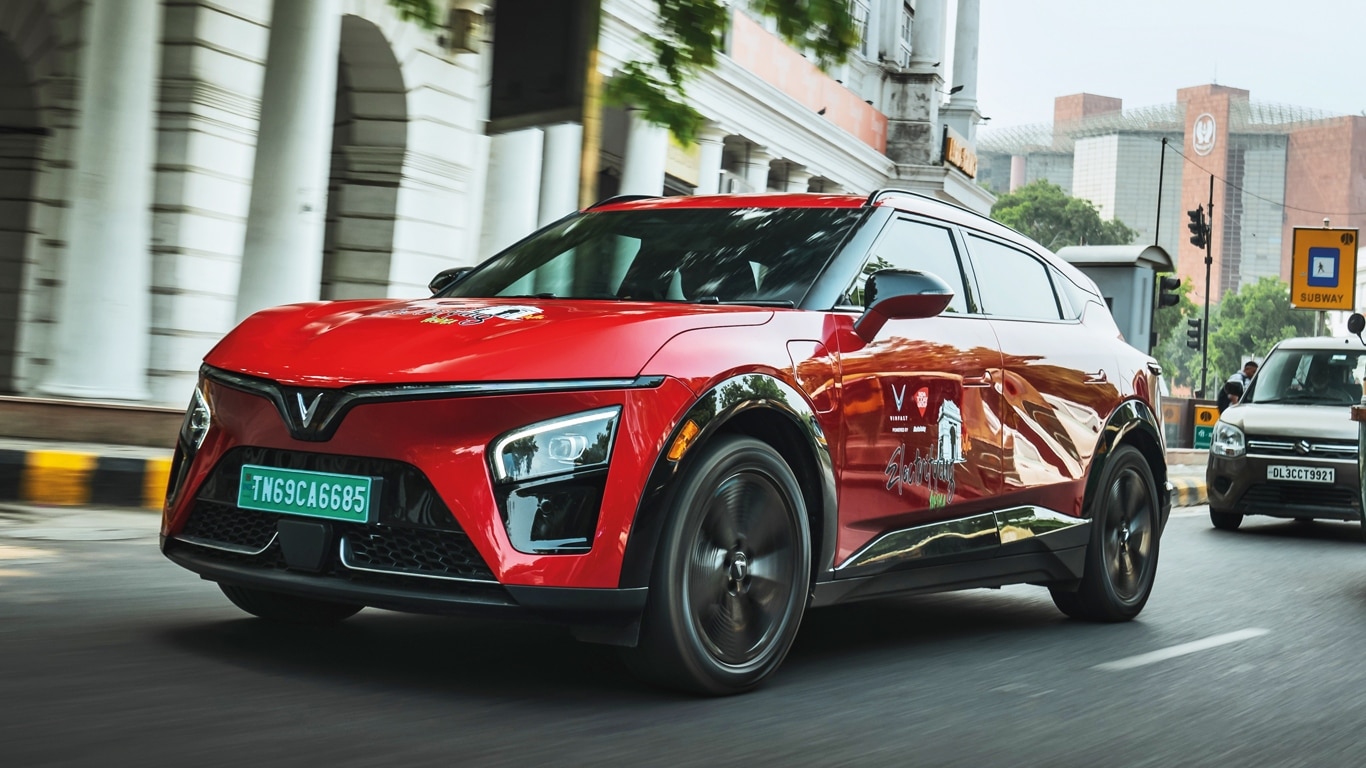
Elon Musk-led Tesla, which entered India in September 2025, has struggled to make inroads. Meanwhile, VinFast, which entered the Indian car market with the VF6 and VF7 SUVs around the same time, has emerged as India’s fifth-largest electric carmaker.
The BaaS bandwagon
In 2026, nearly every automaker has jumped onto the BaaS bandwagon to lower upfront costs. From eVitara to Tiago EV, most EVs now have a separate battery rental price. Maruti Suzuki introduced the eVitara with a BaaS offering at Rs 10.99 lakh.
Under the BaaS plan, the price of the Tata Tiago EV starts at Rs 4.69 lakh, about Rs 2.30 lakh less than the regular price, and users pay an additional Rs 2.60 per km as a subscription fee.
EVs overtake hybrids
Two years ago, strong hybrids and battery electric vehicles each accounted for roughly 2% of the passenger vehicle market. While hybrid penetration has remained broadly flat, EV adoption has accelerated sharply.
“Both EVs and hybrids were at 2% penetration two years back. One has remained at 2.5%, the other will be exiting this year at around 8%. The direction is very clear,” says Chandra.
India’s EV car market remains small, with monthly sales averaging around 30,000 units. In a market of this size, one successful model can significantly shift market share, as JSW MG Motor India’s MG Windsor EV has shown with its battery-as-a-service offering.
Chandra expects EV sales to rise from about 200,000 units in FY26 to 350,000 units this fiscal. The Indian market could reach one million annually by FY31, taking electric vehicle penetration to 15-20%, he forecasts.
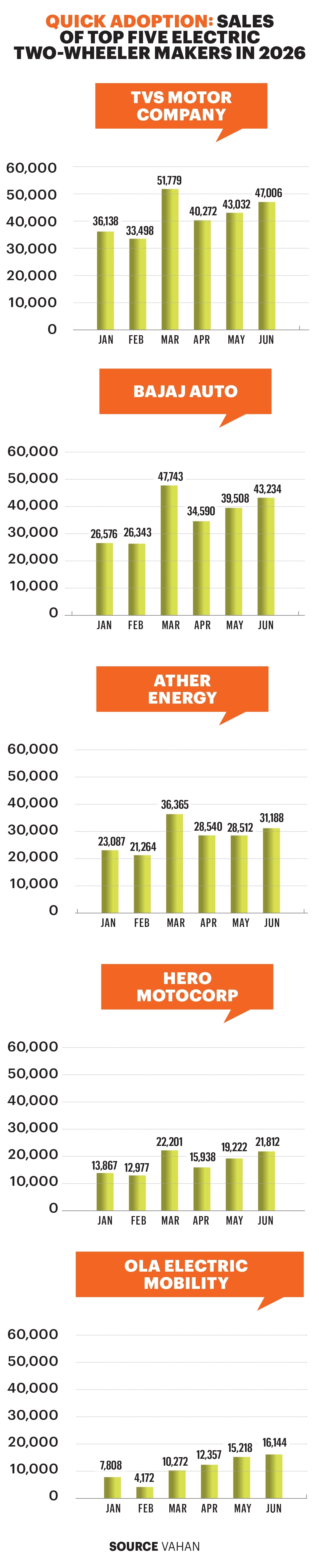
It is not just cars and SUVs. EV penetration in two-wheelers crossed 10% for the first time in June. In three-wheelers, it stands at 64%, while commercial vehicles are gaining gradually, aided by e-buses and small commercial vehicles. With the recent rise, NITI Aayog’s target of 30% new vehicle sales being electric by 2030 is within reach.
Reflecting the growing interest in EVs, a Gurugram-based software professional Abhishek Sharma switched to an EV. He used to spend Rs 700 a day on fuel while commuting to Noida. After the recent fuel price hike, he replaced his old ICE car with the MG Windsor EV. He says home charging now costs him less than Rs 100 a day, helping him save around Rs 16,000 a month and nearly Rs 2 lakh a year.
From lower running costs and improving resale prospects to a wider choice of models and supportive policies, electric vehicles are moving from an alternative option to a practical choice for everyday commuters.
@karandhar11


