













Will india miss its 500 GW renewable electricity target by 2030? A growing mismatch between buildout of renewable projects and grid infrastructure is emerging as the most critical risk to the country’s green energy goals.
Project developers Tata Power, Adani, JSW, and NTPC Green were forced to reduce solar power production last fiscal in Maharashtra, Rajasthan, and Gujarat, the states with the highest solar power output, due to congested grid. This, in fact, impacted Tata Power’s earnings as well. Project developers are also delaying the addition of new solar power capacity in the absence of adequate grid infrastructure, say industry watchers.
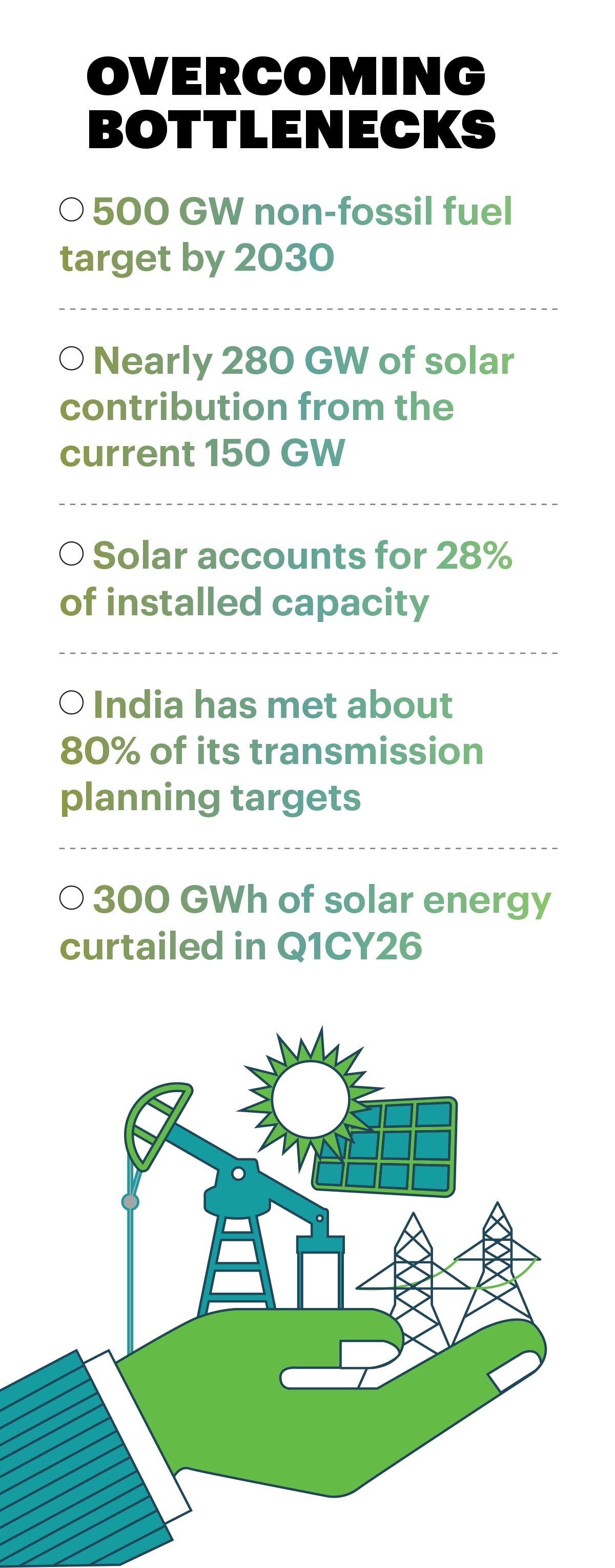
India lost around 34 gigawatt-hours (GWh) of renewable energy generation in a single day on March 30 due to insufficient transmission margins, equivalent to the daily power consumption of about five million middle-class, urban households in India, according to Ember, a global energy think tank. In the first quarter of this year, transmission constraints accounted for nearly two-thirds of all renewable energy curtailment at 300 GWh.
The targets for building the evacuation infrastructure are now significantly higher than historical build rates. There is a reason for that. Transmission planning timelines have traditionally synchronised with thermal capacity, which typically takes 36–60 months to come online. In contrast, renewable energy projects start much faster, often within 12–18 months. As a result, transmission infrastructure development is lagging behind renewable energy deployment.
“Overloading of the transmission system takes place during summer months at some of the locations, because of which some of solar and wind plants cannot evacuate full power. This is more seasonal. Some of the transmission lines that are in the pipeline, once executed, will take care of the problem,” says Tata Power CMD Praveer Sinha.
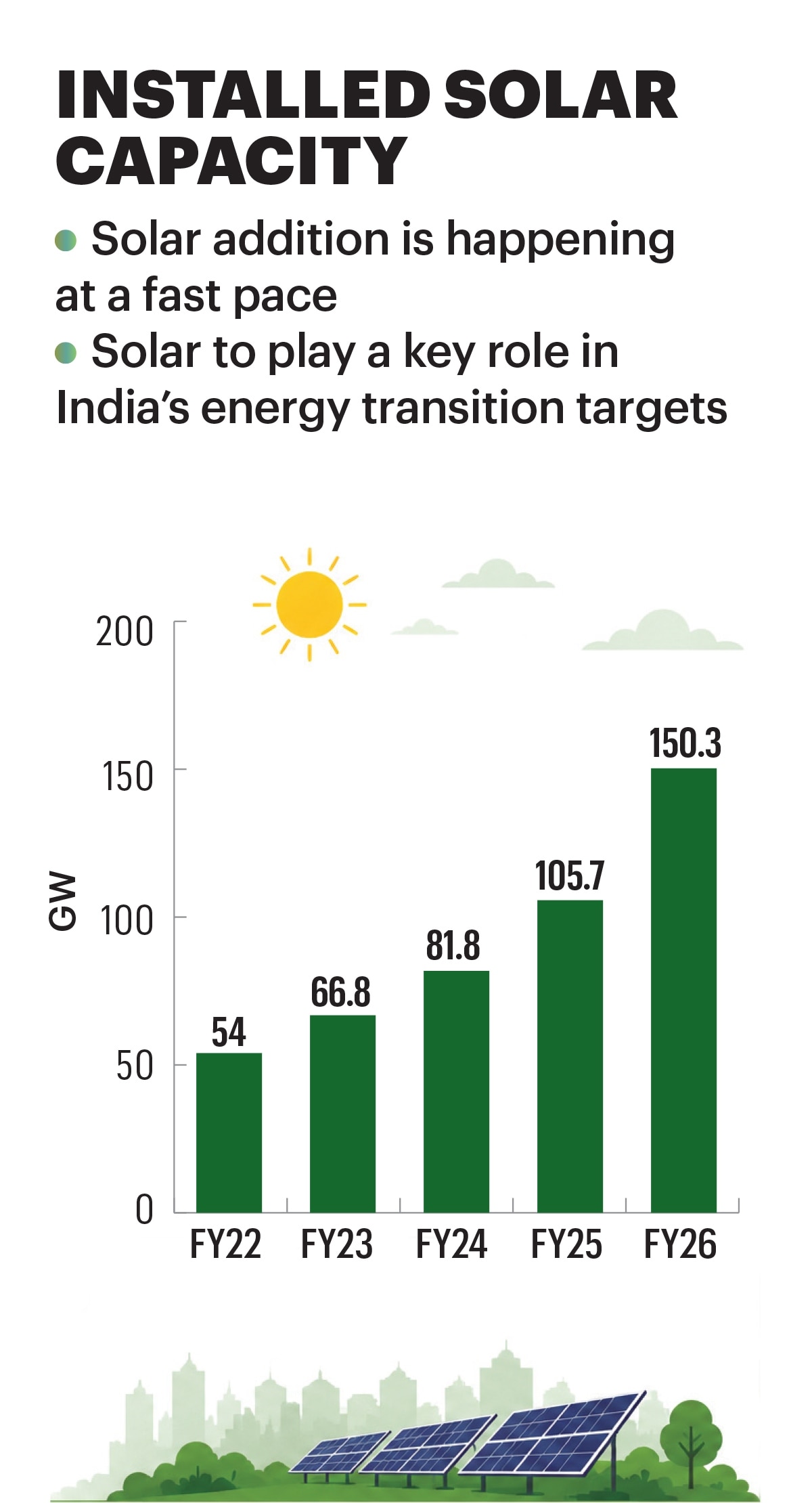
Coal plants could not reduce generation beyond a point due to technical constraints, leaving limited room on the grid to absorb rising solar power. As a result, some solar generation had to be curtailed to maintain grid stability. Rapid growth in solar capacity is enabling solar to serve an increasing share of daytime demand, altering net load patterns that conventional generators have historically supplied. There is an economic cost at play as well. Operating thermal power plants at low capacity to allow higher injection of renewable energy into the grid during the day is expensive and leads to a higher per-unit cost of coal-fired electricity. Thermal plants also need to run at a minimum plant load factor to remain operationally and economically viable. For FY26-27, renewable energy projects in India are expected to face average connectivity delays of four–five months beyond their commissioning timelines. Around 20 GW out of 45 GW of projects could see delays extending beyond four months. This is most acute in Rajasthan’s pooling stations. Over 12 GW of solar and wind capacity in Rajasthan and around 8 GW in the Western Region and the Southern Region combined, face such delays. This not only creates financial stress for developers but also results in system-level opportunity costs due to unutilised generation capacity.
India’s transmission network spans about 503,661 circuit kilometres (ckm). It comprises the national grid, the inter-state transmission system (ISTS), and the intra-state transmission system (InSTS), which operates within states and connects to the distribution system. The national grid connects India’s five regional power grids: Northern, Western, Southern, Eastern, and Northeastern.
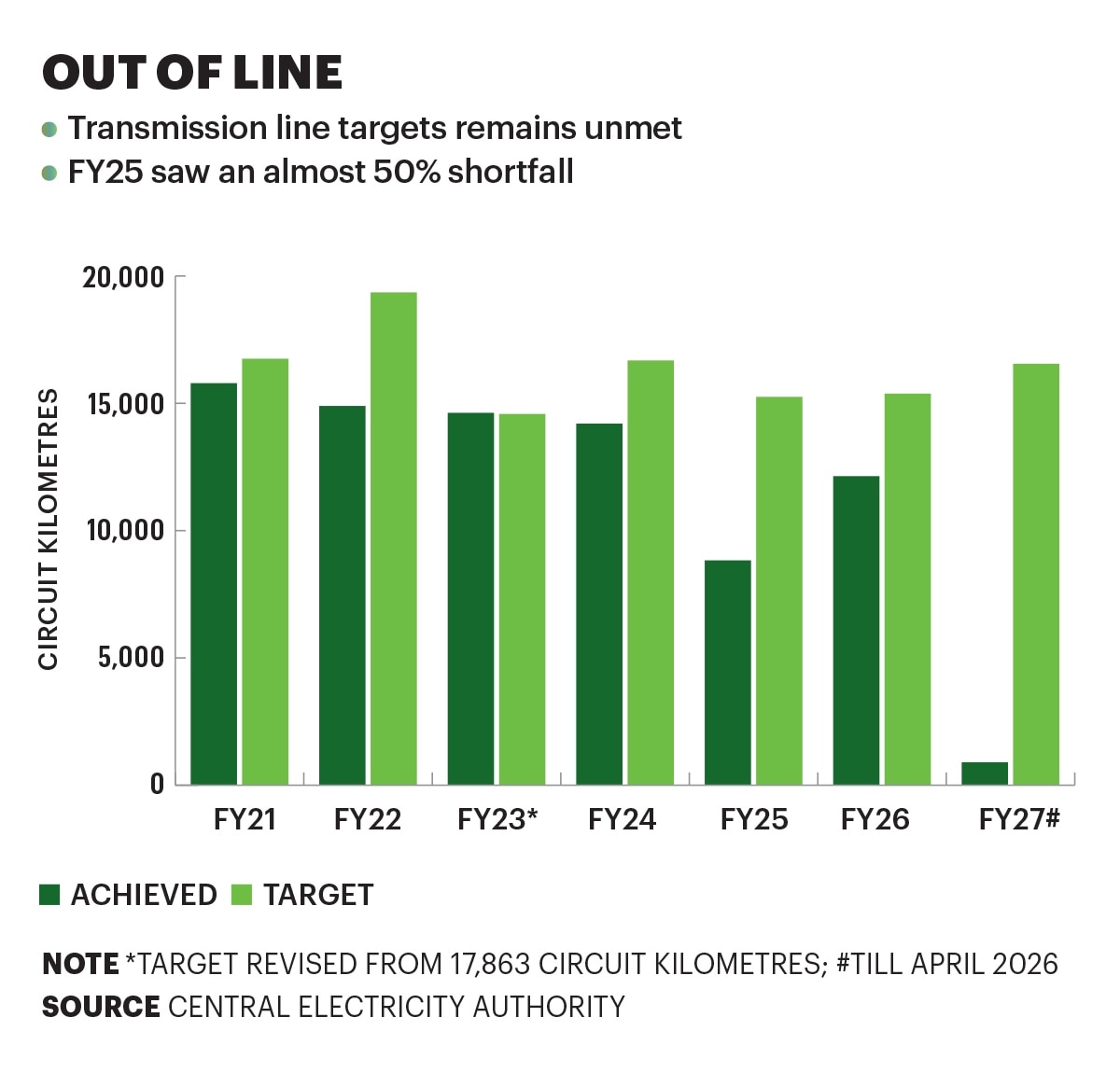
The latest National Transmission Plan (2022) seeks to expand the network to 648,190 ckm by FY32. This implies an annual addition of around 24,000 ckm against the current average of 13,000 ckm added in the past five years. Meeting this goal will be critical to integrating India’s target of 500 gigawatts (GW) of non-fossil capacity by 2030.
According to an analysis by Ember, over the past five years (FY2021-22 to FY2025-26), India has met about 80% of its transmission planning targets on average. Annual additions have been around 13,000 ckm, against a target of roughly 16,230 ckm across inter-state transmission system (ISTS) and intra-state transmission system (InSTS).
This persistent shortfall has led to a large backlog of projects. Combined with new generation and rising demand, the annual requirement has increased sharply. For FY2026-27, the target for the ISTS component alone has risen to about 25,146 ckm. The government’s own estimate pegs the total additional ISTS requirement at 61,411 ckm by the end of FY2029-30. In addition, there will be InSTS requirements, though these are harder to assess as India is only beginning to mandate transmission adequacy at the state level.

According to industry players, there is a need for long-term transmission line planning, keeping in mind the massive solar deployment in the pipeline. Sinha explains that curtailment is happening in a few places, and while its is difficult to estimate how much, it would range between 20–40% plant-wise in various states. “We continue to work with transmission companies and the central transmission utility to ensure that the curtailment is reduced, and we can evacuate all the power. In cases where we have the general network access (GNA), and curtailment takes place, there, of course, we are reimbursed the cost on the supply basis,” Sinha says. The Central Electricity Regulatory Commission has a graded financial compensation framework for power curtailment under the GNA regime which allows power producers to access the interstate transmission network.
Grid planning in India will require a range of long-term reforms to prevent build-up of large connectivity queues, growing mismatch between generation and transmission infrastructure, and the associated rise in renewable energy curtailment. Vineet Mittal, Chairman, Avvada, says India needs to do more aggressive grid planning.
“We should not only be planning for 2030 but should already be preparing for 2035 and beyond, keeping in mind our massive energy transition plans. Renewable-energy expansion is increasingly constrained by transmission infrastructure. Transmission planning and execution for the renewable-energy corridor should ideally be more closely integrated with the renewable-energy ministry itself to accelerate the projects,” he explains.
Transmission planning is currently under the power ministry.

The growth of solar capacity across ISTS pooling stations has been rapid due to the modular nature of solar projects and their relatively short construction timelines. However, this has also resulted in substantial transmission infrastructure being developed for evacuation from these regions, much of which remains underutilised outside solar generation hours. About 71% of interstate transmission corridors operate below 30% utilisation, meaning large transmission investments remain underutilised during non-solar hours, according to an IEEFA and JMK report.
Slow progress on evacuation infrastructure means renewable producers are holding back from bringing new capacity online, ultimately risking the country missing its 2030 target. India’s renewable energy efficiency now depends on infrastructure upgrades. 
@richajourno


