











India’s nano fertiliser drive, launched in 2021, has run out of steam.
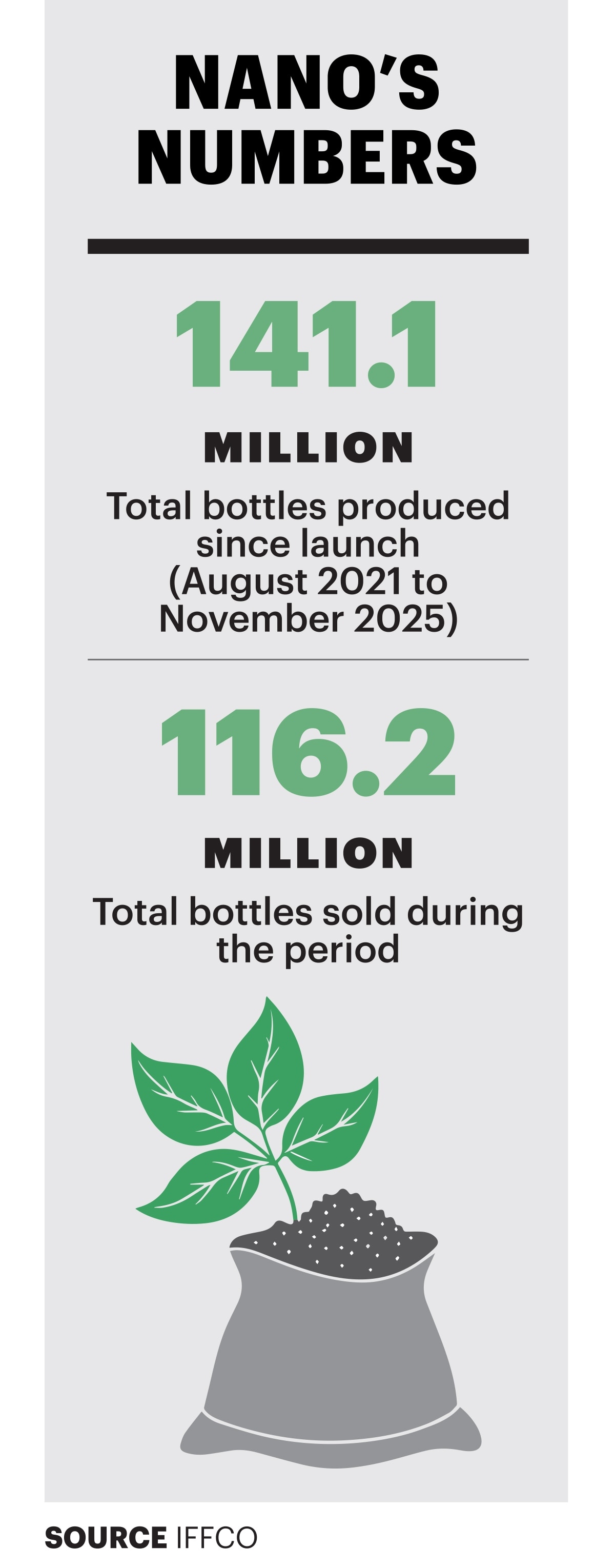
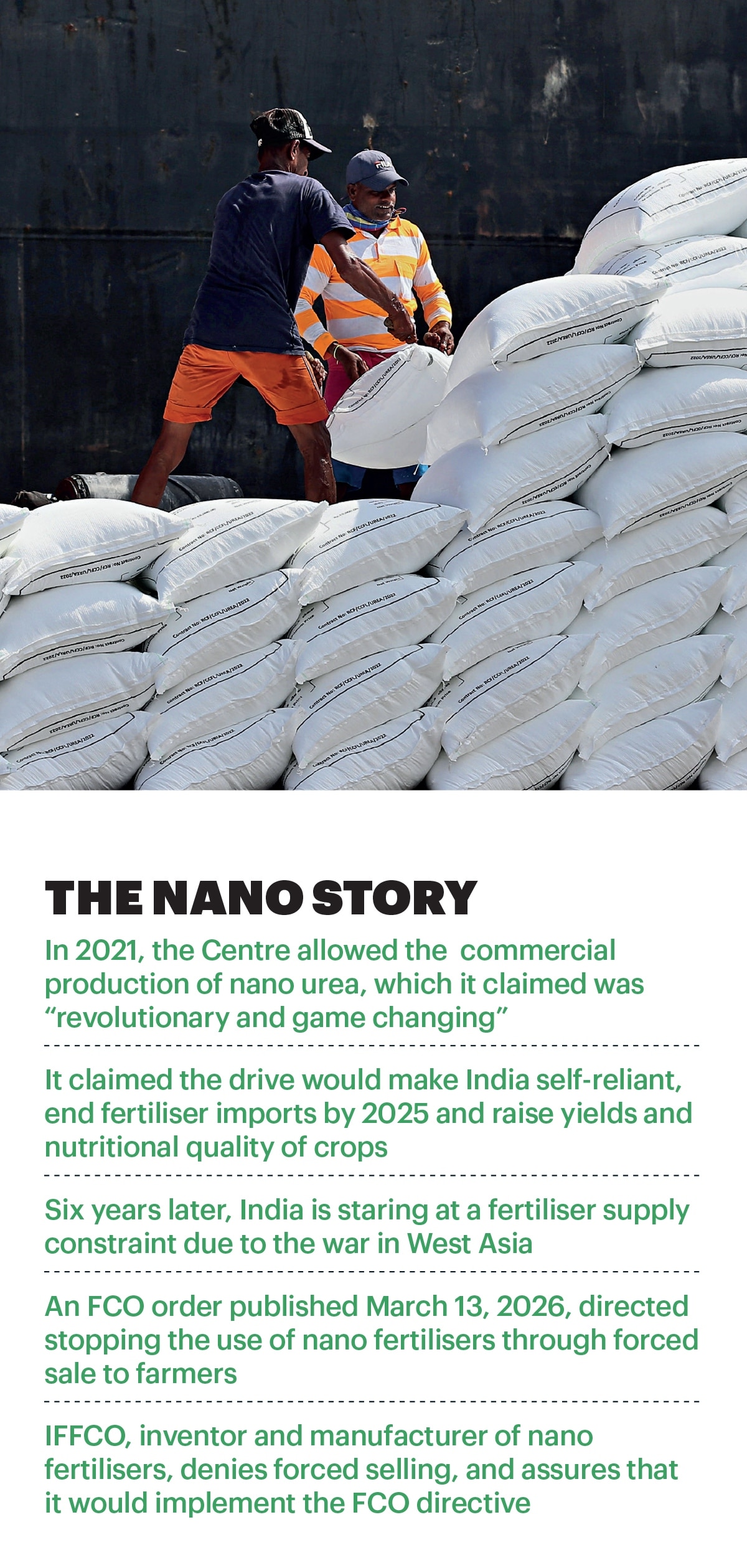
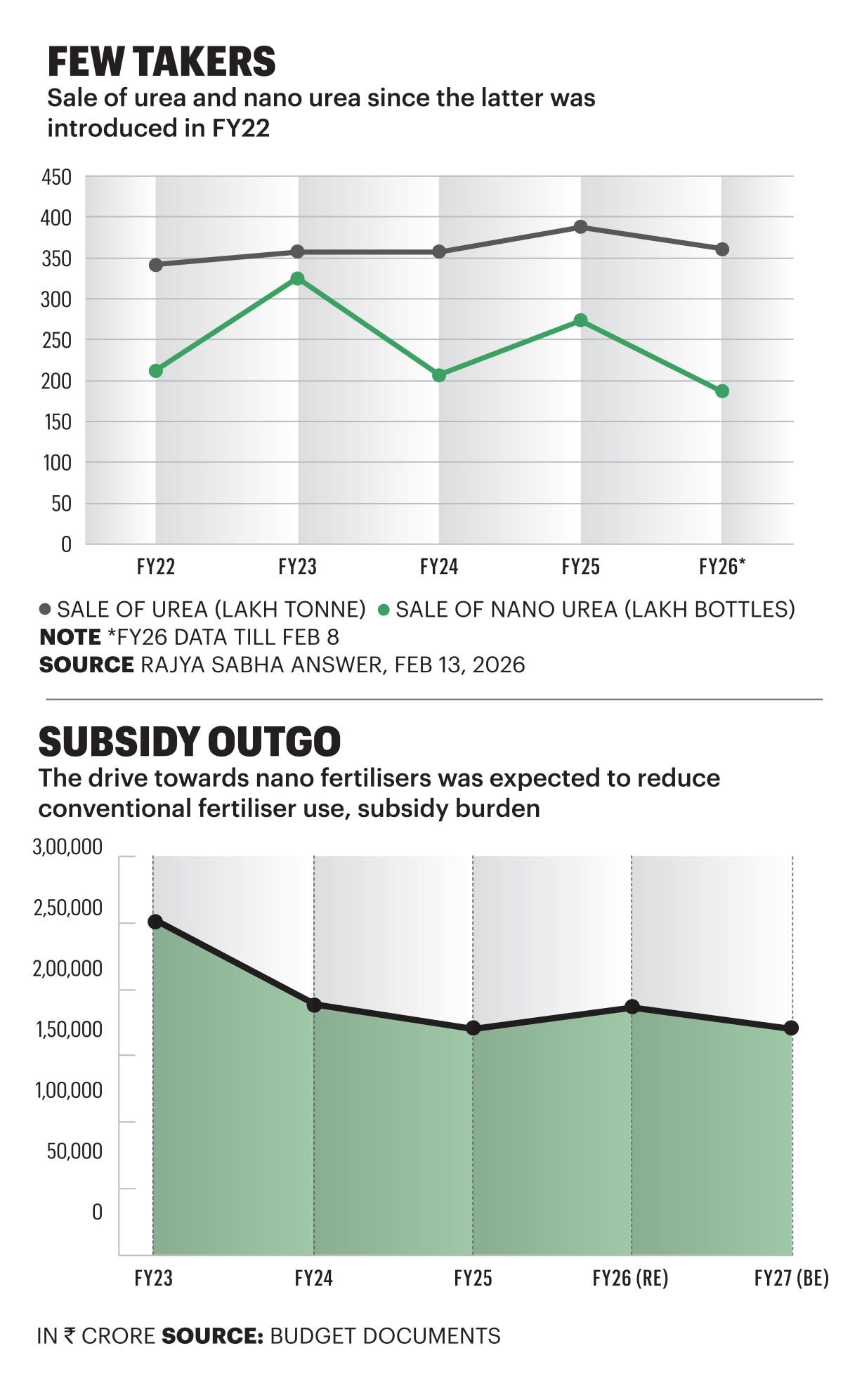
In 2021, the Centre allowed commercial production of nano urea as “revolutionary and game changing.” It claimed the drive would make India self-reliant and end fertiliser imports by 2025; cut fertiliser use and subsidy outgo; raise yields and nutritional quality of crops; prevent soil, air, and water pollution; and restore soil nutrient imbalance caused by excessive urea use.
Six years later, India is back to square one, staring at a fertiliser supply constraint due to the war in West Asia, which is likely to be felt when rabi sowing starts after the monsoon.no fORCED SALE
The first nano urea plant came up in Gujarat in 2022. The Centre was convinced about its utility and thus promoted its widespread adoption.
But a Fertiliser Control Order (FCO) published March 13, 2026, amended the FCO, 1985, to stop its use. “The manufacturer shall ensure that there shall be no forced sale of nano fertilisers by tagging with other fertilisers or any other kind of agri-inputs.”
This was after Agriculture & Farmers Welfare Minister Shivraj Singh Chauhan wrote to chief ministers, in July 2025, seeking legal action against forced sale, following country-wide protests.
While the Indian Farmers Fertiliser Cooperative Ltd (IFFCO), the inventor and manufacturer of nano fertilisers, denies forced selling and assures it will implement the FCO, Coromandel International, a major private sector fertiliser company manufacturing nano DAP, says its experience has been different. Arun Alagappan, its Executive Chairman, says farmers “have used our nano fertilisers and are now swearing by it…Not only is its application easy, it’s done through drone application. So, that is something which is catching on very, very quickly in this industry.”
Alagappan narrated his experience with nano DAP: “There’s been a lot of talk on nano fertilisers and we have had a very good run with it. In fact, I was recently at an institute in Hyderabad (Professor Jayashankar Telangana Agricultural University), where we've done a lot of trial plots with the industry. And we feel that nano is a good product. It has to be applied correctly, and there's absolutely no problem with nano as a product.”
Nonetheless, farmers from Punjab and Haryana told Business Today that forced sales are continuing. “Despite the minister’s official stand, when we buy conventional fertilisers and pesticides, local agriculture cooperative societies and private vendors make it conditional on buying nano urea and nano DAP bottles,” says Parminder Singh Ghuman, a farmer from Punjab’s Sangrur.
Haryana farmers’ leader Gurnam Singh Charuni confirms this: “We have been telling them, don’t impose but show results; then, farmers will buy on their own. Sometimes, farmers are forced to buy nano fertiliser because of shortage of conventional fertilisers”. Meanwhile, the Agriculture & Farmers Welfare Ministry is evaluating the raison d'être of nano fertilisers.
FRESH TRIALS
On February 13, 2026, the ministry informed Parliament that all nano-fertiliser manufacturers would be required to conduct bio-efficacy trials across agro-climatic zones. Three separate mechanisms have been put in place for “evaluation” of the impact of nano fertilisers on at least 12 major crops by multiple institutions under the supervision of India Council of Agricultural Research.

These evaluations cover the entire gamut: “efficacy, utility and impact” and “the extent of replacement” of conventional fertiliser; “crop productivity and nitrogen use efficiency”; “long-term” impact on “crop yield, produce quality and soil nutrient balance as well as working mechanism of nutrient from nano fertiliser in plant metabolism”, “crop growth, soil health and nutrient uptake,” and “bio-safety/toxicology trials.”
KJ Patel, Managing Director of IFFCO, says he welcomed fresh trials because “conflicting results across different trial conditions are not an anomaly in the science of agricultural innovation. They are the very reason continued multi-location, multi-crop, multi-season trials are essential.”
Ramesh Raliya, a former IFFCO scientist credited with inventing nano urea and nano DAP, says fertiliser performance cannot be measured by a one-size-fits-all evaluation. It depends on factors like soil type, crop type, cropping history of the field, soil health, irrigation, and how and when it is applied. “The more data we have, the better decisions farmers and other stakeholders can make.”
However, what remained unaddressed by both was why such trials did not precede the widespread adoption.
POTENCY CHALLENGED
In another unusual move, another FCO published on March 9, 2026, cut the nano-fertiliser dose, raising doubts about its efficacy in supplying nutrients.
“Package of Practice must contain the crop-wise basal dose of 75% RDF (Recommended Dose of Fertiliser) with 25% dose of nano fertiliser as per the trial’s positive outcome,” the notification said.
This is a climbdown from the IFFCO protocol, which all field trials have followed until now; 50% basal dose of RDF and 50% of nano fertiliser. This is particularly true for nano urea liquid. Urea accounts for 60% of total fertiliser use and is a major source of nitrogen, a macronutrient.
To understand the FCO directive, consider urea use for wheat or paddy.
A ‘basal dose’ of RDF means the first dose of conventional granular urea applied to the soil at the time of sowing, constituting 50% of total urea use. Nano urea is meant to replace the rest 50% of conventional urea (applied before flowering); it is applied to the foliage (not soil) in two sprays from a 500 ml bottle.
The IFFCO protocol came in 2021, after nano fertilisers were “tested on over 11,000 farm fields on 94 crops and 20+ agricultural research institutes/universities (affiliated with the ICAR) on 43 crops” and approved by the Centre. The tested nano fertilisers were nano nitrogen (nano urea and nano DAP), nano zinc and nano copper.
The recent FCO directive capping nano fertiliser to 25% now suggests a preference for conventional fertiliser. This, then, shifts focus to the scientific rigour of IFFCO’s trials and the application of nanotech in fertiliser.
“Nano urea particles of 20–50 nanometres have a dramatically higher surface-area-to-volume ratio compared to conventional granular urea, allowing them to be absorbed directly through leaf stomata with far greater efficiency. Our laboratory and field data demonstrate that the nutrient use efficiency of nano urea is 85–90%, compared to a mere 25% for conventional urea, which is a staggering leap that any scientist or farmer should find compelling,” Patel tells Business Today:
The agriculture ministry, which issues FCOs, doesn’t seem to agree with IFFCO’s claim that nano fertilisers can replace 50% of conventional fertiliser use, the basis for accruing the benefits discussed earlier.
Business Today asked Patel to share comparative data from IFFCO’s trials demonstrating the nano fertiliser’s efficiency in delivering nutrients to crops vis-à-vis conventional fertilisers. He didn’t respond.
While foliar use of conventional urea is limited to exceptional cases like drought, nano fertilisers—meant for such use—are exclusively meant for foliar use.
CAPACITY CHALLENGES
IFFCO claims its trials showed nano fetilisers increasing crop yield by 3-8%. However, trials by the Punjab Agricultural University (PAU), also sponsored by IFFCO and published in December 2024, challenged this finding and led the agriculture ministry to stop forced sales and order retrials.
The PAU tested nano urea on wheat and paddy in 2020-21 and 2021-22. It followed the IFFCO protocol: 50% basal dose of conventional urea and 500 ml nano urea through sprays. It found that nano urea significantly reduced the grain yield of rice and wheat by 13% and 17.2%, respectively, compared to 100% conventional urea. There was also 35% and 24% reduction in grain protein content (nutritional value) in rice and wheat, respectively, and a negative impact on chlorophyll content (SPAD), dry matter, tiller density, root growth, and macronutrient content.
In short, Rajeev Sikka, who led the study, said: “If the plant’s needs are not fulfilled by the application of 50% dose of nano urea sprays, the yield and quality of the produce will reduce.”
This study confirms what farmers have been saying for some years. Balbir Singh Rajewal, founder of the Bharatiya Kisan Union (BKU), says: “Farmers have seen the results, which are not good. So, we are discouraging farmers from buying nano fertilisers.”
Sangrur farmer Ghuman points out that the use of nano urea brings down wheat yield from 20-25 quintal per acre by five-six quintal. It is also expensive to hire labour to spray it, unlike granular urea, which a farmer can spray on his own. Besides, one acre needs five bottles of nano spray, not one as is being said, and the sprays get washed away in rain and dew. According to Charuni, it would be wrong to assume that yield improves. “They are misguiding us,” he says.
Nandula Raghuram, Chair Emeritus of the International Nitrogen Initiative, explains: “Conventional urea works best when applied to the soil, as crops evolved their root system to derive nutrition from it. Therefore, maximising availability of urea in soil surrounding the roots has been the focus of all efforts to improve the efficiency of fertilisers. Foliar spray is at best supplemental, whether in conventional urea or nano urea.”
A nano-tech expert working in the fertiliser sector explains on condition of anonymity that plants absorb nutrients from soil through roots, which is the systemic route. “It is like injecting a drug into the bloodstream. Foliar spray has little use. Nanotech may help in delivering micro-nutrients (potassium, phosphorus, etc.) but not nitrogen, which is required in bulk,” he says.

Concerns around the utility of nano fertilisers have been flagged in global studies as well. A 2023 publication by the University of Copenhagen concluded that nano urea had “no scientifically proven effects” and was “marketed with misleading and wrong statements about its efficiency, underlying plant uptake pathways, and environmental friendliness.”
It also warned: “The expectations raised by IFFCO are far from reality and may lead to large-scale yield losses with serious consequences for food security and livelihood of farmers.” It advised “much more priority should be given to scientifically prove their efficacy and mode of action.”
For now, the jury is out on the efficiency of nano fertilisers, and only more research and studies would be able to address the gaps highlighted by stakeholders.


