










It was a deal that made the market sit up and take notice. In September 2025, food delivery firm Swiggy sold its entire 12% stake in ride hailing start-up Rapido for almost Rs 2,400 crore. The size of the deal turned heads, but to seasoned watchers of India’s start-up ecosystem, the real story was in the timing.
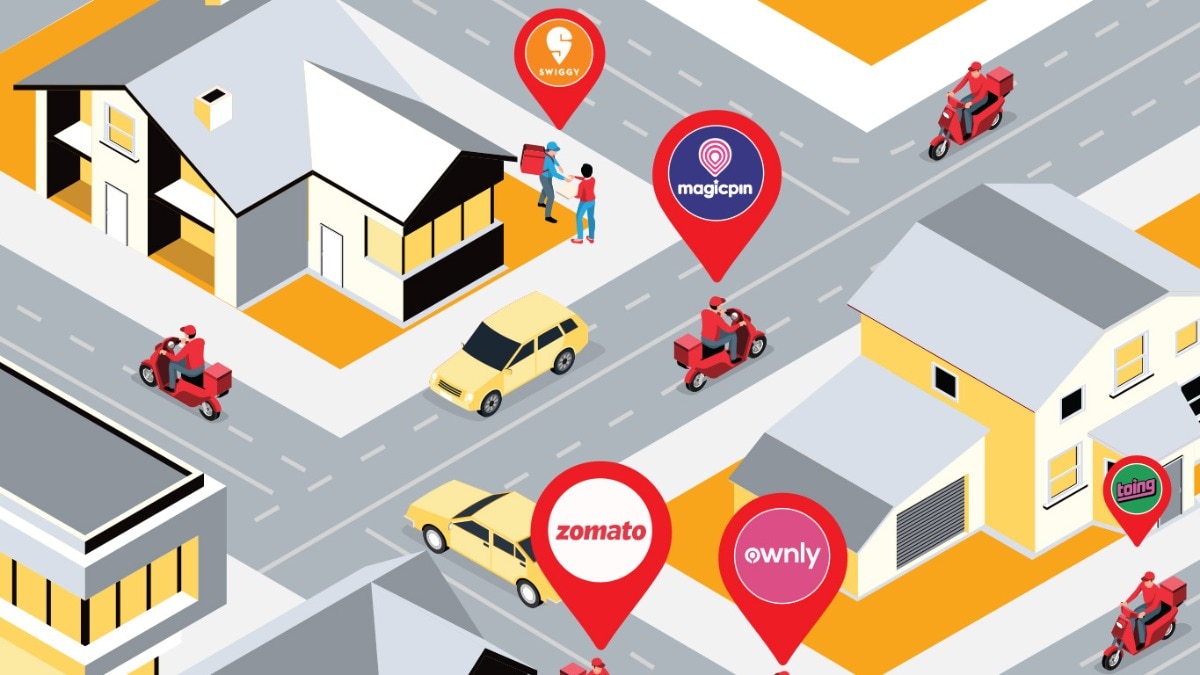
Rapido had just launched Ownly, an affordable food delivery business, making it untenable for Swiggy to continue owning a significant stake in a direct competitor.
Behind the sale—and the boardroom manoeuvres preceding it—lies a richer narrative; it’s the story of a market reaching maturity amid slowing growth and pivoting to capture its next set of customers. It drew the battle lines for what promises to be a war centred around value meals—wholesome food at an affordable price point, signalling a new phase of competition and innovation in food delivery. The new value challengers—magicpin and Ownly—are rewriting the rules of the game, prompting a response by the duopoly of Zomato and Swiggy as customers get put off by the increasing cost of ordering food and time taken for it to be delivered. Customer dissatisfaction is being reflected in the numbers reported by the Big Two.
“The value proposition of online food delivery has significantly eroded for consumers,” says Rohan Agarwal, a partner at Redseer Strategy Consultants. “Customers now rarely receive the discounts they once enjoyed and face substantial fees, leading to a hefty final cost.” Compounding this is a notable decline in speed with average delivery time now 43 minutes, a figure that climbs during peak hours. Agarwal attributes this largely to shortage of delivery staff.
Deepinder Goyal, founder of Zomato, says the recovery in food delivery growth has been slower than expected due to “weak discretionary spending, delivery partner constraints, and cannibalisation from quick-commerce verticals.”
Sriharsha Majety, CEO, Swiggy, emphasises a fundamental challenge, reflected in results for Q1FY25. “The biggest unlock for the sector is affordability,” he said. “The challenge lies in delivering value without subsidies or compromising service.” During the recently announced Q2 results, Majety said with affordability likely to be the single largest unlock, it is incumbent upon market creators such as Swiggy to try multiple approaches and see what succeeds, even if that means disrupting the status quo.
Towards Duopoly
Food delivery in India is a saga of boom, bust and consolidation. It began modestly in 2008 with Zomato—then Foodiebay, a no-frills restaurant discovery platform. The years that followed saw the entry of a raft of competitors—Foodpanda, TinyOwl, Uber Eats—that were consumed by a market notorious for high burn rates and razor-thin margins.
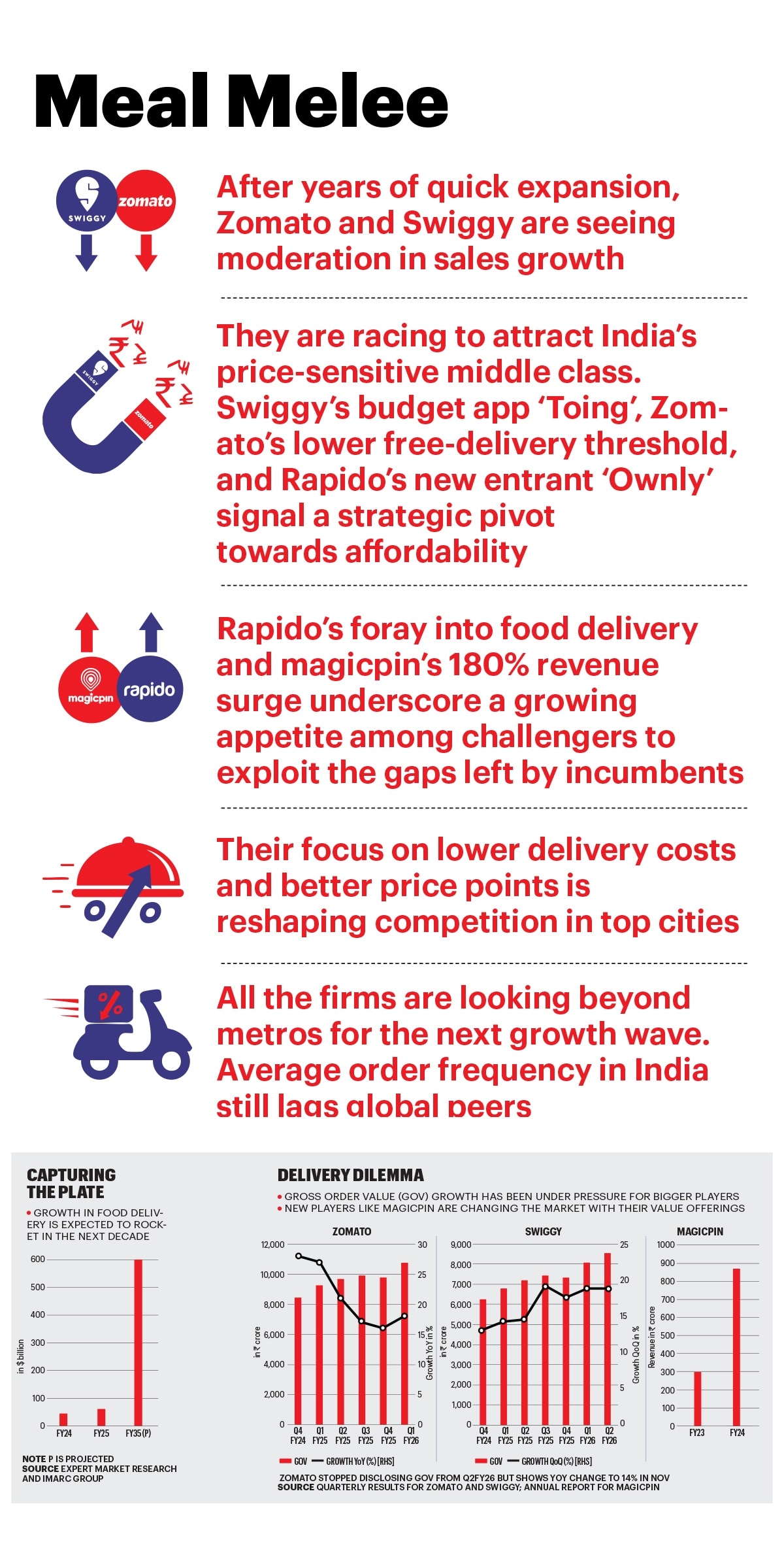
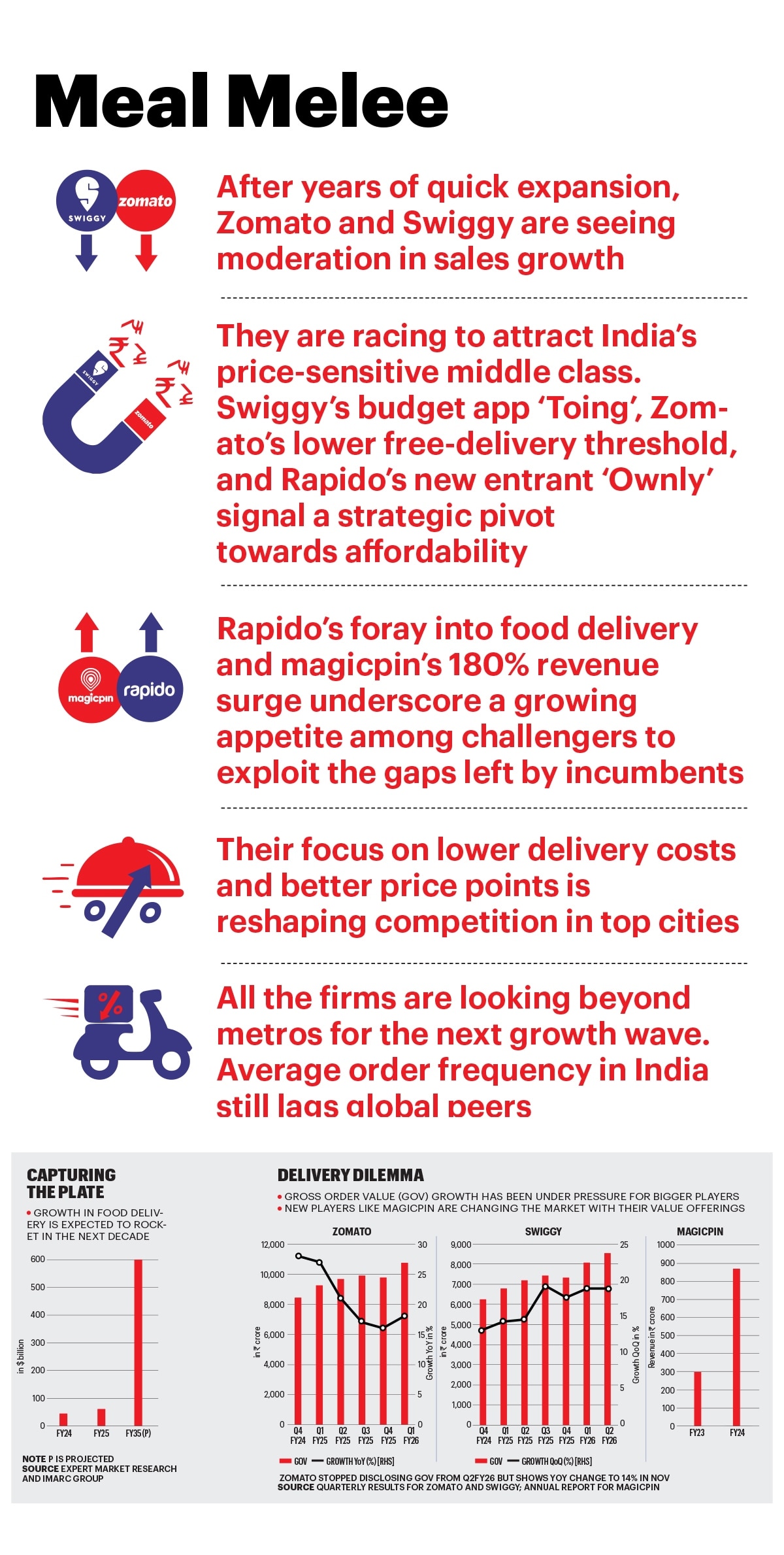
The landscape changed in 2014 with the entry of Swiggy, which brought new energy and operational rigour to the business. The year was a high watermark for entrepreneurial appetite with the launch of 234 food delivery start-ups, according to TrueGrit Analysis’ Ankit Arora, an independent advisor and former investor and board observer at Swiggy and AgroStar. The number peaked at 625 in 2015. The sector grew 40% to about $42 million in 2014. The inflection point came in 2018 when Zomato and Swiggy joined the unicorn club, signalling the arrival of big money. The frenzy was short-lived. By 2020, the field had narrowed to just 20-25 serious competitors. Post-2020 investor caution triggered consolidation, culminating in the 2025 troika of Zomato (now known as Eternal), Swiggy and magicpin, which operates as a buyer-side app on the government’s Open Network for Digital Commerce platform. India’s online food delivery market is projected to hit $600 billion by 2035, says Imarc.
Just as the market seemed to have settled, growth metrics began to flash amber. The Indian food delivery market, now estimated at $61 billion where Zomato and Swiggy have 85-90% market share, is showing signs of deceleration.
The Numbers
The story is stark. For Zomato, the slowdown has been evident for five consecutive quarters. The gross order value (GOV) fell from Rs 9,913 crore in the third quarter of FY25 to Rs 9,778 crore in the fourth quarter of FY25, before inching up to Rs 10,769 crore in the first quarter of FY26. More telling is the sharp decline in adjusted revenue growth for the segment, which halved from a 34% year-on-year increase in Q4FY24 to 17% in Q4FY25.
Swiggy’s trajectory mirrors the trend. Its GOV, Rs 7,436 crore in the third quarter of FY25, dipped to Rs 7,347 crore in the fourth quarter of FY25, and was Rs 8,086 crore in the first quarter of FY26.
Industry experts say even this modest growth was not driven primarily by a significant expansion of the user base but increase in platform fees and higher commissions from restaurants. Frequency growth is clearly being driven by the value-conscious segment, says Sandeep Gogia, MD & Sector Lead, Tech & Digital at Equirus Capital, adding that the value cohort contributes a higher share of monthly active users as well as repeat orders. Asked if “value meals” could converge into a category that becomes mainstream, Gogia says this segment has already moved beyond experimentation.
The Value Gambit
Analysts at Ashika Institutional Equities say the value-meal cohort is growing significantly faster than the premium segment. Over the last year, Indian food-delivery platforms have seen a sharp jump in ordering frequency from price-sensitive users, especially students, young professionals, and budget-first consumers. “With the food-delivery market maturing at 14–15% growth, the next leg of expansion clearly hinges on capturing this value segment. These offerings are pulling millions of users back into high-frequency ordering, making budget meals the real growth engine,” they say.
Slowing growth in the premium segment is, however, fraught with a fundamental economic challenge. “A significantly higher number of use cases can be unlocked with a Rs 150 order value. However, making money on these low-value orders is extremely challenging," says Agarwal of Redseer. “On a typical Rs 200 order, a platform earns Rs 45-50, while the delivery cost is Rs 60-65. So, the fundamental question is: how do you make money on this?"
Will restaurants be able to support lower price points over the long term? Gogia says restaurants’ willingness varies by scale. Large and cloud-first brands have adjusted menus, portions, and ingredient mixes to make affordable meals viable. According to analysts at Ashika, this model isn’t great for long-term unit economics. Shortage of delivery boys and lower average order value lower margins. The companies are relying heavily on batching to make it work.
Smaller kitchens with higher input cost volatility will feel more pressure. The key enablers are volume and consistent demand through delivery platforms offsetting thinner per-order margins.
For Rapido, Ownly is a strategic diversification. “We are tapping into the Rapido ecosystem to optimise costs and build a scalable, sustainable model that addresses the slowing food delivery growth in India,” says Aravind Sanka, CEO of Rapido, also a co-founder of Ownly.
Then there is magicpin, the quiet number three with laser focus on the value segment in India’s top 15-20 cities. According to Tracxn, magicpin reported a revenue of Rs 315 crore in FY23, which rose a staggering 180% to Rs 880 crore in FY24, while losses narrowed 6% to Rs 107 crore. Magicpin also caters to the beauty and fashion retail segment, among others.

“A large value segment in India’s food delivery space is underserved. Many local merchants lack visibility on big aggregators, while prices there are often out of reach for mass consumers. At magicpin, we’re bridging that gap by enabling value-driven merchants to reach nearby customers through shorter delivery routes, reducing costs and unlocking a market overlooked by traditional players,” says Anshoo Sharma, Chief Executive Officer and co-founder of magicpin.
Why not target the untapped Tier-II and III towns as well? Sharma says there is a massive market of students and young professionals staying away from home who are tech-savvy and looking for a better price point. The new entrants believe they have an edge. Industry experts say the ability to drive disruption with a fundamentally different mindset is far stronger when you are not already invested in the existing model. “Incumbents carry the baggage of an established revenue profile, which creates a natural reluctance to cannibalise their own business,” says Agarwal.
But the incumbents are responding. In response to Swiggy's Toing and 99 Store, Zomato has lowered the minimum order value for free delivery for its Gold members from Rs 199 to Rs 99. Recently, it introduced a separate section on its app, “Under Rs 250.” Goyal has said that Zomato could launch a separate app when it becomes clear that it is the right long-term approach for targeting budget-conscious customers.
The companies are also introducing affordable formats and loyalty programmes. In September, magicpin rolled out ‘Inner Circle,’ a corporate and student rewards initiative to make everyday consumption more affordable. With food delivery price points starting at Rs 49, Rs 69, and Rs 99, the programme, says Sharma, offers exclusive discounts and has seen strong traction—crossing 150,000 enrolments within a month and expanding across 3,000+ colleges and 500+ corporate offices in key metros, including Delhi-NCR, Bengaluru, Hyderabad, Mumbai, Pune, and Kolkata.
Beyond Metros
While the current battle is happening in the top cities, the industry’s long-term gaze is shifting. Aakash Agrawal, Head of Digital and New Age business at Anand Rathi Investment Banking, says, “The real growth will not come from the top eight urban cities. Consumption data shows Tier II and III areas are growing faster. Infrastructure in these regions has improved over the last two years.” Smaller cities offer attractive margins due to lower operating costs.
There is immense headroom to grow. An average Indian household in the top 20% income bracket orders food just six-eight times a month, a fraction of the 20-25 times a month in markets such as China. Agrawal predicts an easy jump to 12-15 orders per month, a trend already hinted at by Swiggy’s Bolt—a quick delivery model—which now accounts for 10-12% of its orders.
Innovation, says Rohit Kapoor, CEO of Swiggy Food Marketplace, is far from over. The next wave will be about making the experience “more contextual and seamless,” from smarter packaging and faster formats to healthier categories and hyperlocal integrations.
To what extent will the new competitors make an impact? Agrawal says they will obviously gain some market share. “There’s always low-hanging fruit—customers who will try a new service. However, the infrastructure and scale that the two major incumbents (Zomato and Swiggy) have created are difficult to match,” he says.
New Opportunity
There is a clear consumer focus on affordability. This is an opportunity for disruption. There is a substantial, unmet demand for unlocking regular, individual meal occasions—like a weekday lunch or a single snack—at lower price points of Rs 150-200. While serving this segment profitably is a major challenge due to fixed delivery costs, the sheer volume of unmet demand is creating conditions for new, innovative business models to emerge and cater to the value-conscious consumer base.
The Great Indian Food Delivery Story has entered its second act. The first was about building scale and seeing who survived. The second is a more nuanced battle for the hearts, minds, and wallets of the value-conscious consumer. The plates are being reset, and the menu is changing for good.
@palakagarwal64


