














It is billed as India’s answer to global insurers underwriting maritime assets, and promises a timely boost to a country that relies on sea routes for its energy security and much of its international commerce.
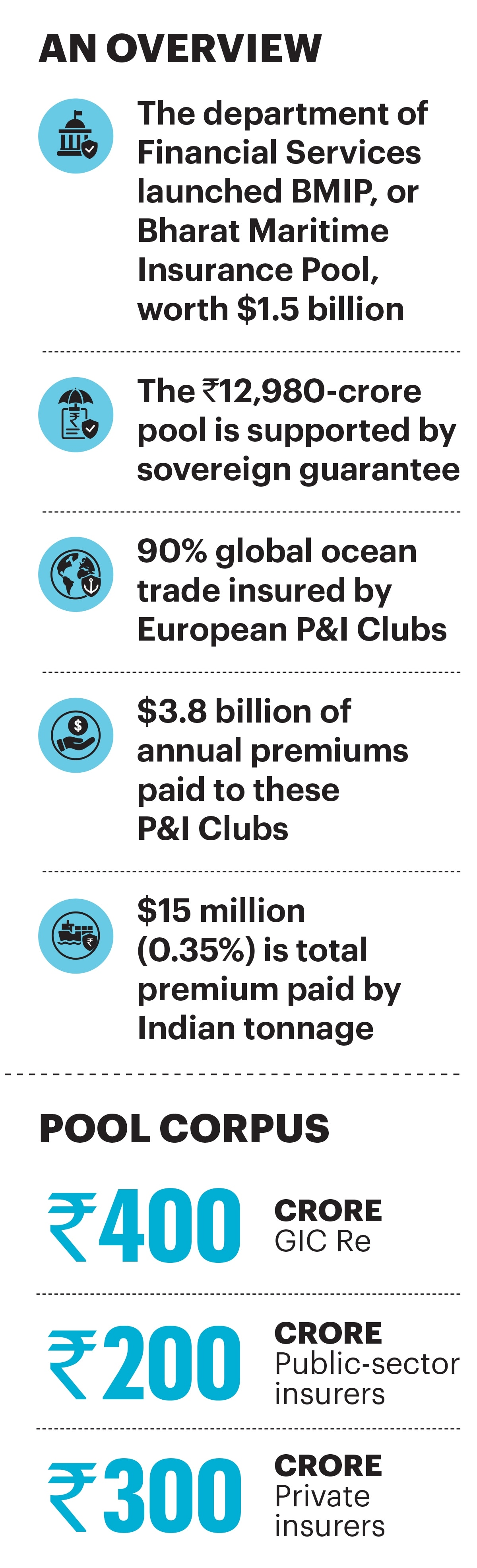
The $1.5 billion Bharat Maritime Insurance Pool (BMIP), a safety net unveiled in May 2026 amid the latest conflict in West Asia, offers uninterrupted insurance coverage to India-flagged and India-controlled merchant vessels.
True, the initial response to BMIP from maritime stakeholders has been less than enthusiastic, if not downright cold. Yet, its potential to reduce Indian dependence on foreign insurers over time is not in doubt.
In hindsight, BMIP’s unveiling was prescient, coming just days before three Indian seafarers died in a US strike on a Palau-flagged vessel, MT Settebello, in the Gulf of Oman on June 10, 2026.
The incident, which triggered outrage in India, was grave enough for Prime Minister Narendra Modi to raise it at the G7 summit in Evian, France, and at a bilateral meeting there with US President Donald Trump in mid-June. The US justified the attack, which came ahead of a tenuous ceasefire that is now in effect in West Asia, on grounds the vessel had violated its blockade of Iranian ports.
Freedom of navigation and safety of shipping and seafarers in the Strait of Hormuz, the chokepoint for 60% of the world’s oil trade, have been key global concerns since the US and Israel started the war against Iran in end-February.
They have only been upstaged by growing global worries over the rising price of crude oil and a steep increase in shipping and insurance costs as a result of the war. The war premium for an Indian ocean-going vessel ranges up to half a percentage point.
India’s maritime sector accounts for more than 70% of trade by volume and nearly 95% by value. The Indian marine cargo insurance market is estimated to be worth $2.89 billion in 2026 and expanding at a compound annual growth rate of 5.21%, according to MarkNTel Advisors, a market research and consulting firm.
Claim, Counter-Claim
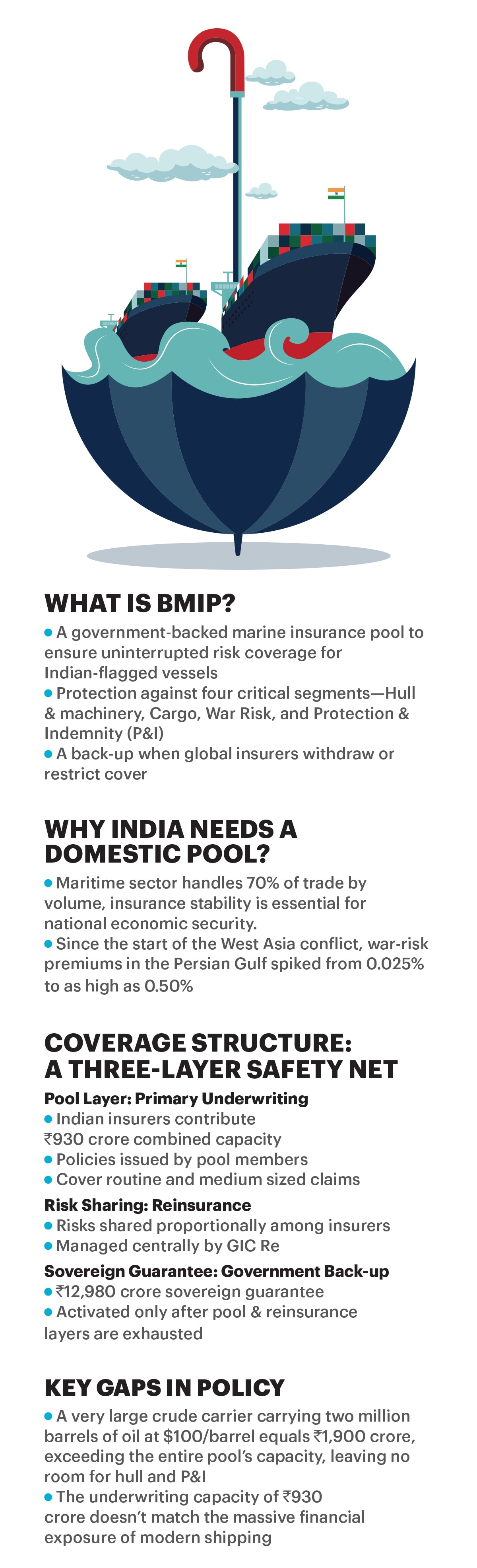
BMIP, backed by a sovereign guarantee of $1.4 billion, is aimed at protecting the domestic shipping industry from global volatility. It offers hull and cargo insurance, Protection and Indemnity (P&I) and covers war risk. P&I insurance covers third-party liabilities such as oil pollution, wreckage removal and damage done to ports.
“The indigenous pool has already resulted in reduction of premiums for hull war and cargo war risk covers in the country by 27% and 48%, respectively,” Debashish Prusty, additional secretary in the Department of Financial Services, claimed at a workshop in Mumbai organised by state-owned Shipping Corporation of India Ltd.
Indian National Shipowners’ Association (INSA) CEO Anil Devli quickly countered the claim. “One of our members sought a quote for BMIP cover. We were told that it is 27% lower than the market. I want to tell you that the quote we have got is 70% more than what we got in London,” Devli said.
The association doesn’t want it to be made mandatory for Indian vessels to obtain P&I cover from a domestic entity.
“It will be disastrous for Indian shipowners. The BMIP will probably be available for inland water transport or coastal, whereas the larger ships will then be left without a P&I cover and people will stop taking out ships,” said Devli.
Marine law experts say BMIP should be complementary to the international group of 12 P&I clubs providing marine liability cover to 87% of the world’s ocean-going tonnage.
Failed Precedents
Past attempts to put indigenous marine insurance in place have been non-starters.
They “foundered for reasons that were, in retrospect, structurally predictable: inadequate capitalisation, insufficient technical expertise and an institutional framework that proved unable to resist the pressures that inevitably bear down on state-backed financial entities,” says Gautam Bhatikar of law firm Phoenix Legal.
He says BMIP meaningfully addresses the capitalisation challenge through the sovereign guarantee. Deeper vulnerabilities remain—chief among them being underwriting discipline.
BMIP is seen as a strategically significant development for India’s maritime sector because India relies overwhelmingly on maritime trade for its energy security, commodity imports and international commerce. The creation of domestic maritime risk capacity is timely and necessary.

Sovereign Initiative
Harsh B. Buch, founding partner at law firm Orion Counsel, says BMIP should not be viewed merely as an insurance initiative but as a maritime sovereignty initiative.
“Recent geopolitical events—from sanctions regimes and disruptions in the Red Sea to fragmentation of global trade—have demonstrated that access to maritime insurance can become a strategic vulnerability. In that context, BMIP represents a conscious effort by India to reduce excessive dependence on external insurance markets during periods of geopolitical uncertainty,” says Buch.
For decades, Indian shipping has operated with a fundamental vulnerability—over-reliance on foreign insurers, particularly the International Group of P&I Clubs, for coverage that is essential to the continuity of trade. BMIP addresses that gap.
“The pool size of $1.5 billion, backed by a sovereign guarantee of $1.4 billion, lends it the institutional credibility it requires at this stage of its development. The prompt issuance of the first policy upon launch further signals that this is an operational mechanism, not merely a policy announcement,” says Bhatikar of Phoenix Legal.
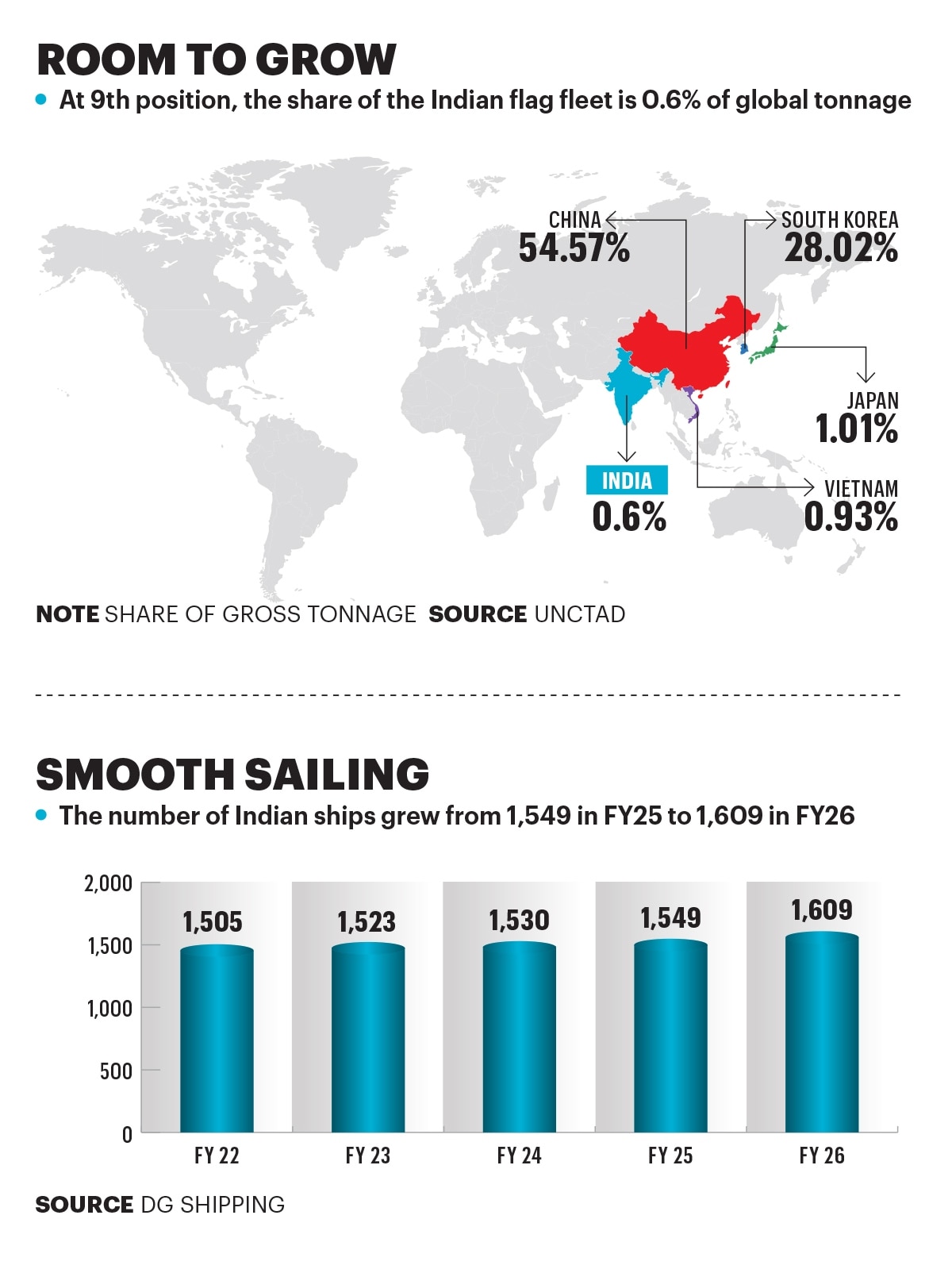
One problem: Indian shipping tonnage is an insignificant 0.6% of world tonnage.
“An Indian P&I entity is not commercially viable unless there is persistent and substantial growth in Indian flagged tonnage,” says Devli.
Not a Replacement
In the near term, BMIP will function as a strategic complement to existing international coverage rather than a replacement. This is not so much a reflection of a shortcoming in the pool’s design but a function of how global maritime commerce operates, experts say.
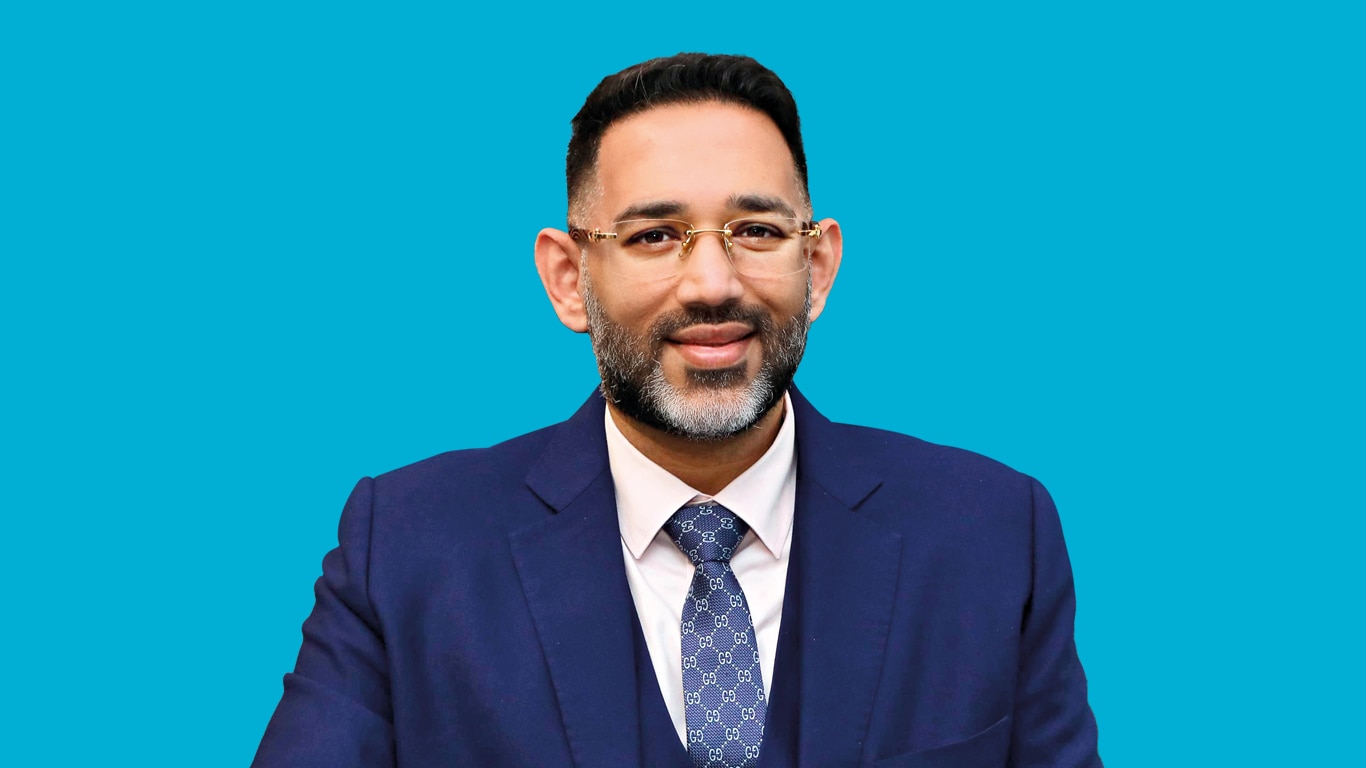
Aliasgar Hajee, CEO of Shipbuilding and Ship Management at SHM Group, says that at this stage, most shipowners would evaluate BMIP as part of a broader risk management strategy rather than view it through an either/or lens.
“Insurance decisions are influenced by operational requirements, trading routes, lender expectations and regulatory considerations. Over time, the market will determine the optimal balance between domestic and international coverage solutions,” says Hajee.
International counterparties, including lenders, ship charterers and port authorities, operate within frameworks that carry deeply established expectations around insurer recognition and financial standing.
Bhatikar says certificates issued by international P&I Club members carry legal weight across virtually every major port and arbitration forum in the world. For BMIP to achieve that recognition will require time, demonstrated performance, and a track record of credible claims settlement.
“Where BMIP’s value becomes immediately apparent, and potentially indispensable, is in scenarios where international coverage is withdrawn or rendered commercially untenable. War-risk coverage in volatile corridors such as the Red Sea and the Strait of Hormuz is the clearest example,” says Bhatikar.
“In such situations, BMIP serves not merely as a complement but as the only viable alternative, ensuring that Indian trade is not held hostage to decisions made in foreign insurance markets in response to geopolitical developments entirely outside India’s control. That function alone justifies its existence,” he says.
The sustainability of any domestic maritime insurance framework will depend on active participation by shipowners, operators, insurers, brokers and other maritime stakeholders, says Buch.
Sailors’ Deaths
The recent deaths of Indian seafarers in the Gulf region show that compensation and accountability are complex matters when dealing with foreign insurers.
BMIP could facilitate rapid financial support, coordinated repatriation, emergency assistance to families and offer institutional support for Indian seafarers caught in geopolitical events that may not fit neatly within traditional insurance categories.
Under the current framework, Indian crew members aboard vessels insured through European P&I Clubs are subject to foreign arbitration processes, regulatory considerations and the complications of sanctions regimes that can delay or complicate claim settlements.
For families, this frequently translates into prolonged uncertainty and limited recourse, says Bhatikar.
“BMIP offers a meaningful shift in that dynamic. By anchoring insurance within Indian jurisdiction, crew welfare claims, including injury, death, and repatriation, would be subject to Indian courts and Indian regulatory oversight. This strengthens India’s position as a flag state with enforceable duty-of-care obligations towards its seafarers, and provides affected parties with a far more accessible avenue for accountability and redress,” says Bhatikar.
Ecosystem
Hajee says that for long-term sustainability, the focus should be on building a strong ecosystem rather than viewing insurance as a standalone product.
“This requires adequate capitalisation, access to global reinsurance capacity, robust underwriting expertise, efficient claims management and broad participation from shipowners, ports, offshore operators and other maritime stakeholders. Equally important is scale. As India’s maritime economy expands through investments in ports, shipping, shipbuilding and offshore infrastructure, the domestic insurance market must evolve alongside it,” he says.
India has limited domestic expertise in specialist marine underwriting, particularly in war risk and P&I lines, and building that capability is a generational undertaking. The true test of BMIP will come not in the issuance of policies, but in the settlement of large, complex and contested claims.
“How the institution performs under that pressure will determine whether this initiative fulfils its considerable promise or joins the list of well-intentioned reforms that failed to endure,” says Bhatikar.
A Long Way To Go
Equally important is the development of genuine technical capacity within the pool and its member-institutions in areas such as claims investigation, casualty management, and legal recovery. These are specialist functions that cannot be indefinitely outsourced to international reinsurers without replicating, in a different form, the very dependence BMIP has been created to resolve.
“Finally, from a maritime law perspective, an important question is whether BMIP-backed guarantees and security instruments will receive the same degree of acceptance before foreign courts, admiralty jurisdictions, ports, and commercial counterparties as International Group letters of undertaking,” Buch says.
Indian ship owners say they are open to indigenous marine insurance but BMIP has a long way to go to find international acceptance.
Buch says BMIP is the beginning of a journey rather than its culmination.
The real test will not be whether it can underwrite policies, but whether it can catalyse the development of a genuinely industry-led maritime risk culture in India.
If it succeeds in doing so, BMIP could become one of the most consequential institutional developments in the Indian maritime sector in decades, says Buch.
@richajourno


