
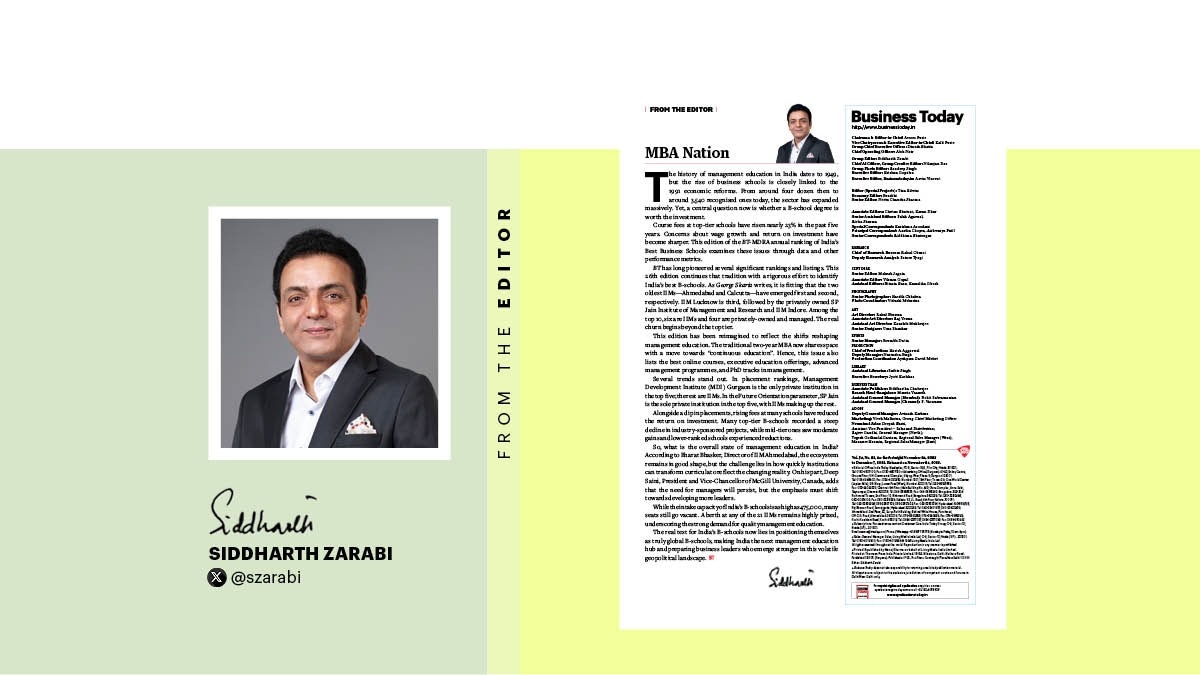
The history of management education in India dates to 1949, but the rise of business schools is closely linked to the 1991 economic reforms. From around four dozen then to around 3,540 recognised ones today, the sector has expanded massively. Yet, a central question now is whether a B-school degree is worth the investment.
Course fees at top-tier schools have risen nearly 23% in the past five years. Concerns about wage growth and return on investment have become sharper. This edition of the BT-MDRA annual ranking of India’s Best Business Schools examines these issues through data and other performance metrics.
BT has long pioneered several significant rankings and listings. This 26th edition continues that tradition with a rigorous effort to identify India’s best B-schools. As George Skaria writes, it is fitting that the two oldest IIMs—Ahmedabad and Calcutta—have emerged first and second, respectively. IIM Lucknow is third, followed by the privately owned SP Jain Institute of Management and Research and IIM Indore. Among the top 10, six are IIMs and four are privately-owned and managed. The real churn begins beyond the top tier.
This edition has been reimagined to reflect the shifts reshaping management education. The traditional two-year MBA now shares space with a move towards “continuous education”. Hence, this issue also lists the best online courses, executive education offerings, advanced management programmes, and PhD tracks in management.
Several trends stand out. In placement rankings, Management Development Institute (MDI) Gurgaon is the only private institution in the top five; the rest are IIMs. In the Future Orientation parameter, SP Jain is the sole private institution in the top five, with IIMs making up the rest.
Alongside a dip in placements, rising fees at many schools have reduced the return on investment. Many top-tier B-schools recorded a steep decline in industry-sponsored projects, while mid-tier ones saw moderate gains and lower-ranked schools experienced reductions.
So, what is the overall state of management education in India? According to Bharat Bhasker, Director of IIM Ahmedabad, the ecosystem remains in good shape, but the challenge lies in how quickly institutions can transform curricula to reflect the changing reality. On his part, Deep Saini, President and Vice-Chancellor of McGill University, Canada, adds that the need for managers will persist, but the emphasis must shift towards developing more leaders.
While the intake capacity of India’s B-schools is as high as 475,000, many seats still go vacant. A berth at any of the 21 IIMs remains highly prized, underscoring the strong demand for quality management education.
The real test for India’s B-schools now lies in positioning themselves as truly global B-schools, making India the next management education hub and preparing business leaders who emerge stronger in this volatile geopolitical landscape.













