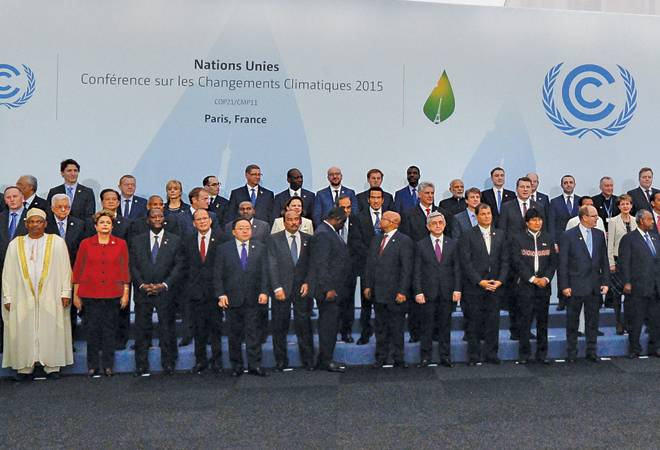
By the time this appears in print, the negotiations at the United Nations Conference on Climate Change in Paris would have ended. The core issue that needs to be resolved is 'differentiation', or how to differentiate the actions of developed and developing countries.
Developed countries want the annex-based differentiation to go. In the 1992 climate convention two annexes, or lists of countries, were created - Annex 1 (developed countries) and non-Annex-1 (developing countries). The formation of the two groups was to reflect the fact that some countries were historically responsible in causing climate change and that some countries had pressing, important priorities such as poverty eradication and, therefore, had the right to emit, for their economic development. Under the convention, developed countries were also mandated to support developing countries with finance and technology development and transfer, so that they could better adapt to the impacts of climate change and, also, better transition towards a low-carbon economy.
But now, developed countries believe that such differentiation is no more valid. They point to countries, such as South Korea, Singapore, Israel, Saudi Arabia, Kuwait and UAE, which are non-Annex 1 countries. These countries have high per capita emissions, per capita income and high human development index. Lately, the North has also started including China, Brazil, South Africa and India in this 'new, changing' list because of their high aggregate emissions and rapid economic growth.
Developing countries, on the other hand, are convinced Annex-based differentiation must continue. Their conviction is based not only on the fact of historical emissions, but also that Annex 1 countries, even now, have very high per capita emissions. If we take 1850 as the starting point, then more than 60 per cent of all CO2 emitted so far has been from developed countries. Developing countries believe the historical responsibility of developed countries remain as valid, today, as they were in 1992.
What adds to this belief is the sad fact that, since 1992, developed countries have hardly met their commitments. They have failed to meet their commitments on finance. They have failed collectively to reduce emissions as significantly as they promised. Whatever emissions have reduced in Annex-1 countries is because of outsourcing of emissions to countries such as China and India. That is, the developed countries, instead of manufacturing products in their own countries, are outsourcing industrial products from developing countries.
This contest now threatens to rip apart the convention.
To break this impasse, it is important to deconstruct the politics of differentiation. So far as developing countries are concerned, even if some developing countries are not comfortable with annex-based differentiation (such as some least developed countries or LDCs), all want, in greater or lesser degree, the convention principles of equity and common but differentiated responsibilities (CBDR), to get reflected in each and every element of the Paris deal.
But developed countries are out to bypass the convention. The 'differentiation' quotients they have proposed for different elements of the deal are all different. For mitigations or emissions reductions, they have proposed (and now it is universally accepted) "self differentiation". That is, countries will self-differentiate their mitigation targets through the bottom-up process of intended nationally determined contributions (INDCs). As US President Barack Obama put it in his original style at the opening of the Paris climate conference: 'Targets that are set not for each of us, but by each of us' (emphasis added)".
Formulations such as these are in the advantage of developed countries. In such a regime, no one can push nations such as the US to undertake deep de-carbonisation of their economies. They, therefore, have provided significantly weak mitigation targets in their respective INDCs. In fact, they will continue to misappropriate the remaining carbon space.
The world just has 1,000 gigatonnes CO2 of atmospheric emitting space to keep within the 2C temperature target. Shouldn't the developed world vacate this space so that countries like India, South Africa, Bolivia, Brazil and Angola, along with another 129 developing, least-developed, existentially threatened nations survive and grow? This is the question the developed countries are assiduously avoiding at the Paris CoP.
On finance, they are talking about "dynamic differentiation". They are using terms like "evolving responsibilities and capabilities" which means that when a developing country crosses a certain threshold (say in terms of per capita emissions or income), they too should contribute to finance. Lately, developed countries have started saying that developing countries which are "in a position to do so" should contribute to finance.
Developed nations have been vocal about their financial support to LDCs and AOSIS and not to countries like India. This is pure 'salami tactics': break the unity of developing countries in Paris. They are offering money to some of the poorest countries of the world, so that they just keep quiet vis-a-vis the positions of countries like India. So, at this juncture, it is important for the developing countries to be smart about differentiation. They cannot keep parroting the old melody.
On the mitigation side, it is quite clear the bottom-up, self-differentiated approach is built on weak climate integrity. It will always be the 'lowest common denominator'. We will never be able to keep the global temperature increase within the 2-degrees safety threshold under this approach.
Similarly on finance, it is impractical on the part of developed countries to say that their financial support will only be for LDCs. Countries such as India, too, have a very large number of poor people and they would also need support for adaptation and, loss and damage.
Lastly, it is in no one's interest to say that countries like South Korea or Saudi Arabia should not do more. So, how should we move ahead?
1. We can solve the problem of differentiation by operationalising equity and allocating fair share of carbon budget to countries based on the CBDR principle. This will allow every country to know their limits. Every country - developed or developing - will have clear targets on mitigation. This will be a true differentiation, for those countries that have used their carbon budget in the past will have less in the future and vice-versa.
2. Under any fair distribution formulation, developed countries will have a relatively low budget from now till 2100, because they have overused their budget. So they will have to perform mitigation actions in developing countries to meet their fair target. This will unlock the carbon market. Developing countries can decide to sell their fair share to developed countries and use the money to invest in low carbon infrastructure and energy access.
3. On technology, developed and developing countries (including the private sector in both spheres) should come together and invest in technology development and make Intellectual Property Rights (IPR) of key technologies accessible to all. All countries can contribute. India's International Solar Alliance is one such example where all countries can invest to reduce the cost of solar technologies and make it accessible to all.
4. On adaptation and loss and damage, it should be the responsibility of developed countries to financially support developing countries to adapt and provide for relief and insurance for loss and damage suffered by them. The rationale is that the current impacts of climate change are because of the historical emissions of the developed countries. They, therefore, have the moral responsibility to ensure that the developing countries are shielded as far as possible from the impacts of climate change. Here it is important to understand that developing countries are already investing hugely on adaptation and loss and damage, and would continue to do so in the future. Developed countries are just putting in money to enhance action. So, overall money is being put in adaptation and loss and damage by all parties.
5. On finance, developed countries must collectively meet their pledge of $100 billion by 2020. We know that this will not be sufficient and, hence, we must agree on some mechanism to ratchet up the contribution of developed countries post 2020. But even so, this won't be sufficient. So, I propose that developing countries with resources can contribute to a South-South solidarity fund run by the United Nations or some other multilateral body. China has already announced its contribution to South-South Cooperation Fund. Other developing countries can also do so.
6. In that case, we will have two funds - one contributed by developed countries (including GCF) and the other by developing countries. This will help maintain the differentiation.
7. On financial support, those developing countries that do not want to take the support can unilaterally announce so at the Paris meet. I would propose developing countries with high Human Development Index (0.85 and above) should certainly unilaterally announce that they would not take support from developed countries. Countries, such as South Korea, Singapore, UAE, Saudi Arabia, Kuwait and, so on, fall in this category. These countries should also be encouraged to contribute to the South-South fund.
8. On reporting and transparency, which is largely a matter of capacity, developed countries should financially and technologically support and help all developing countries to build their capacity for, at least, the next 10 years. Subsequently, from 2025 onwards, all countries can adopt a uniform system of reporting for all. So, the differentiation here is merely time-bound, though support-dependent.
9. Reporting and transparency of the financial support of the developed countries is also very important. So, there should be a detailed protocol on how developed countries would report and verify their financial contributions.
The above formula is an honest way to deal with differentiation. It keeps the annexes, yet encourages more developed non-Annex countries to contribute more to strengthen global solidarity around climate change. It also operationalises differentiation is true sense through fair allocation of carbon budget.
Let's be smart. It is too late to get bogged down.
(Chandra Bhushan is Deputy Director General, CSE, and Head, Industry and Environment Programme)













