
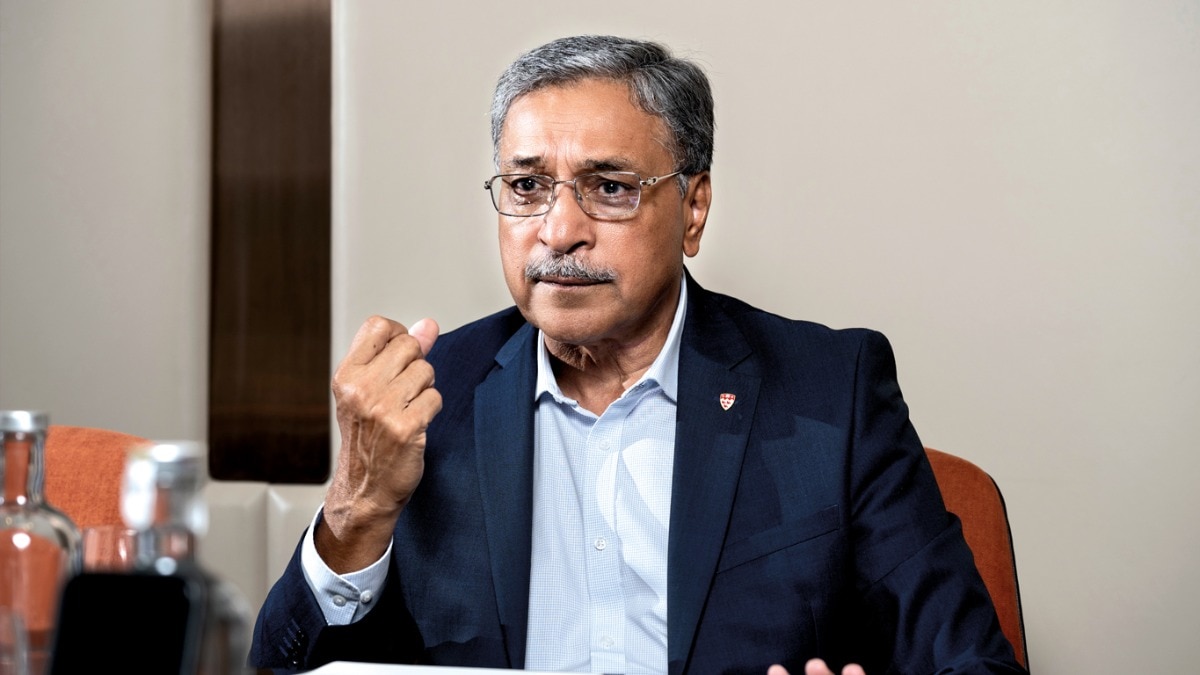
Deep Saini, President and Vice-Chancellor of McGill University, one of Canada’s most prestigious institutions, was born and educated in India before pursuing an international academic career; he now leads a globally recognised research university and manages a budget of about $2 billion. In a rapidly changing global environment, where technology, geopolitics and shifting student flows are reshaping higher learning, Saini argues that management education must evolve just as quickly. During a recent visit to India, he spoke with BT about how universities can stay relevant, how leadership models are being rewritten, and why adaptability will define the next generation of managers. Edited excerpts:
Indian students face increasing barriers to their aspirations to study overseas. Do you see a permanent shift in how Indian students pursue education and opportunities, including in the US?
There is a wider global shift underway, not just in the US. My hope is that the current barriers are not permanent, but institutions must be prepared if they become so. Student mobility will continue; it may not remain at the levels of the last two decades, but no country can afford isolation. There will be a correction to what we see in the US today, though not a return to the past—it will be something new, with new opportunities.
The real challenge for institutions is anticipating where this change is heading. As Wayne Gretzky (former Canadian ice hockey player) said, success comes from knowing where the puck will be, not where it is. At McGill, we are applying that philosophy. We have launched a major institutional review examining everything we do—teaching, operations, admissions—to decide what to continue, what to stop and what new ideas to adopt.
On mobility specifically, Canada remains open. This year, each university received a quota for international students; McGill finished slightly below its quota because we deliberately control admissions. There is room for more high-achieving international students, including from India, to come to McGill and thrive globally, as our alumni already do in more than 185 countries.
McGill University’s school of management dates back to 1906 and is among the first globally. How do you see the role of modern business education, given that corporations have to keep playing catch-up with so much change, including technology?
It is very important that we stay in tune with the times and the needs of society—delivering that is the key. McGill has done that very well. We have constantly evolved in tune with the needs, and our business school continues to do that.
How do you remain current, how do you address the most recent needs, and how do your models for teaching management change? Management has changed dramatically. Let’s take the example of university management. When I went to a university here in India, the vice-chancellor was an all-powerful person, and what the VC said happened. It was a classic command-and-control model.
I don’t know how it is here now, but I can tell you that at McGill, if I tried to issue a command, that would be the most certain way to ensure that what I ask for doesn’t get done.
My role as a leader today is to build consensus, lead through intellectual and moral authority, and bring people along so they feel they want to be part of the project rather than be told to fall in line. And I don’t think it’s that different in the private sector.
There is a greater demand for servant leaders—people who lead to serve, rather than to command. People are asking for not just shareholder value but social value. I call it stakeholder value, and that value is to be provided in a different way than simply through economic success.
Empathy is a very important part of this. For the last two years, I have been participating in a course at our business school, the Desautels Faculty of Management, titled Happiness Means Business. It is about how your state of mind—and how you project it—impacts your management capability.
Is the pursuit of profit the ultimate goal of a manager?
A relative of mine once came to my house when we had two cars—mine and my wife’s—and he asked me, “Which one costs more?”
I told him, “If you ask me which is the better car, I can answer that, but I can’t answer which costs more because it’s irrelevant.”
You can think about providing profit and providing value as two different things. I think if you focus on providing value, profit gets wrapped into it. If I became the richest man in the world but was disconnected from those around me, would I be able to do something good with that wealth? I would consider that a failure, and that applies to a company as well. Providing value to society is very important.
What lessons do you think Indian business schools can learn from McGill’s enduring success?
Remaining relevant and current is critical. Keeping an eye on where the puck is going prepares you to start moving in that direction today. That is what we have done well, and we continue to ask that question. It means sometimes stopping things you used to do.
Another critical element is experiential learning. Learning by doing is an important part of the Canadian education system. It is becoming increasingly important: practice must be part of your training. One hour in a classroom with the CEO of a successful Indian company would be of incredible value—that is experiential learning.
What is your view on the future of global management education? Professor Henry Mintzberg, a renowned teacher at your faculty of management, has been critical of the conventional management education model—even of Harvard Business School.
We will always need managers. Companies, institutions and organisations need to be managed. The part we can do more of is to make more of our managers leaders; people often confuse the two. We also need to inject empathy and service into our management models.
What Mintzberg has in mind, you can only ask him. But in my view, value is not measured only in terms of share price.
There are times I have run into MBAs who tend to be very performance-driven, almost robotic, because they have a model in mind and want to apply it everywhere. We need to introduce a greater element of innovation in thinking, give people greater freedom to think on their own. Thinking outside the box is important—that is how progress happens. Not enough of that has historically happened in management education. It cannot be simply learning a set of formulas.
We are living in the age of Artificial Intelligence (AI) and it is sweeping through almost every sector. What consequences do you foresee?
When mechanisation happened, we lessened the load on our muscles. AI could become the tool that reduces the “menial labour” on our brain—a new kind of help for the most important muscle in our body.
It frees up thinking space and computing power in our heads, pushing us beyond the drudgery of certain tasks.
I am optimistic about AI for two reasons. One, AI does us a favour by giving quick answers and allowing us to apply our brains at a higher level, to be more creative.
I would compare AI to nuclear energy. With nuclear energy you can light up the world—or you can blow it up. Humanity has done a good job of controlling that impulse. Since Hiroshima and Nagasaki, nobody has used a nuclear bomb despite more nations possessing them. That means we can regulate ourselves. My hope is we will do the same with AI. We could destroy the world with AI, but I think we will end up using it for good causes.
What are your thoughts on rankings of educational institutions and their relevance?
If we didn’t have rankings, we would have to invent some. They are not perfect, but they are necessary—some even call them a necessary evil.
If I go to the bank for a loan, the bank checks my creditworthiness. Rankings are akin to the creditworthiness of a university.
But if you live only by rankings, you will die by rankings. Institutions should focus on what they need to do that organically translates into higher rankings.
At McGill, we have an obsessive commitment to excellence in teaching and research. Our mission statement says research must be measured by the best international standards, period.
If you pursue research simply to go up in rankings, that is wrong. But if you pursue excellence, it will be recognised. Outstanding research gets read, cited, acknowledged and leads to applications, and that influences ranking metrics.
Rankings are also relative. You can improve but still fall because someone else rises faster. That is partly what I mean by living by rankings and dying by rankings.
What defining moments shaped your career?
What helped me? A flexible approach to learning and curiosity. When I had options, I often chose the riskiest—also the most exciting. People saw risk; I saw excitement.
And having grown up in India—a complex society with many languages, religions and diverse regions—teaches you cognitive flexibility. That helps you navigate complex situations later in life.
What makes Indian managers successful globally?
One key factor, in my view, is the ability to live with complexity—making sense of it and having the cognitive flexibility to think at multiple levels simultaneously. That is our strength, and it is very likely the factor that helped so many people of Indian origin succeed on the global stage.
@szarabi













