
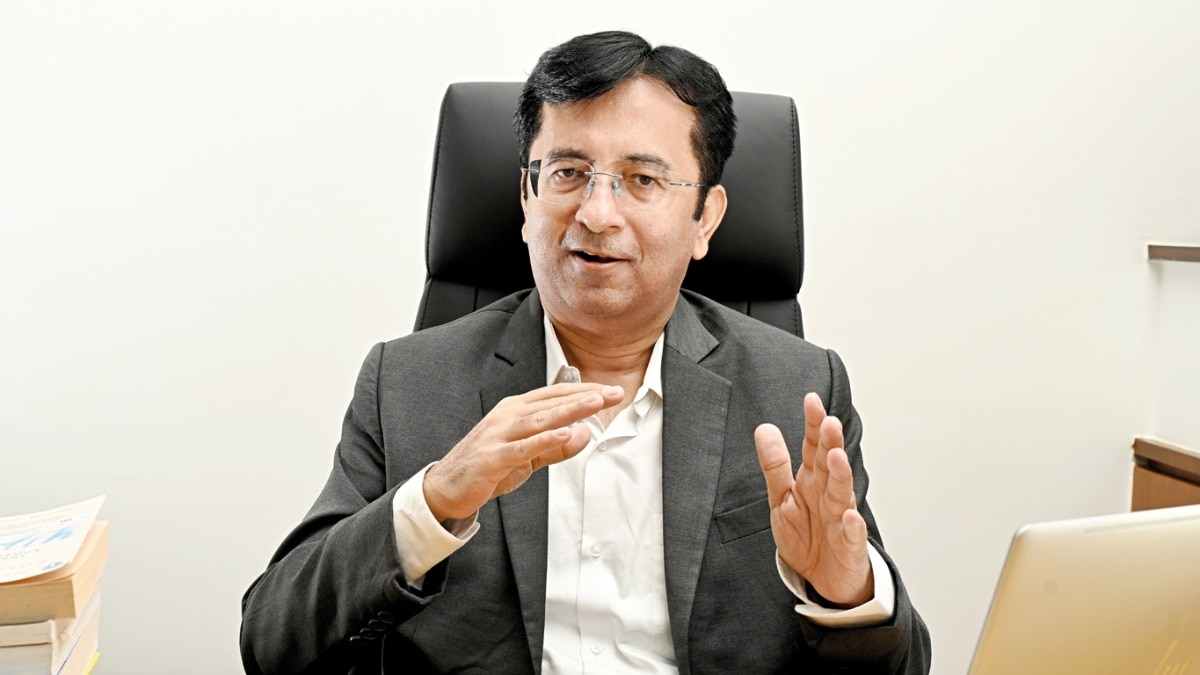
One of India’s leading mutual fund companies, Parag Parikh Financial Advisory Services (PPFAS), has two of its schemes in the BT-VR Top 100 Mutual Fund Schemes. Parag Parikh Flexi Cap Fund, with Rs 1.15 lakh crore, has the largest assets under management (AUM) among equity schemes, while Parag Parikh ELSS Tax Saver Fund has an AUM of Rs 5,524 crore. In this exclusive interview with Siddharth Zarabi, Group Editor, Business Today, Rajeev Thakkar, CIO & Director of PPFAS Mutual Fund, shares his insights on market trends, evolving investor behaviour, and what lies ahead for India’s mutual fund investors. Edited excerpts:
Q: At the outset, can you share how your core investment philosophy balances conviction in fundamentals with the lure of short-term themes and high-beta opportunities?
A: Typically, the life situations, goals, aspirations, and risk appetite of investors do not change within 12 months. At best, some small tweaks may be required here and there. So, to your question as to how one balances the longer-term fundamentals and convictions with the shorter-term noise, my recommendation would be to have a small allocation to these tactical things (macro-economic uncertainties). People either go overweight on equity or underweight on equity in terms of their asset allocation. The bulk of the investing should be driven by their life situation. I wouldn’t recommend a 70-year-old requiring monthly cash flows to be heavy in equity, and a 25-year-old with a long investing career ahead should be equity-heavy despite the noise. I would recommend tuning out of some of these headlines that concern us on a day-to-day basis.
Q: How should an investor also read the prospects of the market for the new Samvat (Hindu solar calendar)?
A: A lot of investors are relatively new to the market. Just for context, pre-Covid, we had about 40 million demat accounts, and today that number stands close to 200 million. Now, some of this would be duplication, but a lot of new investors have come into the markets. Even in the mutual fund space, the number of unique investors has grown quite a bit. A lot of people haven’t seen the sideways market, and they are surprised by the past 12-month market performance. I would like to point this out to the new set of investors that equity, by nature, has this kind of trend. There are some years of superlative returns. There are some years where the market goes nowhere or, in fact falls as well.
Recommendation number one is, invest only that money into equities that you can stay invested in for a period of at least five to seven years.
There has been a big disconnect between valuations that prevail in India and the valuations that prevail globally. While GDP growth has been strong, corporate profitability has been weak, and I have a hypothesis around this that even in sectors that are seeing a reasonable amount of volume growth, the competitive intensity has been at a high level. Newer players are coming in, existing players are fighting for market share, and people want to grow their sales even at the cost of profitability.
In the absence of earnings growth, the stock price performance is subdued. Ultimately, stock prices are slaves of earnings, and earnings have been disappointing.
Q: Indian equities continue to command a significant premium as compared to peers. What is your view—is some sort of recalibration underway?
A: I have a simple answer to those who make this point that India’s growth rate is higher. One, today the country of listing does not necessarily reflect in the underlying business. We have enough companies listed in India that have huge global operations. Tata Motors in India owns Jaguar Land Rover, Hindalco owns Novelis, and Tata Steel owns Corus.
Indian companies are also multinationals, and while one can argue that India’s growth rate is higher or could be higher depending on one’s views, a situation where if you buy the global parent, the entire Indian market cap is accounted for as a small portion of that and the rest of the global business you get free. That situation is clearly an anomaly. You cannot explain that away by India’s high growth rate.
Q: Is the number of investors and the amount of domestic inflows evidence that the Indian market is maturing or overconfidence in equities?
A: I would say a bit of both. At one end, Sebi (Securities and Exchange Board of India) data shows that in the last financial year, we probably raised Rs 1.7 lakh crore via IPOs (initial public offerings).
This is a good sign of capital formation happening in the country, a young demographic, and more savers as compared to retirees. (This is seen in) the growing systematic investment plan (SIP) book, employees’ provident fund (EPF) money coming to the markets, National Pension Scheme (NPS) money coming to equities, people getting into this equity culture because of ESOPs (Employee Stock Ownership Plans) with their employers, and financial literacy efforts of AMFI (Association of Mutual Funds in India) and various bodies.
However, the flip side to this is that while we raised Rs 1.7 lakh crore in IPOs, speculators collectively lost Rs 1.06 lakh crore via F&O (futures and options) transactions. The bulk of the trades today are of a gambling nature on the stock exchanges rather than capital formation or a long-term wealth creation strategy. That is something we need to keep in mind.
Q: What do you think will be the key sectors to watch out for?
A: One sector where valuations look reasonable as compared to historical averages has been the banking space. Here, sentiment has not been that great. In IT services, the consensus is that a lot of headwinds—global captives, the effect of AI on the amount of work that will be there and resultant impact on margins, etc—are coming in.
Growth rates have been subdued. However, in the past as well, we have seen the sector go through cycles where some periods are high growth and some periods where the growth is subdued. I think these two spaces look reasonably okay to identify individual opportunities.
Q: How do you see fund management evolving in India for the next five years, and what is required for fund houses to stay relevant?
A: One trend that has played out globally and that will play out sooner or later in India is the trend towards passives.Passives will carve out a share in the Indian market. There is strict categorisation at the Sebi level in terms of a large-cap fund, mid-cap fund, large- and mid-cap, money market fund, and liquid fund.
Beyond a certain number of schemes from different fund houses, there is not much differentiation that can come in. One could see some consolidation down the road.
Q: Many investors say that there are just too many options in mutual fund investing. How should an investor build a portfolio without getting overwhelmed?
A: The first decision does not even involve selecting a mutual fund scheme. I think where people make a mistake is getting the broad asset allocation right. I think people make a fundamental mistake here.
When it comes to mutual fund schemes, if someone is new to investing and even in my view, people who have been around for a while, also would do well in terms of selecting diversified equity funds, rather than going with specific thematic funds or sectoral funds.
If people invest in a diversified fund, either via something like a flexi cap or a multi cap or by selecting large-, mid- and small-cap funds, they should be okay. One caveat I would like to recommend is, don’t go overboard on small caps and mid-caps. These are smaller companies where the fund will invest. They are by nature more volatile than the more established companies. The profit pool, roughly 65-75% of the overall corporate India profit, is concentrated in large caps. Mid and small caps have a smaller pool.
Q: What is the ideal portfolio mix that an average investor should have?
A: Historically, gold has always been part of our culture. Most people will have gold in their lockers at home or in their bank lockers. I would ask not to rush into gold just because past performances have been good. Also, investors should be mindful of not overallocating to themes and small-cap, mid-cap funds.
@szarabi













