
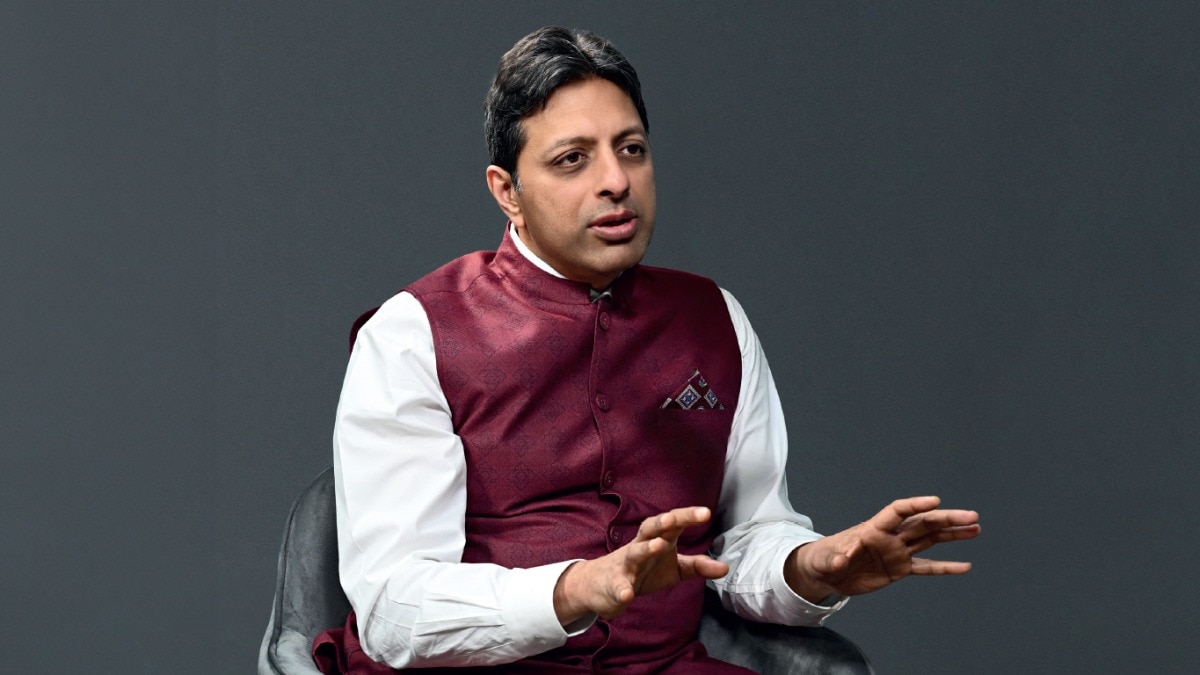
He has been with Amazon since 1999, long enough to have watched the company evolve from an online bookstore into an everything store, a global technology conglomerate, and a major long-term investor in India. So, when Amazon recently announced a $35-billion investment in the country, it made sense to speak with Amit Agarwal, Senior Vice President for Emerging Markets at Amazon, and one of the executives closest to that growth story.
In a conversation with BT, Agarwal spoke about what the announcement signals. He also reflected on his years at Amazon and what he took away from working closely with founder Jeff Bezos as his technical advisor in 2007 —especially the focus on customer obsession, innovation and thinking big.
That thinking, Agarwal confirms, is also reflected in the way Amazon runs meetings. It is true, he explains, that meetings often begin with everyone reading a memo first. For every meeting, there is an owner who brings a six-page narrative and a set of anticipated questions from the reader with upfront answers. The six-page limit is deliberate: it forces clarity and crisp thinking, unlike presentations or long write-ups where it is easy to drift. Edited excerpts:
SZ: Take us through the details of the investment. Why India and why now?
A: Let me give you a little bit of perspective. We started here in 2003, and that was our first development centre, essentially software development and product talent building capabilities for our global business. In 2013, we launched Amazon.in. We have also launched Amazon Web Services, Prime Video, MX Player.
We have many different businesses that are all thriving and scaling well in the country. And back in 2020—when Jeff Bezos was here—he boldly declared how the 21st century is likely to be India’s century. And we made three pledges at that point in time. We pledged to digitise 10 million small and medium-sized businesses, enable $20 billion in exports, and support two million jobs. We have delivered on those pledges ahead of time. Between 2010 and 2024, we invested $40 billion, making Amazon the largest foreign investor in India, the largest enabler of exports, and one of the largest creators of jobs in the country. Now, as we look forward to the next five years, we estimate we are going to invest an additional $35 billion by 2030. Based on the momentum we are seeing in exports, we aim to enable $80 billion in cumulative exports by 2030 and support 3.8 million jobs. On the digitisation front, we are leaning into AI, which is probably the biggest disruption of our lifetime. We want to empower four million government school kids with AI literacy and training. All in all, we are very proud that Amazon is the largest foreign investor in the country and the largest enabler of exports and jobs.
SZ: In today’s “10-minute delivery” era, it may be important to note that you introduced next-day delivery in India around 2013. Can you elaborate on that?
A: We have always been focused on speed. And to that end we are probably the only unique online place in India where customers can get 10,000 items in 10 minutes, 100,000 items in hours, 1 million items the same day and next day—and all this with free delivery for Prime members. This is probably the best deal on earth! I do not feel very surprised that we find our customers loving convenience, because India is no different than any place on earth where they love a large selection, at great value and at speed. The thing that is distinct about India is the rate at which it is innovating, and I find it very fortunate to be growing with that trend as a company and personally.
SZ: How do you rate your success with quick commerce?
A: It has always been a centrepiece of our service that we care about speed. We launched our first micro fulfilment centre somewhere in the first quarter this year, and I am super excited by our momentum. And in a short period of time, we have grown to more than 300 such centres in three cities, nearly one every day. When we look at the trajectory in the last 30 days, we are at a run rate of launching two micro-fulfilment centres every day. We already have the supply chain that allows us to offer these products to our customers fast. So, the infrastructure is already built out for us. And then we already have customers as Prime members who pay for convenience. And the rate of Prime growth in India is also increasing.
SZ: What defines an Indian customer today?
A: I would say the Indian consumer of 2026 is just like the consumer of 1995. They love a large selection at great value and fast speed.
SZ: They have more money to spend than in 1995...
A: So those are the things that change, but at a base level, if you had the same question 20 years later, I would say the customer then is the same as the customer today in what matters to them. Our job is to deliver on customer expectations in a way that delights them. So how you could delight them in 1995 is very different from today and would be very different in the future with the power of AI. The Indian consumer is more demanding and extremely adaptive to how technology changes and adopt it very quickly. I get surprised each time with how much change has happened in just the three months that I have not been here in India.
Sz: What can you recount as an example?
A: You cannot get past any of the airports now without Digi Yatra. It is how fast that whole notion of convenient airport access and boarding has changed in the country. It is just incredible. It is just another UPI revolution happening right in front of us. We just spoke about ultra-fast delivery. I reached home on Friday and realised that I had forgotten my razor. And I was like, “Oh my God—I should probably just go to a store and grab one. Even if I order online, I would probably get it next day.” My dad said, “I will do Amazon—it will come in 10 minutes”. So just before I went for a shower, I ordered my razor. By the time I was back, it was at my doorstep. I feel India leans into the pace of innovation much harder and adopts it very quickly.
SZ: What about the availability of delivery people in India—is that key?
A: You could argue that. I mean there are systemic conditions that are conducive to that innovation. The density is higher, the availability of labour is higher, and there’s an established customer habit of calling their local neighbourhood store and ordering things one at a time instead of stocking up a pantry. That’s different from the US, where you do pantry shopping—you buy a lot of goods at the end of the week and then deplete them. In India, apartments are often smaller, so people tend to order things in small batches.
SZ: Recently, Albinder Dhindsa, the CEO of Blinkit said India’s quick commerce bubble may be close to bursting. Is that so?
A: I can talk about our strategy. You know, we are very focused on building a very large and profitable business. And when we enter and offer any service to our customers, we ask ourselves: what are the sustainable unit economics? And when we look at our 10-minute delivery service, we already have a built-out supply chain. We have a customer base that comes to us for speedy large selection. So, we do not have to invest as much as somebody else might have to create a supply chain or to drive customer acquisition. Our 10-minute service is driving further usage of our existing assets and reducing our costs.
SZ: So, will you be the winner in the long term in quick commerce?
A: Well, I can only tell you that I am very optimistic about our future. I cannot comment on others. Based on what we are seeing in terms of how quickly customers are adopting our service, how it is leading to further downstream impact in terms of greater frequency, and how sustainable the unit economics is for us because of our existing assets, I am very optimistic about our success.
Sz: What are your thoughts on the concerns around the AI use case versus the investments that companies are having to put in?
A: AI is probably the largest disruption of all. And when you have that kind of a disruption, you lean in, all in. And the Amazon strategy is a full stack strategy. We have also launched our foundation models. We are investing in services that make high-performing models—not just ours, accessible to developers so they can build applications.
Sz: There are fears about an AI bubble….
A: Well, I think if you look back at any disruptive moments in history, humans probably overestimate them in the short term and underestimate them in the long run. And as a company that is very focused on the long term. I think in the long term, this will be very rational.
Sz: Finally, how is it working with and for someone like Jeff Bezos?
A: Well, I had the good fortune to be working closely with him as his technical advisor in 2007. And I would say that you really start appreciating how you obsess with customers, how you can really, really think big and invent on behalf of customers, and how you can think long term. So, the foundations of our leadership principles are based on that ability for us to deliver. And I have developed a true appreciation for what true customer obsession, invention and thinking big and long-term thinking looks like.
@szarabi









