
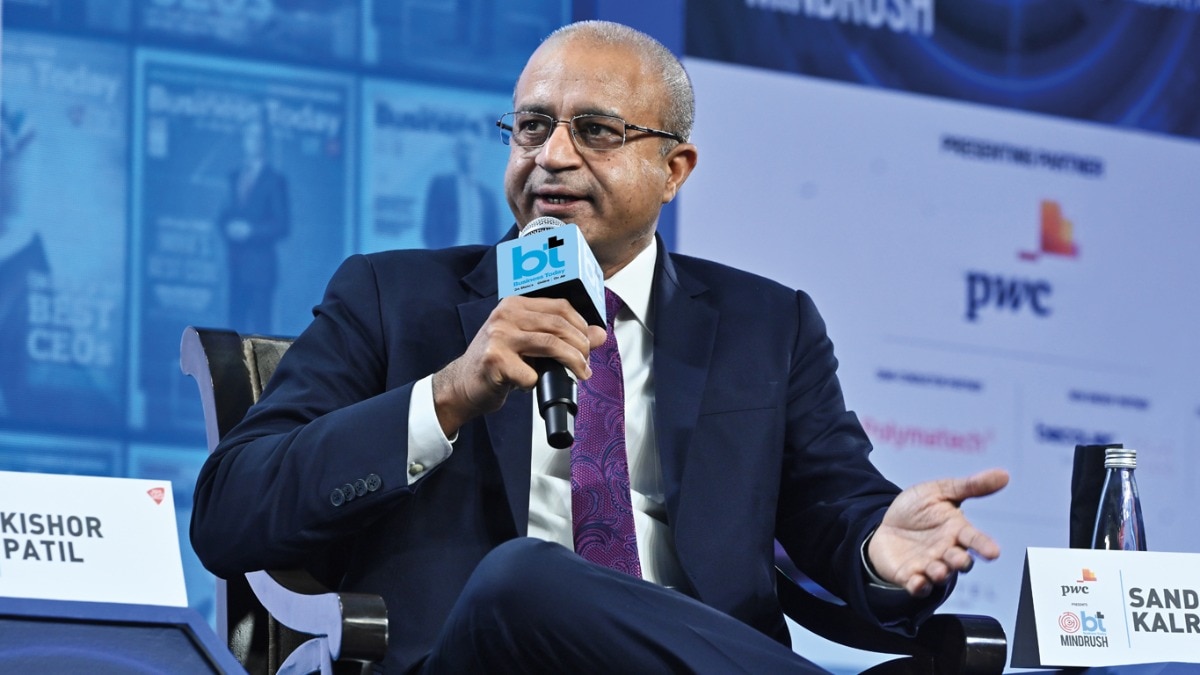
Persistent Systems is making its biggest and boldest bet yet. With its proposed $1.45-billion acquisition of Germany-based Nagarro, the company is not only executing the largest deal in its history but also positioning itself to become India’s seventh-largest IT services firm.
The announcement, however, has triggered mixed reactions on Dalal Street. While investors acknowledge the strategic logic of expanding Persistent’s global footprint, many have questioned the steep premium, the sizeable debt required to fund the transaction, and whether integrating a slower-growing company could weigh on Persistent’s industry-leading growth and profitability. However, CEO and Executive Director Sandeep Kalra remains unfazed.
Under Kalra’s leadership, Persistent has grown from a niche technology player into a global enterprise with annual revenues surpassing $1.6 billion, while significantly expanding its capabilities across digital engineering, cloud, cybersecurity, data and analytics, application modernisation, and enterprise AI. He has also led the company’s AI-first strategy. Kalra believes Nagarro is the missing piece in Persistent’s global ambitions. The acquisition strengthens the company’s presence across Europe, West Asia, and Japan. Together, the combined entity is expected to generate nearly $3 billion in annual revenue.
In a conversation with Business Today, Kalra addresses concerns around valuation, leverage and integration head-on. He explains why this transformational deal could redefine the company’s next decade of growth. Edited excerpts:
Q: Persistent Systems has delivered strong organic growth over the years. Why was this the right time to pursue a transformational cross-border acquisition?
A: We have grown from being a $500-million organisation to roughly a $1.7-billion global organisation over the last several years. As we have increased in size and scale, we’ve built newer capabilities like AI-led platform engineering, cloud, digital engineering, and more. Our customers have seen us evolve from a smaller player into a very credible challenger to the larger firms, and today 82% of our revenues come from North America. However, we needed stronger delivery centres, capabilities, customer relationships, and feet on the ground in Europe. Nagarro turned out to be an excellent cultural fit—from its digital engineering DNA and AI capabilities to its strong footprint across Europe, West Asia, and Japan, it complements us beautifully.
The combined company grows from a $1.7-billion Persistent into a $2.9-billion Persistent-Nagarro Group, with approximately $1.7 billion of revenue from North America, around $600 million from Europe, nearly $70 million from West Asia and Turkey, along with a presence in markets such as Japan and the Philippines.
It becomes a truly global AI-led product engineering and enterprise transformation powerhouse. Nagarro adds meaningful scale in industrials—a roughly $400-million vertical for them, taking the combined business to about $440 million. We also gain a significant presence in the consumer vertical, while strengthening service capabilities across SAP, Adobe, and several other areas.
Q: What specific capability and client gaps does Nagarro address for Persistent?
A: If we look at the customer bases of both companies, among the Top 200 customers, there is an overlap of only about 10 customers. That means we gain more than 190 customers across Europe, West Asia, and even the US, each generating over $1 million in revenue. Had Persistent tried to build that customer base organically, it would probably have taken us a decade or two. This is not only about cross-selling and upselling our capabilities across geographies. It also gives us the opportunity to deepen relationships with customers across industry verticals where we currently have limited exposure.
Our aspiration has been to become a $2-billion organisation by the end of FY27, and beyond that, to build a $5-billion company. The way we have structured the transaction is also important.
Q: What convinced you that Nagarro was the right acquisition, and how did you arrive at the valuation?
A: Nagarro is a highly respected company. We wanted to bring a respected team of technologists into the Persistent family, and that is where our interest began. Over the past couple of years, while Nagarro has remained a strong growth company, its valuation has come under pressure. Being listed in European markets also meant that technology services companies were not valued the same way they typically are in India. From a valuation standpoint, the transaction is at roughly 9X CY25 EBITDA.
Depending on where the company lands within its guidance range, the multiple works out to somewhere between 7.8x and 8.7x EBITDA, broadly around nine times based on the enterprise value we are paying.
Q: Since Nagarro’s recent growth has been slower than Persistent’s, how do you address concerns that the acquisition could dilute Persistent’s growth?
A: Over the last 24 quarters—six straight years—Persistent has consistently delivered more than 3% sequential compounded quarterly growth, regardless of whether the market environment was strong or weak. That is the same rigour we want to bring to Nagarro. But uncertainty is the bigger factor right now.
Nagarro has an excellent customer base. They have been technically very strong and have delivered outstanding customer satisfaction, among the best in the industry, according to ISG reports. Today, Nagarro’s largest customer contributes around $45 million in revenue. At Persistent, over the years, we have perfected the art of mining customer relationships, increasing wallet share and scaling strategic accounts. That is exactly what we want to bring to the combined company.
Q: How does this acquisition strengthen Persistent’s AI and digital engineering capabilities, especially at a time when AI is reshaping the global IT services industry?
A: Persistent has been investing heavily in AI over the last several years. We have built an AI-led software development lifecycle platform called SASVA. We have developed strong capabilities across Anthropic, OpenAI, and open-source models. We also have the ability to work with enterprises to build their own AI models, enabling them to reduce dependence on frontier models where appropriate. On the Nagarro side, they have built similar capabilities not only in software development, but also in industry-specific AI solutions. The combined company gives us a much larger platform to continue investing in AI capabilities. It also strengthens our position with strategic partners such as Microsoft, Amazon, Google, Anthropic, OpenAI, Databricks, and Snowflake.
Q: What are the biggest execution risks in a transaction of this scale, and how do you plan to manage them?
A: In any acquisition of this size and scale, integration is one of the biggest risks. When two organisations come together, challenges typically arise if there are significant overlaps, whether at the leadership level, in customer ownership or in organisational culture. From a cultural standpoint, both companies are founder-led, with founders who come from strong technology backgrounds. That gives both organisations a technology-first DNA, which is a very important common thread. Both companies also have an entrepreneurial mindset. Persistent’s largest verticals are banking and financial services, healthcare and life sciences, and technology.
Nagarro’s strengths lie in industrials and consumer. Similarly, Persistent currently has around 300 employees in Europe. The combined company will have nearly 3,000 employees there. Outside India and Europe, our presence has been relatively small, whereas Nagarro has established operations across the Middle East, Japan, and the Philippines. There is enough opportunity for everyone in the combined organisation.
Q: How does this acquisition reshape Persistent’s capital allocation priorities over the next three to five years? Will more acquisitions follow?
A: Capital allocation generally comes down to three choices—investing in acquisitions, investing organically for growth, or returning capital through dividends and other shareholder payouts. This acquisition gives us significant scale across geographies, verticals and capabilities. We do not intend to pursue any other major acquisitions over the next two to three years.
If there are acquisitions, they are likely to be much smaller—either vendor consolidation opportunities or niche capability acquisitions in specific domains or service lines. Our immediate priority is very clear: obtain the necessary regulatory approvals, complete the transaction, integrate the two organisations and drive growth.
@sakshibatra18













